


Why Moonshot AI's launch has put Chinese startups in US crosshairs
The US concerns come as Chinese AI artificial intelligence (AI) companies rapidly expand their presence in the global market
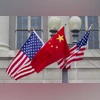 "us china, us-china, us flag, china flag")
The US concerns come as Chinese AI companies rapidly expand their presence in the global market. (Image: Bloomberg)
Listen to This Article
The United States is stepping up pressure on China's artificial intelligence (AI) companies, accusing some of them of using American technology without permission and helping strengthen China's military capabilities.
The latest is Chinese AI startup Moonshot AI, whose recently launched Kimi K3 model has drawn global attention for delivering strong performance at a lower cost. As Chinese AI models become more popular around the world, Washington is considering tougher action, including sanctions, export restrictions and limits on access to advanced AI chips, Nikkei Asia reported.
Moonshot AI comes under US scrutiny
The Donald Trump administration has warned that it could impose sanctions or other restrictions on Chinese AI companies, including Moonshot AI, over allegations that they copied technology from leading American AI developers.
The concerns emerged after Moonshot launched Kimi K3, an open-weight AI model with 2.8 trillion parameters. The model has been widely noted for offering high performance at a lower price than many competing systems.
Moonshot is also preparing for a Hong Kong stock market listing within the next six months. The company is expected to begin its final funding round before the listing in August at a reported valuation of about $50 billion, the news report said.
Also Read

 "Desalination plant")
 "Police stop protestors gathered in support of Cockroach Janta Party and demand Union Education Minister Dharmendra Pradhan's resignation | (PTI Photo)")
 "AI, Artificial Intelligence")
 "q1 results today")
 "poultry, chicken farm")
Allegations over AI training methods
The news report said that US officials have claimed that Moonshot may have used a technique known as "distillation" to build its latest model.
Distillation is an AI training method in which a smaller model learns from the responses of a larger and more capable model. The approach itself is widely used in the AI industry, but it becomes controversial if companies use proprietary models without permission.
Michael Kratsios, director of the White House Office of Science and Technology Policy, alleged that Moonshot built an internal system capable of carrying out large-scale distillation of American AI models while making the activity difficult to detect. He also claimed the company had obtained servers powered by Nvidia's latest GB300 chips and had access to additional computing resources in Thailand for AI training, Nikkei Asia reported.
Similar allegations have previously been made by Anthropic and OpenAI against several Chinese AI companies, including Alibaba, DeepSeek and Minimax.
Sanctions and export controls under consideration
The US government has signalled that it is prepared to take stronger action if it finds evidence of intellectual property theft.
Treasury Secretary Scott Bessent said Chinese companies that illegally copy American AI technology could face sanctions or be placed on the US Entity List. Companies on this list are generally barred from accessing advanced American technologies, including Nvidia's most powerful AI chips.
At the same time, the Bureau of Industry and Security (BIS), part of the US Department of Commerce, has launched an investigation into whether Chinese companies have gained access to restricted US AI chips through unofficial channels.
If violations are confirmed, more Chinese AI firms could face tighter export restrictions.
Chinese AI models gain global popularity
The US concerns come as Chinese AI companies rapidly expand their presence in the global market. Chinese open-source and open-weight AI models have become increasingly popular because they offer competitive performance at significantly lower costs.
On OpenRouter, a platform that allows developers to access hundreds of AI models through a single interface, Chinese models have accounted for at least 30 per cent of enterprise usage every week since February, the news report said.
Large international companies, including Uber and Airbnb, have also acknowledged using some Chinese open-source AI models.
Security concerns over open-source AI
Washington's worries go beyond intellectual property. According to US media reports, the White House is also examining whether advanced Chinese AI models should face broader restrictions because of cybersecurity risks.
One concern is that AI models could contain hidden "backdoors" -- secret access points that might allow malicious actors to exploit systems.
The news report quoted an AI engineer as saying that such risks are technically possible if harmful code or data is introduced while training an AI model. However, he noted that many large companies reduce these risks by running open-source models on their own isolated servers instead of relying on public internet services or official APIs.
Civilian tech companies also attracting attention
The scrutiny is not limited to AI startups. In June, the US Department of Defense added several major Chinese companies, including Alibaba, BYD and Baidu, to its list of firms that it believes have links to China's military.
The companies are best known for consumer businesses such as e-commerce, electric vehicles and internet services, rather than defence equipment.
However, Washington argues that many modern technologies can serve both civilian and military purposes.
The role of dual-use technology
The growing focus is driven by the idea of "dual-use technology" -- innovations that have both commercial and defence applications.
Artificial intelligence is one of the clearest examples. AI can improve consumer products and business services, but it can also support military planning, intelligence gathering, cyber operations, satellite image analysis and autonomous weapons.
The same argument applies to technologies such as batteries, robotics, cloud computing, drones and advanced manufacturing. Products developed for commercial markets may also strengthen military capabilities.
US officials believe these technologies could become strategic assets in future geopolitical competition.
What is the Pentagon's China military list?
The Pentagon maintains a list of Chinese companies that it believes are linked to or support China's military under US defence law.
Being included on the list does not automatically ban companies from doing business in the US or impose full sanctions. However, the designation can limit business with the US defence sector and increase regulatory scrutiny.
China has rejected many of these US designations, arguing that Washington is using national security concerns to restrict Chinese technology companies. Several firms named by the Pentagon have also denied having military ties.
As AI becomes central to both economic growth and defence planning, the technology rivalry between the US and China is expanding far beyond trade.
More From This Section
 "pakistan Flag")
 "crude oil, hormuz, persian gulf")
 "Marco Rubio")

 "Kakao workers attend a partial strike in Seongnam, South Korea, on June 10")
Don't miss the most important news and views of the day. Get them on our Telegram channel
First Published: Jul 23 2026 | 11:56 AM IST