


Who is Brendan Carr? The regulator behind Jimmy Kimmel's suspension
Since Carr began leading the FCC in January, he has continued pulling from that playbook, making his priorities known and leaving the door open for companies to take steps to please him
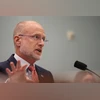 "Brendan Carr, chairman of US FCC")
Carr, 46, was appointed by President Donald Trump to lead the US Federal Communications Commission late last year | Image: Bloomberg
Listen to This Article
By Kelcee Griffis
Brendan Carr, the chairman of the US Federal Communications Commission, is attracting the kind of attention that’s rarely bestowed upon his position.
By attacking late-night comedy host Jimmy Kimmel, leading to the suspension of his show, Carr has dominated the news cycle in the past 24 hours, enraging celebrities and pundits and prompting Democratic lawmakers to call for his resignation.
Carr, 46, was appointed by President Donald Trump to lead the regulatory agency late last year. He has been a staunch supporter of the president, routinely using the power of his position to take up Trump’s grievances against those in the media he sees as biased against him. As the head of an agency that is typically more concerned with expanding access to affordable internet, Carr is coloring outside the lines of traditional FCC rule-making and deal-approving power and using public conversation to insinuate change throughout the media landscape.
Also Read

 "rupee, indian rupee, indian currency")
 "imf")
 "White House")
 "united states, US, US banks, us economy, inflation, market")
 "Jerome Powell")
“Brendan is in some sense exactly who he always has been, which is a slightly nerdy, conservative-movement lawyer,” said Daniel Suhr, president of the Center for American Rights, a group that advocates against what it characterizes as liberal bias in broadcasting. “What’s changed is the willingness to use the levers of power to set up the policy wins.”
In speaking with right-wing podcast host Benny Johnson on Wednesday, Carr set in motion a swift cascade of events that led to Walt Disney Co.’s sudden decision to pull the Jimmy Kimmel Live! show off the air. The conversation centered around Kimmel’s Monday-night monologue, about the person accused of killing conservative activist Charlie Kirk, which conservative commentators seized on as a mis-characterization of the political beliefs of the shooter.
Carr encouraged local station owners to stop carrying content supplied by the national networks when it doesn’t align with local viewers’ values and suggested Disney’s ABC could come under FCC scrutiny.
Hours later, Nexstar Media Group Inc., which owns more than 20 local stations affiliated with ABC and that’s seeking merger approval from the FCC, announced it was pulling the show. ABC parent company Disney soon followed, pausing the show indefinitely. Carr made subsequent media appearances on Fox News and on CNBC, where he said Nexstar’s decision was a sign of a “much bigger shift that’s taking place right now in the media ecosystem.”
Echoing comments that Trump has made, Carr suggested that networks like ABC are canceling their late-night talk show hosts amid shrinking audiences, because people don’t like the commentary they’re hearing there, not due to any pressure from the FCC or administration.
While the FCC doesn’t outright police the content of broadcasters like ABC affiliates, it does grant the licenses that allow the stations to remain on the air, and those licenses come with an obligation that broadcasters serve the public interest with their content. There’s a very high bar for stations to lose their licenses, and it would be unlikely for any station to be punished for airing a national network late-night show that contained controversial comments.
The fact that Carr suggested Kimmel should be taken off the air, and he was, even without a real possibility of any station’s license being revoked, shows how eager broadcasters are to curry favor with Carr, said Andrew Jay Schwartzman, a senior counselor at the Benton Institute for Broadband and Society.
Nexstar is seeking FCC approval to merge with Tegna Inc, another large station owner. All of those station owners are awaiting FCC action that would allow them to further consolidate.
The local TV industry’s response to the cancellation of the Kimmel show is “traceable to their industry’s number one priority, which is lifting the FCC’s limits on the number of stations they can own,” Schwartzman said in an email. “It is not a coincidence that Nexstar, the company that most wants regulatory relief, was first out of the gate.”
Trump praised Carr on Thursday and drew a direct link between coverage that the president views as negative and the prospect of TV licenses being revoked as a consequence.
“They’re getting a license,” Trump said, referring to broadcast networks. “I would think maybe their license should be taken away. It will be up to Brendan Carr. I think Brendan Carr is outstanding. He’s a patriot. He loves our country, and he’s a tough guy. So we’ll have to see.”
Carr’s actions build on his deep understanding of communications law, FCC policies and how to leverage them. He is a longtime FCC insider who served as the agency’s general counsel at the beginning of Trump’s first presidency. He was elevated to one of the five FCC commissioner positions in 2017 under then-FCC Chairman Ajit Pai.
For much of his time as a commissioner, Carr flew under the pop-culture radar, leading projects related to 5G infrastructure and blue-collar communications workers. He often donned reflective vests and hard hats, joining work crews on job sites and sometimes scaling broadcast and mobile towers with them.
But during the previous administration of President Joe Biden, Carr increased his profile and aligned himself more loudly with Trump’s agenda, decrying perceived conservative censorship on social media platforms – an ecosystem that the FCC has no regulatory control over. Carr authored a chapter of Project 2025, the conservative policy blueprint for a second Trump presidency steered by the powerful Federalist Society, which aimed to reshape the federal government and consolidate executive power in favor of far-right policies.
“Watching him through the minority role at the commission is like watching the education of Brendan Carr,” said Nathan Leamer, a former Carr colleague at the FCC. During that time, Leamer said, he saw Carr “evolve and understand what levers were at his disposal,” wielding an increasingly active presence on the social media platform X.
Since Carr began leading the FCC in January, he has continued pulling from that playbook, making his priorities known and leaving the door open for companies to take steps to please him. He has focused on rooting out diversity, equity and inclusion efforts at communications companies, publicly stating that any merger approvals are contingent on the cancellation of such policies.
Companies including T-Mobile US Inc and Verizon Communications Inc have had to make to make concessions as they lobbied for approval for acquisitions.
Carr’s shadow shaped the merger between Paramount Global and Skydance Media, too. Just hours after he said he was pleased with Skydance’s concessions that were characterized as voluntary – which included dropping DEI policies and appointing an ombudsman to handle news bias complaints – he approved the entire package. Paramount, the parent of CBS, MTV and other media business, also settled a lawsuit brought by Trump alleging media bias at CBS News and ended its late night show hosted by Stephen Colbert, who has also been a critic of Trump.
Carr also threatened to revoke satellite company EchoStar Corp.’s portfolio of spectrum licenses, worth tens of billions of dollars, if the company didn’t put the licenses to what Carr saw as better commercial use. Elon Musk, who played a high-profile role in the Trump administration earlier this year, had been gunning for such rights for SpaceX’s Starlink satellite-internet service. Carr eventually blessed EchoStar’s plan to sell the licenses to AT&T Inc. and SpaceX for a total of $40 billion, dropping his regulatory probe into EchoStar that spurred the sales.
“It is soft power,” Leamer said of Carr’s tactics. “It’s how you let a complaint sit where it is and allow people to engage with that. I think that’s actually the difference in the way he’s done this.”
Carr has suggested the seismic changes to the media landscape aren’t over. Speaking on CNBC on Thursday, Carr said “we’re in the midst of a massive shift in dynamics in the media ecosystem for lots of reasons, again, including the permission structure that President Trump’s election has provided. And I would simply say we’re not done yet with seeing the consequences of that shift.”
More From This Section
 "Kim Jong Un")
 "The headquarters of the UK's Secret Intelligence Service, known as MI6, on the River Thames in London")
 "United Nations Security Council")
 "Donald Trump, Trump, Keir Starmer")
 "President Donald Trump and Britain's Prime Minister Keir Starmer announce an agreement between the two countries during a joint press conference at Chequers near Aylesbury, England")
Topics : US Federal agency Donald Trump administration Local cable channels United States US government US Republicans
Don't miss the most important news and views of the day. Get them on our Telegram channel
First Published: Sep 19 2025 | 8:02 AM IST