


A voice for nomads
An Ahmedabad-based NGO is trying to resolve the problems that India's nomadic communities face
 "NGO, VSSM")
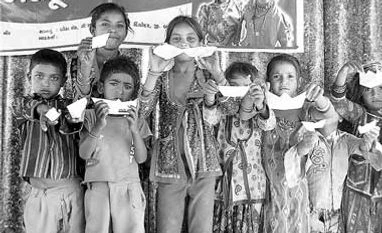
Children who are part of a VSSM activity
It used to be said that the nomads of India only stopped wandering when they dropped dead. Across India today, in face of inevitable comparisons with urban Indians and most importantly, the loss of their traditional livelihoods, nomadic communities too are aspiring to partake of the spoils of development. The odds, however, are stacked against them. The British had labelled 200 tribes of snake charmers, bear dancers and other itinerants as "criminal", and they have been socially, politically and economically marginalised ever since. Since independence, their unique set of problems has received little redressal from the government, which is what the Ahmedabad-based NGO Vicharta Samudaay Samarthan Manch, (VSSM), seeks to change.
A collective platform for nomadic and de-notified tribes that were originally listed under the Criminal Tribes Act of 1871 and were de-notified under the Criminal Tribes Act of 1952 communities, VSSM works in nine districts of Gujarat. "Our primary focus is to ensure their social identity, civic rights, education, health facilities, housing and livelihood options", says Mittal Patel, the young founder of VSSM. "When we started working with nomads and de-notified tribes in 2006, we found that there was little or no awareness about their problems, it was as if they were invisible!" At that time, when Patel, then a recent journalism graduate, approached the government for information on nomads and de-notified tribes, all she got was a list of names. "That was when I decided to give up journalism and devote my life to the task of giving these invisible tribes the voice and space they deserved," she says.
As Patel spent time with different nomadic tribes, she realised how different their issues were from the mainstream. "First, the itinerant lifestyle isn't suited for sending children to school," says Patel. "Second, these communities rarely own any land. Without a permanent address, most find it near impossible to get voter and ration cards made!" Some nomadic communities like snake charmers aren't allowed to practice their traditional livelihoods any more. "Obviously, we would like to see them receive extra help from the government," she says. "Just as it compensates individuals whose land it acquires for public works, it must also compensate communities whose livelihoods it has outlawed!"
The first breakthrough that VSSM achieved in 2006 was to get nomadic and de-notified communities counted in the census. "We created awareness about their existence in a day-long programme, after the population of Gujarat rose from five to 5.5 crore overnight!" says Patel. VSSM has also worked not only to get voter cards for its beneficiaries, but also to later pressurise the government into accepting only voter cards as ID and address proof to access other schemes. So far, the Gujarat government has issued voter cards to 60,000 members of these tribes.
Other than enabling members of nomadic and de-notified communities to access government schemes and benefits, VSSM also provides interest-free loans to individuals who are unable to practice their traditional livelihoods, like snake charmers. VSSM has disbursed 800 small loans to help such individuals start their businesses. Additionally, it also runs two hostels in Ahmedabad with over 700 children residing there. "We realised that offering hostel facilities was the best way to ensure nomad children who traditionally roamed around with their parents, could access good schools," says Patel.
On the anvil, now, is a larger hostel to cope with increasing demand. "This year we received twice as many applications as we had space for our hostel facilities," she says. ''We need to buy our own land and construct a facility that can house double the current number of children.'' With an annual budget of Rs 3 crore, VSSM obtains most of its funds from individual donors in Gujarat and Maharashtra, as well as a few corporates. Having created a model of tribal development which enables such communities to access existing government schemes, Patel hopes to replicate this in other districts of Gujarat soon.
Meanwhile, the road ahead is full of obstacles' bureaucratic apathy, corruption and more. In Banaskantha, VSSM has been fruitlessly trying to get plots of land allotted to 15 Vanzara families. Although their names are on the list of people below the poverty line, the nomads continue to be without a roof over their heads. "We're demotivated, but will not back down," says Patel. "Not until we have helped make India's disenfranchised a little more visible than before."
To learn more, visit www.vssmindia.org
Next up, an entertainment club that uses cinema, art and music to entertain and inspire street children
Next up, an entertainment club that uses cinema, art and music to entertain and inspire street children

Don't miss the most important news and views of the day. Get them on our Telegram channel
First Published: May 21 2016 | 12:22 AM IST