


Celebrate the body electric with Kathak and Flamenco
Torobaka brings kathak and flamenco together in a high-intensity performance
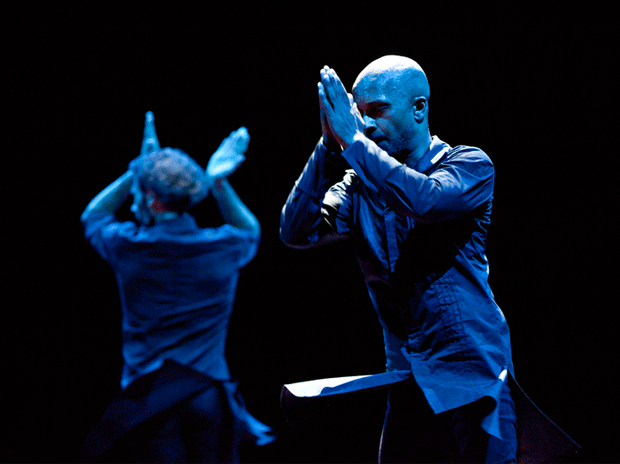 "Torobaka")


Fire teases Water. Water responds with the same playfulness, coming within touching distance of Fire. Fire falls back and then returns with greater intensity. Water welcomes the confrontation. And so the duet continues. The two circle each other, part playful, part confrontational, their arms whirling, their feet spinning and tapping, until it is difficult to tell which one is Fire and which Water.
“Torobaka”, a 70-minute dance-duet that has emerged from a unique collaboration between UK-based contemporary kathak dancer Akram Khan and acclaimed Spanish flamenco dancer Israel Galván, is something like that. The stage is electrified as the two men, both masters in their field, create a new vocabulary of the dance forms.
“The piece is inspired a little bit by toro and vaca. Toro means bull — the quality of bull, which is symbolic in Spain because of the bull fight. And vaca is cow, which in India is sacred,” explains Khan, one of Britain’s most influential choreographers. “So, it’s the warrior versus the monk.”
The movements of the cow and the bull are evident in the intense physical dialogue between Khan and Galván. Sometimes it is like witnessing the two in a bullring or like watching two gladiators circling each other. Yet, in that highly-charged encounter there is a hint of humour, with confrontation turning into a tongue-in-cheek conversation carried out through movements.
But Torobaka is not a fusion of kathak and flamenco. Both forms retain their unique flavour even as they find a common vocabulary. “It’s like jugalbandi in form,” says Vivek Mansukhani, director (arts) for British Council India that is presenting Torobaka as part of the ninth edition of The Park’s New Festival 2015 in association with Prakriti Foundation. Performances have already been held in Chennai, Hyderabad, Bengaluru and Kolkata. The next stop is Delhi.
Accompanying the dancers is music as intense, vibrant and diverse as their dance with four musicians singing Sanskrit, Sephardic and Carnatic songs. “It’s not as much music as there is sound effect, singing and vocal orchestration on stage,” says Mansukhani who saw the performance in Chennai.
There was a time when Khan was not very keen on the idea of bringing the two dance forms together. None of the versions he says he saw matched up to what he had seen his guru perform in the 1980s. “The one by my guruji was very beautiful; it was lively and joyful,” he says. The later attempts he witnessed felt superficial.
That was until a mutual friend from Israel asked him to watch Galván perform. In Galván he saw an artist redefine flamenco. “I have never seen that before. I have never seen an artist redefine the form itself,” says Khan. Galván too came and watched Khan perform. The two decided to create a piece together.
“I think there are similarities between the two dance forms, but it was not the similarities that interested us. What interested me was that musically we were similar but as dances we were so different,” says Khan. “If I would describe him as fire, I would describe myself as water; he is explosive and I am more liquid.” This conflicting-complementing quality has had some reviewers describing Khan as “gracefully compact” and Galván as “rapier-like”.
Yet, during the performance, as they come together to dance in perfect harmony or move away to do their own thing, the lines sometimes begin to blur. Flamenco seems to slip into kathak and kathak into flamenco.
Khan’s work is usually based on themes. But this show doesn’t have a particular theme. “It’s not a narrative. It’s really just a celebration dance and music,” says Khan.
There is a reason for that. “Thematically, we were interested in different things,” says Khan. “We had to find common ground. So we decided to find a rhythmical structure.”
The result is Torobaka – a concert of dance and music.
“Torobaka”, a 70-minute dance-duet that has emerged from a unique collaboration between UK-based contemporary kathak dancer Akram Khan and acclaimed Spanish flamenco dancer Israel Galván, is something like that. The stage is electrified as the two men, both masters in their field, create a new vocabulary of the dance forms.
“The piece is inspired a little bit by toro and vaca. Toro means bull — the quality of bull, which is symbolic in Spain because of the bull fight. And vaca is cow, which in India is sacred,” explains Khan, one of Britain’s most influential choreographers. “So, it’s the warrior versus the monk.”
The movements of the cow and the bull are evident in the intense physical dialogue between Khan and Galván. Sometimes it is like witnessing the two in a bullring or like watching two gladiators circling each other. Yet, in that highly-charged encounter there is a hint of humour, with confrontation turning into a tongue-in-cheek conversation carried out through movements.
But Torobaka is not a fusion of kathak and flamenco. Both forms retain their unique flavour even as they find a common vocabulary. “It’s like jugalbandi in form,” says Vivek Mansukhani, director (arts) for British Council India that is presenting Torobaka as part of the ninth edition of The Park’s New Festival 2015 in association with Prakriti Foundation. Performances have already been held in Chennai, Hyderabad, Bengaluru and Kolkata. The next stop is Delhi.
Accompanying the dancers is music as intense, vibrant and diverse as their dance with four musicians singing Sanskrit, Sephardic and Carnatic songs. “It’s not as much music as there is sound effect, singing and vocal orchestration on stage,” says Mansukhani who saw the performance in Chennai.
That was until a mutual friend from Israel asked him to watch Galván perform. In Galván he saw an artist redefine flamenco. “I have never seen that before. I have never seen an artist redefine the form itself,” says Khan. Galván too came and watched Khan perform. The two decided to create a piece together.
“I think there are similarities between the two dance forms, but it was not the similarities that interested us. What interested me was that musically we were similar but as dances we were so different,” says Khan. “If I would describe him as fire, I would describe myself as water; he is explosive and I am more liquid.” This conflicting-complementing quality has had some reviewers describing Khan as “gracefully compact” and Galván as “rapier-like”.
Yet, during the performance, as they come together to dance in perfect harmony or move away to do their own thing, the lines sometimes begin to blur. Flamenco seems to slip into kathak and kathak into flamenco.
Khan’s work is usually based on themes. But this show doesn’t have a particular theme. “It’s not a narrative. It’s really just a celebration dance and music,” says Khan.
There is a reason for that. “Thematically, we were interested in different things,” says Khan. “We had to find common ground. So we decided to find a rhythmical structure.”
The result is Torobaka – a concert of dance and music.
“Torobaka” will be performed at Kamani Auditorium, New Delhi, on October 12 and 13.
For details, log on to www.britishcouncil.in/torobaka-akram-khan-and-israel-galván
For details, log on to www.britishcouncil.in/torobaka-akram-khan-and-israel-galván

Don't miss the most important news and views of the day. Get them on our Telegram channel
First Published: Oct 09 2015 | 9:16 PM IST