


Marine Drive: Mumbai jewel
This month marks a century since the construction of the C-shaped boulevard on Mumbai's Marine Drive began. The author chronicles the history of one of the city's landmarks
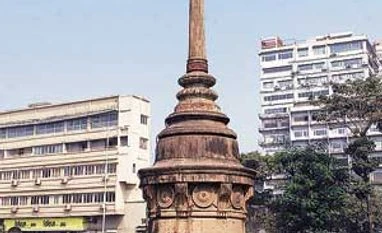 "A lamp post at the Kennedy sea-face")
Roughly seven decades ago, it took ardent promises of Western-style bathrooms and customised interior design on the part of landlords to lure tenants to the plush Marine Drive. While the precinct had started establishing itself as a tony one, the commencement of the Second World War caused the Indian population to empty out, worried by the heavy presence of European residents.
The US army and air force had opened offices in the buildings there and the spotting of a submarine added to the tension. To-let signs became a common sight. Soon, some like wedding planner Perin Irani's mother warily decided to rent homes. "My father would not talk to my mother for three months, saying she had brought us to a jungle," recalls Irani, in her balcony that overlooks the Arabian Sea. "Later he thanked her for it, because of this view."
To this day, that view mesmerises Mumbai's well-heeled and impoverished alike. Where residents see it as a mark of pride, it is a soothing parenthesis for visitors. Stretching from Nariman Point to Chowpatty beach, the road is flanked by waters on one side and a neat arrangement of art-deco buildings on the other.
The salt-laced breeze and the sight of unrestrained waters have a healing quality about them. Generations of citizens escape their closet-sized apartments to enjoy the sense of freedom that the clean, roomy promenade here offers. December 18 this year will mark a century since the construction of the C-shaped boulevard began at the Kennedy sea-face near Chowpatty in 1915.
Aside from the scenic purpose it serves, Marine Drive was envisioned to connect Nariman Point and Malabar Hill. It was built on land from the reclamation of Backbay, which began in earnest in 1919. Stone and mud were quarried in the north in Kandivali, brought by train to the site and dumped into the sea, says Kunal Tripathi, founder of the Mumbai Heritage Twitter account.
After it was completed, people would often trek to Malabar Hill to take in the beautiful illuminated curve of the road - a visual that prompted a European journalist in the 1930s to first call it the "Queen's Necklace". The concrete tetrapods seen along Marine Drive were placed there in the 1960s to scatter the energy of waves breaking against the sea-wall.
Apartments came up only around the mid-1930s, in a burst of optimism post World War I. Bombay became home to newly-rich businessmen who wished to splurge on apartments and offices in the same neighbourhood as the heirs of India's former princely states and the cream of the Hindi film industry. Managers and chairmen of companies, moved in.
The southern end was dominated by Europeans, while Indians lived mainly on the northern side of Marine Drive. Kuwaiti royals built the Al-Sabah and Al-Jabreya Court buildings there as holiday homes. They continue to own a few apartments there but have rented out the rest.
According to film historian Bhawana Somaaya, people would line up outside Chateau Marine to watch Hindi cinema star Nargis, as she and her entourage clambered into an Impala and left for shoots. Dev Anand similarly waited outside his lover Suraiyya's home in Krishna Mahal. Other stars like Vyjayanthimala and Mumtaz lived on Marine Drive too, as did director Mehboob Khan.
Mumbai still boasts the second highest number of art-deco structures in the world after Miami, and most edifices in Marine Drive were designed in this style. The aspirational nature of the precinct is evident in building names that contain terms such as "mahal" and "chateau". But the architect Claude Batley once described these constructions as "giving the impression of a rather badly fitting set of false teeth."
The haphazard planning across Mumbai thereafter has rendered his statement obsolete. The five or six storey buildings of Marine Drive with long balconies and curved edges are in fact pleasing to the eye now. Inside the homes, as local resident and wealth manager Anupam Pareek points out, the best materials were used - stairwells of Burma teak, handmade Italian tiles, copper embellishments. Already marked as a heritage space by the civic authorities, local groups are also trying to get the neighbourhood recognised as an UNESCO World Heritage site.
Time has claimed some quintessential aspects of Marine Drive over the years. Pareek fondly recalls the double-decker bus no 123, which would take him along the scenic route to R C Church in Colaba. Now, that service has stopped but a tourist ferry passes by Marine Drive during evenings on the weekend. The palm trees that once lined the promenade have been replaced by round shrubs.
The enclosures that protected the trees, seen in the forgotten but engrossing Hindi film Taxi Taxie, are no longer there. Indira Chabbria, who moved to Marine Drive in the 1950s, remembers running across vast fields where grass grew as tall as children's waists. The Wankhede Stadium replaced Lloyd's playground, where children from across the city gathered in thousands for a game of football or cricket.
A night shot of Marine Drive
The sense of space is further hampered as each home owns two to four cars, causing parking to now happen perpendicular to the buildings. As a result, inner roads witness scenes of a long Honda sedan struggling to leave its spot without scratching any neighbours, while cabs wait impatiently to pass through.
In the 1950s and 60s, women would step out dressed in sarees made of the finest chiffon or net, says Chabbria. The trip from home to the promenade, often made not on foot but by car, was an event. Regal Buicks, Studebakers and Packards roamed the streets.
Some residents tell stories of roads being so empty that youngsters could race their cars in reverse. While Nariman Point was yet to be reclaimed and developed into a commercial hub, a small hillock there served as a preferred spot for couples in courtship.
One wall close to the sea was used to project short movies and trailers of then-upcoming films. In comparison, current recreations such as late-night races of loud motorbikes and open-air gyms used for parkour seem somewhat bland. At one time, there were lights on the promenade that would have to be lit manually every evening. Much to the chagrin of residents, white LED lights recently replaced the warm golden glow of yellow street lights.
Pizza by the Bay is perhaps the most popular establishment on Marine Drive today, housed in a building owned by former city mayor Nana Chudasama who likes to hoist posters with cutting political messages (the latest is "Bihar - art of alliances conquers strategy of strategists"). But city historian Deepak Rao misses its predecessor, the Parisian Dairy.
"For just four annas, we would get this much mawa cake," he says, cupping his hands as if holding an imaginary basketball. Before the gleaming Intercontinental Marine Drive, there was Hotel Natraj that famously served ice-cream at the Yankee Doodle parlour. Locals also enjoyed smoking and drinking espresso at Napoli's.
Hotel Natraj, in fact, was built where the Bombay Club, reserved only for Europeans, once stood. This demolition and rebuilding was possible because Coastal Regulation Zone rules were yet to be formed. The Ambassador Hotel, topped with a now-static revolving restaurant, was among the tallest buildings there.
As with many neighbourhoods in south Mumbai, the houses were mostly rented. Owing to the Rent Control Act, however, rental fees remained a pittance. Some landlords were, therefore, compelled to sell flats to tenants and form housing societies that could raise money for various taxes and upkeep of the structures. Those tenants who could not buy a flat continued living there on rent.
A few buildings are evidently in the process of getting necessary licks of paint. Maintenance still appears to be a problem as within the gleaming façade of some buildings, there are leaking pipes and tired walls. But citizen groups, of which there are several here, are more informed and active than elsewhere in the city.
They united to push the Brihanmumbai Municipal Corporation and Mumbai Metropolitan Region Development Authority to launch a beautification drive some years ago. Squatters and illegal hawkers are reported and dealt with routinely.
Nariman Point is no longer the main business district and several other areas have joined Marine Drive as aspirational addresses. New landmarks like the behemoth Bandra-Worli sea link have been built but Marine Drive still exudes unquestionable charm. This is what prompted Indira and her husband Chandru to move back to the neighbourhood after a prolonged stint in Dubai.
On the footpath along the buildings, dogs of every exquisite breed are being walked. On the other side, families, senior citizens and college students unwind on the ledge, unfazed by the traffic and amorous couples nearby. As open spaces threaten to shrink, locals are working to ensure the promenade remains accessible for all. As Rao points out, "You drive by the sea link but here you stop. There are people, there is life." The Queen's necklace belongs to all.

Don't miss the most important news and views of the day. Get them on our Telegram channel
First Published: Dec 05 2015 | 12:13 AM IST