


Shooting star
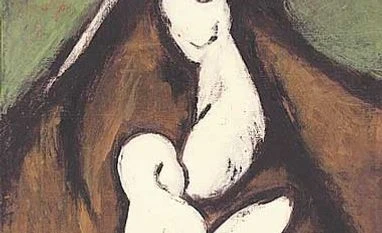 "Abdul Aziz Raiba's 1958 painting, Mother and Child")
Abdul Aziz Raiba’s 1958 painting, Mother and Child
When a star falls, only a few lucky ones are able to track it incendiary trail across the sky. Abdul Aziz Raiba's recent death was missed in the bright marquee lights of the world of art when, as in life, so in death, he faded away unseen and, for all practical purposes, unsung. Yet, he was one of the more significant voices of modernism to arise out of Bombay (now Mumbai) when he dared to dream of a life different from his tailor father's and joined the prestigious Sir J J School of Art on a scholarship from 1942-46.
In those halcyon years, much was made of the artist who was represented by art galleries like Pundole and Chemould, and for a while Raiba's star shone bright in the firmament. He was befriended by the Progressive Artists' Group in general, and by M F Husain and K H Ara in particular. Husain helped him find a job with film maker K Asif as an art director, a task he found uninspiring and quit. Husain then introduced him to the owner of Roop Bharti furniture studio - he too had designed furniture for children's nurseries - but Raiba was keen on furthering his career as an artist and quit again. He had already declined membership of the Progressive Artists' Group for being too restricting and unmindful of indigenous traditions which it opposed; now Walter Langhammer of The Illustrated Weekly of India, art director, critic and mentor, advised him to make Kashmir his goal instead of France.
Kashmir might have been good for his soul but it did little for Raiba's reputation or market when he disappeared from the salons of Bombay for a while. It would take him a long while to make his presence known on his return to a Bombay suburb - by which time no one cared any longer despite a few valiant attempts by institutions such as Clark House.
Raiba's distinctive style used strong outlines with which he delineated narratives and figures, whether fictional or based on real encounters. His interest in Indian art created a strong suggestion of miniature paintings that he rendered in a modern style, but it was his studies of people, his works based on Christ, and mythologies in the miniature tradition that set him apart as someone with a Hindu, Muslim as well as Maratha lineage. He used magic realism effectively, wielding its trope heroically. His choice of jute was driven for reasons fiscal but it set him apart from his peer group.
While his merit was never in doubt, Raiba's lack of language and social skills and his general awkwardness saw his star fade while those of his contemporaries rose. Occasional works currently crop up at auctions too infrequently for him to enjoy recall or nostalgia. Their outcome is difficult to gauge in advance, with the artist selling over his estimate on some occasions or being brought in on others. Those that do find a buyer are probably bought for the quality of his art than for his name, which has become unfamiliar over the years.
Yet, Raiba has had much to commend him, not least his commitment to his own identity and his unwillingness to cater to a lucrative market that would willingly have bent to his muse should he have cared enough. Having lived penuriously, Raiba has not burdened the art world with a huge inventory of his works, the most of which were created from the 1950s to the '70s. But it is possible that many more of these will now emerge - to posthumously earn the artist his credit and due as it failed to do in his life.
Kishore Singh is a Delhi-based writer and art critic. These views are personal and do not reflect those of the organisation with which he is associated
In those halcyon years, much was made of the artist who was represented by art galleries like Pundole and Chemould, and for a while Raiba's star shone bright in the firmament. He was befriended by the Progressive Artists' Group in general, and by M F Husain and K H Ara in particular. Husain helped him find a job with film maker K Asif as an art director, a task he found uninspiring and quit. Husain then introduced him to the owner of Roop Bharti furniture studio - he too had designed furniture for children's nurseries - but Raiba was keen on furthering his career as an artist and quit again. He had already declined membership of the Progressive Artists' Group for being too restricting and unmindful of indigenous traditions which it opposed; now Walter Langhammer of The Illustrated Weekly of India, art director, critic and mentor, advised him to make Kashmir his goal instead of France.
Abdul Aziz Raiba’s 1958 painting, Mother and Child
Raiba's distinctive style used strong outlines with which he delineated narratives and figures, whether fictional or based on real encounters. His interest in Indian art created a strong suggestion of miniature paintings that he rendered in a modern style, but it was his studies of people, his works based on Christ, and mythologies in the miniature tradition that set him apart as someone with a Hindu, Muslim as well as Maratha lineage. He used magic realism effectively, wielding its trope heroically. His choice of jute was driven for reasons fiscal but it set him apart from his peer group.
While his merit was never in doubt, Raiba's lack of language and social skills and his general awkwardness saw his star fade while those of his contemporaries rose. Occasional works currently crop up at auctions too infrequently for him to enjoy recall or nostalgia. Their outcome is difficult to gauge in advance, with the artist selling over his estimate on some occasions or being brought in on others. Those that do find a buyer are probably bought for the quality of his art than for his name, which has become unfamiliar over the years.
Yet, Raiba has had much to commend him, not least his commitment to his own identity and his unwillingness to cater to a lucrative market that would willingly have bent to his muse should he have cared enough. Having lived penuriously, Raiba has not burdened the art world with a huge inventory of his works, the most of which were created from the 1950s to the '70s. But it is possible that many more of these will now emerge - to posthumously earn the artist his credit and due as it failed to do in his life.
Kishore Singh is a Delhi-based writer and art critic. These views are personal and do not reflect those of the organisation with which he is associated

Don't miss the most important news and views of the day. Get them on our Telegram channel
First Published: Apr 23 2016 | 12:05 AM IST