


Debt-free companies perform better in bellwether market: Analysis
Conditions unlikely to ease soon with global, domestic interest rates on the rise
 "graph")
premium
graph
Last Updated : Oct 03 2018 | 9:33 AM IST
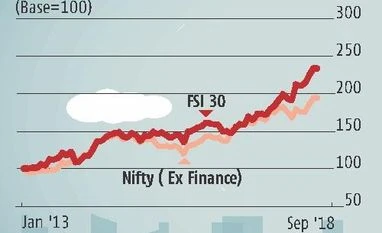
Companies that are able to finance their growth from internal accruals are doing significantly better than those depending on debt, shows an analysis of returns of companies that are part of the National Stock Exchange’s (NSE) bellwether Nifty50 index.
Business Standard looked at companies shortlisted on the basis of their cash flows, debt levels and proportion of assets funded internally, rather than through debt. Companies scoring high on these factors outperformed the bellwether index even as it reached new highs, shows the analysis, which excluded finance companies.
This analysis looks at returns from the beginning of 2013 to the present day. Companies that depended on their own resources had over 30 per cent higher returns, in absolute terms, over the period under consideration. The analysis looked at changes in investor wealth in both sets of companies over the same period of time.
The outperformance picked up especially in the financial year beginning April 2018. The Reserve Bank of India has raised rates twice already this year, by a total of 50 basis points through hikes in June and August. To add to this, debt capital has been hard to come by in recent times, with many bond issuances held back on account of poor market sentiment after lender Infrastructure Leasing & Financial Services defaulted on its obligations.
Companies without debt are in a better place during tightening liquidity conditions, according to Satish Menon, executive director of Geojit Financial Services, in light of the rise in interest rates in recent times.
“When the interest rate goes up, it has an effect on profits. People without debt (are in a better place) because it doesn’t affect their profits,” he said.
Low debt is not always a virtue, but can result in outperformance during certain cycles such as the current one, according to Piyush Garg, chief investment officer at ICICI Securities. This is especially true of companies that don’t even have to raise capital in the stock market since it also means that there is no dilution of equity.
“Typically companies with good business model and decent growth, which don’t raise capital from the stock market have a massive chance to outperform,” he said.
The tightness in local liquidity following rate hikes and because of the IL&FS group issues came even as it was becoming more expensive to raise money globally.
The recent increase in interest rates by the US Federal Reserve is likely to continue, further tightening liquidity conditions globally, according to a press statement on September 28 from Fitch Ratings and its local arm, India Ratings and Research.
Domestic liquidity is also likely to be tight, it said, underlining India’s need for foreign capital and risk aversion in emerging markets, which led to sharp currency volatility in recent times. The Indian rupee has hit successive lows against the dollar in recent times. A weaker rupee makes it more expensive for companies to borrow from abroad.
“At a time when there is uncertainty globally and interest rates have been inching up domestically, the market prefers companies where there is earnings visibility. There is an emphasis on high cash-flow companies when picking one’s portfolio,” said Vaibhav Sanghavi, co-chief executive officer of Avendus Capital Alternate Strategies.
Meanwhile, a Citigroup Global Markets India note said that borrowing costs domestically are likely to rise, which may suggest that firms with low debt burdens may continue to outperform in the days ahead. Volatility is likely to remain high in light of high valuations and the risk of lower growth in certain segments, according to the September 25 India Strategy report, authored by analysts Surendra Goyal and Vijit Jain.