Saturday, January 17, 2026 | 07:27 PM ISTहिंदी में पढें
Business Standard
Notification Icon
userprofile IconSearch

An exhibition of phads traces masterly fashion tradition of Rajasthan

Traditionally, phads are long horizontal scrolls that are painted with natural colours
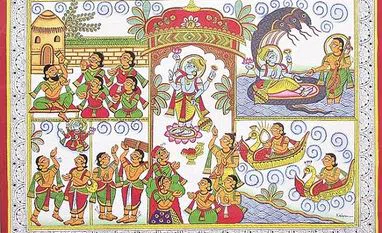
“Satyanarayan ki Katha” in the form of a phad

premium

“Satyanarayan ki Katha” in the form of a phad

Ritika Kochhar
The Devnarayanji phads are the best-selling ones now. That’s because the Gujjars are a rich community,” says Kalyan Joshi, a 30th-generation phad painter. It’s interesting what socio-political nuggets a piece of cloth with traditional artwork on it can offer, but phads — horizontal scrolls from the Bhilwara region in Rajasthan — fall into a shadowland between religion, mythology, folktales, decoration and economics.
 
Traditionally, phads are long horizontal scrolls that are painted with natural colours. Meant to be “read” from left to right, they told the stories of either Pabuji, a Rajput prince who lived in 14th-century Rajasthan, or Devnarayanji, a 10th-century hero who is said to be an incarnation of Vishnu and is venerated by the Gujjar community of camel herders. Pabuji is worshipped by Rabari nomadic herdsmen and, therefore, there are almost no temples dedicated to him except in the remote village of Kolu, where he is said to have lived.
 
A portrayal of the ashtalakshmi
The phads function as nomadic temples that can be set up in the middle of a village square by the bhopa, the priest. He erects the phad shortly after nightfall, consecrates the ground and sings different episodes from the deity’s life, while his assistant illuminates the relevant episode on the phad, making it, in essence, a large graphic novel. Pabuji’s phads are recognisable because they are typically 15ftx5ft and his enemy was Mirza Khan, the cow-killing king of Patan. It’s fun to spot the beard and clothes amongst the depictions of Hindu mythology and moral tales. The ones devoted to Devnarayanji are a vast 35ftx5ft, and show him seated on his python throne, facingthe serpent king, Basak, and hisfour cousins.
 
Modern phads also depict stories such as the “Samudra Manthan”
The phads are commissioned by people for occasions such as a birth in the family or an ailing animal, among other things. The bhopa asks the artist to create it. Once it’s completed, and the eye of the deity “opened” by the artist, the bhopa enacts the story at the house of the patron for 10 to 15 days, after which the phad belongs to the bhopa. The bhopa traditionally begins any performance of that phad with a dedication to the patron.
 
Historically, the Devnarayanji phads have been created for over 750 years by the Joshi clan. “Only about eight people still create them in Bhilwara. It is said that the ones made by Srilal Joshi have the power to exorcise spirits,” says Pragati Agarwal, founder of Art Tree and curator of a show of traditional and modern phads created by Srilal Joshi and his sons, Kalyan and Gopal. The show displays nearly 50 phad paintings, as well as some 100 unframed smaller pieces. Two of the pieces were created in the 1950s by Srilal, when you could buy a phad for Rs 40. Now, the reserve price placed by an auction house for a phad made by Srilal is Rs 4.5 lakh.
 
“Satyanarayan ki Katha” in the form of a phad
But, as economic and political realities change, Kalyan and Gopal have increasingly turned to creating modern phads, which are small enough to fit on a wall. The subjects now include well-known mythological stories such as the “Samundra Manthan” and “Satyanarayan ki Katha”. Agarwal also points out the influence of the pichwai paintings of Nathdwara (about 100 km away) on some of the newer works that focus on Krishna’s “Raas Leela”, and include a variety of trees — something traditional phads lack. There are also some exquisite miniature-inspired pieces where Kalyan has drawn hundreds of cows and elephants, each with its own expression and personality. The brothers have also created works with gold colour, a change from the traditional organic colours that held various meaningsin phads.
 
A traditional phad created by the Joshi clan
It is easy to mourn the change in direction from the mythologically rich phads that were peopled with illustrations of legends of nymphs, heroes, hybrids and gods. And yet, it is exciting to see this quality of miniature art, and the easy way these artists — already immersed in stories of the divine — turn their hands to new styles. It is also interesting to see how organisations like Yes Bank and Sahapedia help document the centuries-old craft art as it transforms itself. The works will also be displayed at the Jaipur Literature Festival next year.
“Phad: Mythical Heritage of Bhilwara” is on view at Bikaner House, New Delhi, till October 8