


Isro's rocket launch this month could change space agency's fortunes
First operational GSLV Mk-II to be a milestone, eye global opportunity to hurl heavier satellites
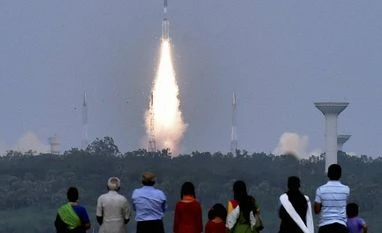 "Geo-synchronous Satellite Launch Vehicle (GSLV) D6 carrying GSAT-6, lifts off from Satish Dhawan Space Centre in Sriharikota, Andhra Pradesh")
Geo-synchronous Satellite Launch Vehicle (GSLV) D6 carrying GSAT-6, lifts off from Satish Dhawan Space Centre in Sriharikota, Andhra Pradesh
The Geosynchronous Satellite Launch Vehicle (GSLV) Mark II is expected make its first operational flight, taking a two tonne weather communication satellite into space on August 28.
So far, Indian Space Research Organisation (Isro) has only launched experimental GSLV launchers to prove the technology to carry two tonne satellites into the geostationary transit orbit (GTO), where communication satellites are parked.
Since its first launch in 2001 using a Russian cryogenic upper stage, Isro has so far done nine launches, including two with cryogenic stage that it built on its own. The space agency has also successfully launched a smaller version of GSLV Mark III, a rocket with a newer design that can eventually carry four tonne communication satellites or for India's manned space mission in the lower orbit.
The August launch of GSLV Mark II, which will carry the INSAT-3DR — a weather communication satellite, similar to one launched in 2013, is a milestone for Isro as this rocket would then be operationally proven, crucial for its commercial satellite business, a Isro spokesperson said.
Currently, Isro uses the Arianespace rocket of the European Space Agency to hurl its commercial communication satellites into space. At the same time, GSLV will also help Isro tap into the growing market for two tonne communication satellites globally.

"Both (GSLV) Mark II and III launches, if successful could partially reduce Isro's dependency on foreign launchers," Maxime Puteaux, a Space industry policy consultant at Euroconsult, the Paris-based space research agency said. "Although for commercial launches to GEO, GSLV Mark III is too small for most of the satellites that are more than 4 tons. For satellites less than 4 tons, it could be competitive on price provided it is available (i.e. not booked by the satellites of the Indian government)."
The first launch of GSLV Mark III, Isro's heaviest rocket will be in December.
So far, Isro has leveraged its workhorse Polar Satellite Launch Vehicle (PSLV) to serve global customers to hurl smaller satellites on the lower earth orbit. Since two decades of its first launch, it has done 35 flights, hurling over 86 satellites, including 45 foreign small and medium satellites. Now Isro is planning to outsource the entire rocket integration to a industry consortium, which include firms such as Hindustan Aeronautics Ltd, Larsen and Toubro Ltd, Godrej aerospace, Bengaluru-based Avasara Technologies and Walchandnagar Industries. It is looking to triple launch capacity in a year to 18 with this approach.
"If you are able to build on top of what we've built PSLV commercialisation and make it more attractive, there is a possibility that the Indian industry can also gain in this global opportunity," said Isro chairman A S Kiran Kumar in a recent interview. "We are looking at the possibility of whether that Indian industry plus Isro, whether they can launch the first vehicle in 2020. Beyond that, they can not only provide satellite launches for us, they can also market outside."
Isro's commercial arm Antrix Corporation markets these services to customers globally. The outsourcing effort would also help Isro drive costs down to make the rocket launch more affordable as global competition catches up. More than 25 new space companies are attempting to build rockets, most of them in the United States, eyeing the global satellite opportunity.
SpaceX, the rocket firm of Tesla founder Elon Musk, and Blue Origin, the firm owned by Amazon founder Jeff Bezos, are in the forefront. But, firms such as Rocket Lab and Firefly Systems are also joining this race.
"Pricing and export control are another condition of GSLV's commercial success abroad. Indeed, by embedding sensitive technologies, the launch of satellites abroad requires the authorization of the government where it was manufactured. Currently these regulations can create barrier to new entrants," says Puteaux of Euroconsult.
Isro so far has been able to launch American satellites on its PSLV rocket, largely due to the shortage of local launchers in the US. But red flags are being raised by the US policymakers on allowing the launch of US satellites on Indian launchers, a move that could potentially be protectionist as US rocket firms build and scale their technology to hurl satellites into space.
"As of today PSLV has launched several small satellites but the US government considers that its pricing is below market prices and creates an unfair competition to US launch providers. Therefore, currently the US government trade representative has enacted a ban on PSLV but grants waivers as the US small satellites operators have no alternative option domestically," said Puteaux. "The extension of this ban to GSLV is uncertain yet and subject to both Antrix's pricing of PSLV and GSLV and the evolution of US trade representative's policy following the expected availability of new dedicated small satellite launchers such as Firefly's Alpha, Rocket Lab's Electron and Virgin Galactic's Launcher One in the coming two years.
Don't miss the most important news and views of the day. Get them on our Telegram channel
First Published: Aug 03 2016 | 7:26 PM IST