


Long-term goal to cut emission must account for equity: Xolisa Ngwadla
Interview with Lead climate change negotiator for the African group of nations
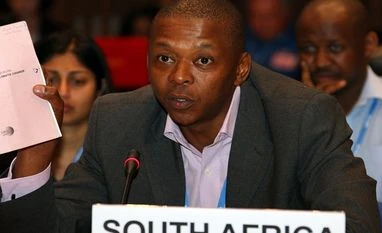 "Xolisa Ngwadla (Photo Credit: IISD)")
Xolisa Ngwadla (Photo Credit: IISD)
Xolisa Ngwadla is from South Africa and is the Lead climate change negotiator for the Africa Group of Nations at Paris. The group comprises of diverse set of countries from the continent and carry great weight at the negotiations. Ngwadla talks to Nitin Sethi on some tricky issues that could hobble the Paris summit.
What are they key expectations for Africa from the Paris agreement?
For the future regime the agreement, it must be effective and ensure deep cuts in emissions to keep the world and Africa safe. For the future regime, it is in the African countries’ interests on the other hand to ensure that the adaptation burden is not left to only the poor countries address. However, we must achieve all this whilst finding the principles of the convention enshrined in the Paris agreement.
Some developed countries are against differentiation between developed and developing countries in the Paris agreement, where does the Africa Group stand on it?
That is a non-starter. We are here to enhance the implementation of the UN Framework Convention on Climate Change. The principles of the convention have to be operationalized in this agreement. The convention places an obligation for all Parties to take both mitigation and adaptation actions.
Then the convention goes further on to actually define that the developed countries should take lead in emission reductions, and rich developed countries to provide finance and adaptation support and technology. We find these provisions of the convention central to the agreement. The convention does not require the developing countries to take similar obligations as the developed countries.
The point I am trying to make is, differentiation is mandated as a principle under the convention, and it does not preclude any country from taking an additional obligation, so we should be looking at a language that reflects that possibility. Take the case of Marshall Island who have taken an emission reduction target comparable to developed countries, they are not required to do so but are willing, and the agreement has to enable them with the support from developed countries. So we need to find the language so we can maintain differentiation and is aligned with more action and ambition.
Then the convention goes further on to actually define that the developed countries should take lead in emission reductions, and rich developed countries to provide finance and adaptation support and technology. We find these provisions of the convention central to the agreement. The convention does not require the developing countries to take similar obligations as the developed countries.
The point I am trying to make is, differentiation is mandated as a principle under the convention, and it does not preclude any country from taking an additional obligation, so we should be looking at a language that reflects that possibility. Take the case of Marshall Island who have taken an emission reduction target comparable to developed countries, they are not required to do so but are willing, and the agreement has to enable them with the support from developed countries. So we need to find the language so we can maintain differentiation and is aligned with more action and ambition.
The new phrases have been suggested to define the long-term goal of the agreement – decarbonisation and climate neutral. What does Africa group make of it?
Also Read

We want a long-term goal but these are terms that are new and we do not understand to the full extent words like decarbonisation. We know that it’s not just carbon-dioxide emissions that cause climate change. There are other greenhouse gases. Decarbonisation leaves these gases out. From our perspective we can learn from the formulation that was agreed in Cancun which refers to peaking and recognises that peaking in developing countries would be later than in developed countries. We don’t believe there can be any long term goal on mitigation that does not take in to account the principle of equity. Equity is essential and the way it was framed in the long term goal in the Cancun decision was a good one we can build on.
The current level of pledges are low and there is a process being negotiated to ratchet them up periodically. How does the Africa Group see that happen?
We see a three step process when it comes to the stock-taking. The first step: parties communicate their INDCs (Intended Nationally Determined Contributions or the pledges for the Paris agreement). The second step is the global stock take taking into account the communicated INDCs in addition to the information coming out of the transparency provisions on how the INDCs were implemented in the previous period. Then the third part: The inscription of the communicated INDCs that will present an opportunity for those parties who wish to or encouraged to take in to account the outcome of the stock-taking exercise and then present their final INDCs for the next period.
But at the same time, it should not present any expectation of an automatic updating. Along we could have a formulation that helps parties to define the international cooperation for additional action without giving it as an undertaking to the Paris agreement. It is very important for the Africa group that the scope of the stock-taking is not limited to mitigation but also covers the delivery of the means of implementation - finance, technology, adaptation and capacity building.
But at the same time, it should not present any expectation of an automatic updating. Along we could have a formulation that helps parties to define the international cooperation for additional action without giving it as an undertaking to the Paris agreement. It is very important for the Africa group that the scope of the stock-taking is not limited to mitigation but also covers the delivery of the means of implementation - finance, technology, adaptation and capacity building.
On the issue of finance, how central for Africa Group is it to see a climate finance road map in the core of the Paris agreement ?
We believe that the agreement should highlight a number of things including finance and not just mitigation. We believe the $100 billion annually should be the base by 2020, however we need to account for delivery of these funds based on agreed methodologies in the agreement and not just any one telling it has done so. We see the OECD report as a good start, but we have our doubts right now over the claimed magnitude of funds in the report. So, we need to have the agreement quantifying how much finance is needed based on needs and accounted through a transparency provision.
There are discussions on the objectives and goals of the Paris agreement and what should be enshrined in its Purpose? Please tell us about it
So on the Purpose the first point is for it to reflect both the objective of the Convention, and the principles of equity and common but differentiated responsibilities and respective capabilities. Third point on substance – temperature goal in similar formulation as we agreed mutually in Cancun. Then it should reflect on the mitigation aspect of that temperature goal and the implication on adaptation of that temperature goal, and the required support. These are they key issues for the Africa Group, and the Like-Minded Developing Countries Group (which includes India and China) has offered proposal for this called article 2bis at the moment. African Group is considering the proposals, as it does address some of the concerns of the African Group.
More From This Section
Don't miss the most important news and views of the day. Get them on our Telegram channel
First Published: Dec 03 2015 | 12:30 AM IST