A government-appointed panel has put forth these recommendations in a report that is yet to be submitted, a report in The Economic Times said.
India sold 22,000 units of electric vehicles in the year ended March 31, 2016, up 37% from the previous year.
This, however, is a tiny volume compared to the 20.46 million vehicles (based on petrol, diesel and CNG) sold last year.
Of the 22,000 electric vehicles, bulk was e-rickshaws and two wheelers. Only, 2,000 units of four wheelers were sold. Companies operating in this segment include M&M and Hero Electric. Commercial vehicle major Ashok Leyland and component maker JBM Group have recently launched electric buses.
The diesel vehicles are seen as a key cause of rising pollution levels, prompting the Supreme Court to ban registration and sale of diesel vehicles with engine capacity of 2,000-cc and above in the National Capital Region (NCR). Pure electric vehicle produces around 35 to 45% lower CO2 as compared to equivalent gasoline vehicle in India based on the fact that most of electricity produced is obtained predominantly from coal, natural gas and oil.
The government approved the National Mission on Electric Mobility in 2011 and subsequently National Electric Mobility Mission Plan 2020 was launched in 2013. As part of the mission, Department of Heavy Industries has formulated a scheme called FAME or Faster Adoption and Manufacturing of (Hybrid &) Electric Vehicles in India.
The first phase of the scheme is being implemented over a two-year period (FY16 and 17) with an approved outlay of Rs 795 crore. The scheme has four focus areas of technology development, demand creation, pilot projects and charging infrastructure.
“The thrust for the government through this scheme will be to allow hybrid and electric vehicles to become the first choice for the purchasers so that these vehicles can replace the conventional vehicles and thus reduce liquid fuel consumption in the country,” G M Siddeshwara, the minister of state in the Ministry of Heavy Industries and Public Enterprises had told the Lok Sabha in December last year.
Achieving the target of selling two million electric vehicles by 2020 will be an uphill task. “It would be tough to achieve (the target) unless ground level infrastructural deficiencies were removed and credit facilities eased for buying green vehicles,” industry body Society of Manufacturers of Electric Vehicles (SMEV) said in a statement in April.


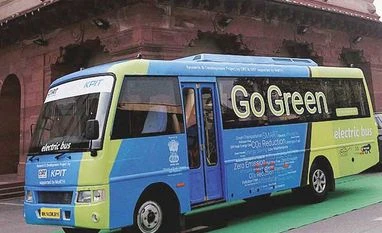 "Electric bus")