


Bolt's 'Big Bang' theory
Tata Motors' latest hatchback is being unleashed on a scale equalling market leader Maruti Suzuki's launches, and is focused on the under-35 audience
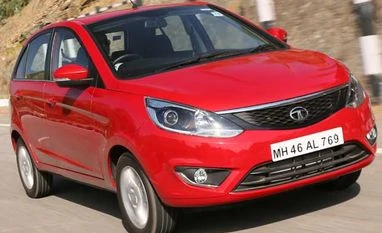 "Tata Motors Bolt")
Tata Motors Bolt
Tata Motors is leaving no stone unturned to roll out the Bolt, its next big launch after the Zest compact sedan. The car and truck maker is preparing to make the Bolt's launch the biggest in the company's history.
At least 100 cities that make up 85 per cent of the market will be targeted in the first week of the launch. This will be much higher than the phase-wise launch by other car-makers which covers an average of 10 cities in the first week, with the exception of Maruti Suzuki that also operates on a similarly large scale during launches.
Bolt is the hatchback version of the Zest, which Tata Motors launched less than four months ago. It will be the latest entry in a volume-led category, for the troubled car manufacturer. The Bolt will go up against the Maruti Suzuki Ritz, Hyundai Grand i10 and Chevrolet Beat and Sail U-VA.

| SPECIFICS |
|
With the Zest, even though it struggled to meet the demand with enough cars, Tata Motors has seen two months of growth on the trot. The company is eager to keep up the momentum.
Its 450 nation-wide dealers have recruited 1,276 people whose solitary job is to cater to Bolt customers. Hiring to prepare for such new cars had begun in April 2014. Mayank Pareek, president (passenger car business unit), Tata Motors, says, "We have created what we call Bolt Force, people exclusively signed up for the Bolt. We need to launch the vehicle simultaneously, not sequentially. We need to create the 'Big Bang'. Products like the Bolt and Zest bring a very new type of customer."
All for the youth
What Pareek refers to is the young population under 35 years of age. The response to the Bolt, so far, has got the team at Tata Motors excited: Fifty-eight per cent of those evincing interest are less than 35 years old in a country where more than 50 per cent of the population is in that age-bracket
"This is a good demographic to have for a new product. The demand mirrors the demography of India," says Pareek. According to industry estimates, the leader, Delhi-based Maruti Suzuki, has around 55 per cent of under-35 customers.
To deal with a young, tech-savvy and gregarious customer, Tata Motors has equipped its workforce with smart tablets to explain the car's features that include three driving modes - city, economy and sport - a touchscreen entertainment console by Harman, dual airbags, Bosch-developed ABS and the new 1.2-litre Revotron engine. Tata Motors opened bookings for the Bolt online (Rs 11,000 as booking amount) a month before the launch (January 22). "We had 33,000 people register for the Bolt, to have an experience of the car," says Pareek. Actual bookings have crossed 1,000, even though the price has not been revealed. Market experts estimate it to be around Rs 4-5.5 lakh. "Eighty per cent of customers need finance to buy the car. Once they know the price, they will calculate the EMIs and then the actual demand will rise. This gets converted in sales over a period of days," says Pareek.
Like the names of its new cars, Tata Motors is hoping to inject some energy into its line-up and reclaim its lost standing. From a comfortable number three in 2012, Tata Motors slipped to an all-time low of being sixth briefly (in 2014). It is now the fifth largest passenger-car manufacturer, trailing Maruti Suzuki, Hyundai, Mahindra & Mahindra and Honda.
Rivals rev up
Maruti Suzuki will also launch at least one new product in hatchbacks, along with a series of upgrades and face-lifts in 2015. Renault and Ford, too, have their hatchbacks to launch, priced under Rs 5 lakh.
Mending perception
A Mumbai-based analyst says, "The Zest has done well for Tata Motors and the build-up to the Bolt also seems impressive. The company has begun well and needs to keep up."
Tata Motors' biggest challenge is its brand image. A successful name in the commercial vehicle space, it has not been able to match the appeal of Japanese, American and European brands in cars and SUVs.
Pareek, who moved to Tata Motors after a 23-year stint with Maruti Suzuki, says the Zest has started the course correction: "The perception about Tata cars is changing. Otherwise, the Zest would not have had the kind of reception it did. After the mass market launch of Nano in 2009, for five years Tata Motors was completely silent. Obviously, it (Tata brand) went out of people's minds."
In mature car markets such as Japan, changing brand perception is near impossible. However, in an emerging market such as India, it is possible because 40-43 per cent of its customers are first-time buyers, carrying no baggage of brand experience. "If we have a great product, aggressively marketed and priced with the assurance of service back-up, the perception will change," says Pareek.
The former Maruti hand says that Tata Motors will triple the dealer-count in the next four-five years to 1,350, especially in the hinterlands. It will put at least one dealership each in the 650 district headquarters, and allow the company to move closer to the 3,854 talukas later. In comparison, Maruti Suzuki has nearly 1,000 dealers.
A flurry of launches, in hatchbacks, sedans, compact SUVs, premium SUVs and MUVs, might get the spotlight back on the company's passenger car business. In fact, ageing products could be altogether - shown the door, soon. Some variants of the hatchback Indica, Nano, sedans Indigo and Manza - have been phased out.
Don't miss the most important news and views of the day. Get them on our Telegram channel
First Published: Jan 20 2015 | 9:40 PM IST