


FMCG's new love: Salons
As men and women spend more at salons, companies in fast moving consumer goods sector are increasingly looking to wedge a foothold in the services business
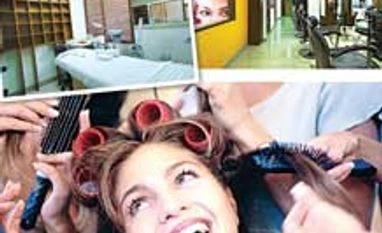 "Salons")
Salons have suddenly become hot property given the recent spate of deals in the space.
Consider this: French cosmetics and beauty major Lóreal bought Mumbai-based Cheryl's Cosmaceuticals, a professional skincare products and treatment company, in September. Sales of the company, founded in 1986, was Rs 20 crore, implying that Lóreal paid nearly double the amount, an estimated Rs 30-40 crore, to secure ownership.
While the acquisition was Lóreal's first in India, it, points to a coming-of-age of the domestic salon business as more FMCG players invest in existing chains. Godrej Consumer invested in 30 per cent in the Mumbai-based B:Blunt, co-owned by Adhuna Akhtar, the wife of Bollywood actor-director-producer Farhan Akhtar, for an undisclosed amount in October. The investment, according to Abneesh Roy, associate director, research, Edelweiss, was strategic, intended to help the company, which has its own line of hair colours and other grooming products.

Salons are proactively seeking out investments as well. The popular hair salon chain, Jawed Habib's, is looking to raise funds from its existing private equity (PE) investors including Mauritius-based Greenfield Investments, after shelving plans to raise money via an IPO. The Delhi-based Shahnaz Hussain, Mumbai-based Enrich Beauty Salons and Bangalore-based You Look Great (YLG) are all expanding following investments made by PE players. International chains such as Toni & Guy and Jean-Claude Biguine (JCB), who also sell their own products, are ramping up too.
Meanwhile, the salons already being run by FMCG companies such as Lakme Beauty Salons (Hindustan Unilever or HUL), Green Trends (CavinKare) and Kaya (Marico) are expanding.
Bundling with services
Spends on grooming are on the increase, with both women and men looking at grooming as a necessary fixed cost rather than discretionary spending. It gives consumer goods companies a new avenue to both utilise and push their products. For instance, Lakme Salons have become an effective way of pushing HUL's range of Lakme skincare and colour cosmetics apart from international professional products such as TIGI (from Unilever's global portfolio), which are utilised during services as well as sold within the outlets.
Though Marico does not push its retail products, it has developed exclusive Kaya products for use and sale in these outlets. The product-and-service business model is increasingly becoming an important aspect of salon operations.
"The market is large and growing. Companies such as Godrej and HUL are extending their business into services.
As more women join the workforce, they will increasingly visit such salons," says Harminder Sahni, managing director of retail consultancy Wazir Advisors.
Action in the mass end
According to industry estimates, the salon business, including both organised and unorganised, is around Rs 12,000 crore, growing at a clip of about 25 per cent every year.
The specialised salon segment, which include clinics such as Kaya and Blush (from Dr Jamuna Pai, a noted Mumbai-based dermatologist), is around Rs 1,000-1,200 crore, growing at around 20-25 per cent yearly. The space is dominated by skin and hair specialists.
It is the mass end - at around Rs 10,000-11,000 crore - that is seeing most of the action. Rahul Bhalchandra, founder & CEO, YLG, explains this has to do with the evolution of the salon business, with consumers wanting better maintenance and hygiene in services for skin and hair. "The specialised end of the market only comes into the picture when there is a skin or hair-related problem. In that sense, it is a niche segment," he says of the clinics.
The opportunity for companies is in the transition from unorganised to organised salons in metros, mini-metros and even tier II cities. Pushkaraj Shenai, CEO, Lakme Lever, says, "Three factors are contributing to this spurt: A growing awareness and interest in beauty services, a greater proportion of working women aspiring to look their best and higher disposable income."
Larger ticket size
Organised play is becoming increasingly viable because of the time and money consumers are willing to spend at a salon. As Dharmendra Manvani, CEO, JCB, says, "If customers were coming once in 45 days, they are now coming once in 30 days. If they were visiting us for an hour for a single service, they are now visiting us for two hours for three services. There is certainly a jump."
Routine services such as manicure, pedicure, waxing, threading and facials could cost a consumer anywhere between Rs 3,000 to Rs 6,000. Hair services are more expensive, going above Rs 10,000. Arvind R P, head of marketing, Kaya, says, "Consumers today have become discerning, which is leading to high spends. Even in a recession, the beauty market continues to boom."
Managing fixed costs such as electricity, laundry and rent are a challenge because if handled ineffectively, they could affect profitability. The other crisis of unavailability of skilled manpower, is being addressed by academies set up by the players to train their staff.
Don't miss the most important news and views of the day. Get them on our Telegram channel
First Published: Nov 03 2013 | 11:30 PM IST