


Global sell-off sees markets, rupee fall
Sensex slumps 400 points; rupee falls to 4-mth low of 61.19/$
)
A sell-off in global equities left the Indian market and the domestic currency reeling on Friday. The global equities rout resulted from a sharp drop in the US markets on Thursday, following major companies reporting weak earnings and fear the US Federal Reserve might increase interest rates sooner than expected.
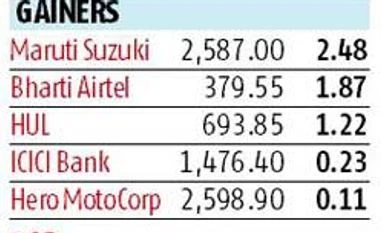
The benchmark BSE Sensex fell 414 points, or 1.6 per cent, to end at 25,480.84, while the National Stock Exchange Nifty ended at 7,602.60, down 118.70 points, or 1.54 per cent. The rupee ended at a four-month closing low of 61.19/dollar, compared with its previous close of 60.56/dollar.
The fall in the markets on Friday was led by index heavyweights such as Reliance Industries and HDFC, which fell about three per cent each. (THE WIDE PICTURE)
"Markets have fallen as part of the collateral damage in global stocks, which extended after the fall in European markets," said Deven Choksey, managing director, Choksey Securities.
Most Asian markets closed about a per cent lower, while European markets opened with declines of as much as two per cent. On Thursday, the Dow Jones Industrial Average had fallen 1.9 per cent, erasing the gain it had recorded so far this year.
The lower-than-expected additions to US jobs in July, announced after the Indian market closed on Friday, would help ease worries, as this would strengthen the case for continuing with the US Fed's stimulus programme, experts said. In July, the US added about 209,000 jobs, against the consensus estimate of 230,000. The US Federal Reserve has committed to keep interest rates low until wages rise and the jobless rate falls.
Having gained about 22 per cent so far this year, the Indian market is the best performer among its large global peers, thanks to about $12 billion of investment from foreign institutional investors (FIIs), owing to low interest rates and the availability of easy liquidity.
On Friday, foreign investors sold shares worth Rs 1,073 crore, after selling stocks worth about Rs 1,600 crore on Thursday, according to provisional data provided by stock exchanges. The two-day sell-off was one of the sharpest this year.
Speaking in New Delhi on Friday, Reserve Bank of India (RBI) Governor Raghuram Rajan said India wasn't immune to global markets.
Experts said withdrawal of the stimulus by the US Fed could apply brakes on FII investment in India. "There is a feeling the American economy is in a reasonably good shape and we could see a reversal in the liquidity currently being made available. Accordingly, people are changing their positions between bonds and equities and there is a feeling foreign flows might dwindle as a result," said U R Bhat, managing director, Dalton Capital Advisors (India).
Some believe stimulus programmes in Europe and Japan could make good the cut in the US stimulus.
"When America continues to a cutback, Europe is coming into the market and printing more. On the other hand, Japan and the UK are not cutting back," Jim Rogers, chairman of Rogers Holdings, had told Business Standard earlier this week. "I don't think any of these banks will stop printing permanently because when things start going wrong, they're going to panic and print more."
Experts don't rule out a further correction in the market in the near term. "The markets had been ignoring international cues for a while, as we were busy being overwhelmed by domestic events. In a bull market, a 10 per cent correction is deemed healthy. So, markets are prepared for a short-term fall," said Ambareesh Baliga, managing partner, Edelweiss Global Wealth. The fall in the markets on Friday was despite a survey showing in July, domestic industrial activity had increased the most in 17 months.
Along with the corporate earnings, investors are now eyeing RBI's monetary policy due on Tuesday, the first since the 2014-15 Budget was announced. "The undertone in the market continues to be bullish in the medium term, though the short run might be dictated by foreign flows. RBI's moves next week will be closely watched," said Bhat.
Experts said though the rupee might remain weak, it wouldn't drop beyond 61.5/dollar. "The rupee might continue to trade weak, unless there are dollar supplies. RBI might be comfortable with the rupee trading between 60.5 and 61.5/dollar because it is a competitive level for exporters and importers," said Naveen Raghuvanshi, currency trader, DCB Bank.

Don't miss the most important news and views of the day. Get them on our Telegram channel
First Published: Aug 02 2014 | 12:59 AM IST