


Stocks on crash course as Sensex falls 660 points
The broader-based National Stock Exchange's Nifty index ended at 8,236.45, down 196.95 points or 2.34% over the previous day's close
)
Markets on Tuesday posted their third-biggest fall of the year on a weak-monsoon forecast and concerns over further rate cuts. Investor sentiment was also hurt over the situation in Greece, as the country moves closer to defaulting on debt repayment to the International Monetary Fund.
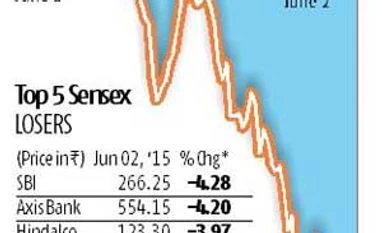
The benchmark Sensex ended at 27,188.38, down 660 points or 2.4 per cent - the most since May 6 - with all but one of its component ending in loss. The broader-based National Stock Exchange's Nifty index ended at 8,236.45, down 196.95 points or 2.34 per cent over the previous day's close.
The 10-year benchmark government bond ended at 7.71 per cent from the previous day's close of 7.64 per cent, on doubts over further rate cuts. Although the Reserve Bank of India (RBI)'s decision to cut policy rate by 25 basis points was in line with market expectations, a cautious stance over future rate cuts coupled with a downward revision in monsoon rain forecast for the year spooked markets.
"RBI's stance was more or less on expected lines, although we were hoping for a 50-basis-point rate cut. The central bank expects inflation to inch higher and has downgraded its growth forecast - not a very good sign of things to come. In this regard, monsoon becomes extremely important and the government may need to take steps to ensure that food inflation does not rise even if the monsoon fails. We expect the market to remain range-bound and be driven by earnings growth from here on," said Rashesh Shah, chairman and chief executive, Edelweiss group. According to provisional figures, foreign institutional investors (FII) sold shares worth nearly Rs 600 crore, reversing their recent buying spree.
Market experts didn't rule out further corrections. But they added that could provide a good entry point for long-term investors. "From an investor's point of view, any knee-jerk reaction in the market should be used as an opportunity to add allocation to equities, as the undertone of the market remains definitely bullish for the coming years. FIIs are unlikely to exit in a hurry, as India remains a bright spot among emerging markets," said Nirmal Jain, chairman, IIFL Group.
After Tuesday's correction, returns on Indian equities again slipped into the negative territory - making it one of the worst performers among major global markets in 2015.
Even though Indian markets have corrected around 10 per cent from their peaks, valuations continue to remain high owing to erosion in corporate earnings.
"Valuations will look richer if we see material earnings cuts in 2015-16. Valuations of high-growth quality stocks continue to be expensive and we do not rule out a further correction in these companies," said Sanjeev Prasad, senior executive director and co-head, Kotak Institutional Equities.
Among large-cap stocks, banks such as State Bank of India and Axis Bank led the fall, dropping four per cent each.

Don't miss the most important news and views of the day. Get them on our Telegram channel
First Published: Jun 03 2015 | 12:58 AM IST