


Breakfast with BS: Gulzar
Rhythms of the cosmos
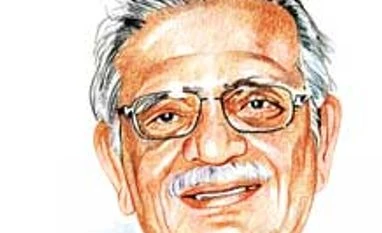)
To phir chaliye" (Let's go, then), Gulzar says on the phone when I call him from the reception of the India International Centre. A minute later, the lyricist, poet, writer, film-maker, and Oscar- and Grammy-winner is down, dressed in his trademark white-starched kurta and trousers. The juti is golden, its toe upturned like the trunk of a bathing elephant. His two-day stubble is grey and sparse. You expect poets and other creative people to be lean and tall. Gulzar is stocky with broad shoulders. He may be 78, but looks ready for a long day of hard work, writes Bhupesh Bhandari.
Sunjoy Shekhar, the youthful translator of his latest book, Half a Rupee Stories (Penguin), has also arrived, and the three of us head to the nearby Vivanta by Taj for breakfast.
At the hotel, on our way to Yellow Brick Road, the coffee shop, a young member of the staff recognises Gulzar and attaches himself to our small party. "Sir," he tells Gulzar, "I am a huge fan of yours. I don't understand much Urdu, but my father does." Urdu may be falling into disuse, but everybody knows it sounds mellifluous. "Jitni Urdu aati hai, sab bol deta hoon" (I speak all the Urdu I know), Gulzar tells him. The buzz in the restaurant picks up when we enter. Gulzar chooses to sit outside, where a few tables have been laid out. It's mid-March, but still pleasant enough to breakfast outdoors. Gulzar is the sensitive face of Bollywood, someone who trod the middle path between the formula-driven stuff churned out by Salim-Javed and bland art-house cinema.

Today, he is no mood to talk about cinema, except that he gave up making films many years ago because it is very taxing, or about his younger days because that story has been told numerous times. That leaves us with books. What does the poet read? "Mainly poetry," he says. "But these days I am quite intrigued by the cosmos. I want to go there, but I don't think it will be possible in this lifetime." And what is it about the space above that interests him? It's the mysteries: "Why have recent meteors fallen on Russia?" he asks. Researchers will tell you it's not a mystery; the country is a large chunk of the earth's surface and, therefore, gets its fair share of meteor hits. "There is a great deal of aamodaraft up there," Gulzar adds and then asks. "How would you describe aamodaraft?" Toing and froing, I offer? "Congestion is more apt," says Gulzar. You can't argue with the guru of Urdu.
Gulzar declines the menu and wants to check out the buffet. He looks at the spread carefully and picks up some cut fruit and orders scrambled eggs. I ask for idlis. In spite of his reluctance to talk films, I manage to drag him into the subject. The seventies were when the legend of the Angry Young Man was born in Bollywood - frustrated over joblessness and the devious ways of the rich. Well before the Amitabh Bachchan-starrer Deewar, Gulzar had made Mere Apne, a story of idle college-educated youths, with Vinod Khanna, Shatrughan Sinha and Meena Kumari. "Is the context for that angst gone today?" I ask. "There is still angst in the youth today," says he.
Still, Gulzar has great hopes from today's young people. They, he says, are no longer happy to be second-class citizens of the world. "They will change things. I hope I live to see that." Much of the current problem, according to Gulzar, stems from the previous generation's "chalta hai" attitude. "The youth don't have our cultural hypocrisy," says he, and launches into a long story. Here it is, in brief: A man insists that his daughter should accompany him to the marriage of a relative's son, though she has never met him and the father has had innumerable fights and disputes with him. The girl can't understand this closeness amid all the bitterness. Point taken; happens in all families, I tell him.
Bollywood frequently paints the politician as the villain, the fountainhead of all evil, the man responsible for all our problems - from global warming to rotten tomatoes. When did this disenchantment happen? How long did it take people after Independence to get disillusioned with their leaders? "It wasn't like this at Independence," Gulzar says. "There was the Jeep scandal with (Defence Minister V K) Krishna Menon. But people didn't believe it. It is only when the (Ramakrishna) Dalmia and (Haridas) Mundhra scandals happened that disenchantment started to set in," says he. The final straw was the Emergency (imposed by Indira Gandhi in June 1975 and lasting till March 1977), says Gulzar, when the police atrocities reminded people of the days of the British Raj.
A waiter walks up to Gulzar and says a guest, who is checking out, wants to come and shake his hand. "I will see him on my way out," Gulzar tells the waiter. But the man apparently can't wait. He strides up to Gulzar with great emotion on his face - a mix of solemnity, gratitude and happiness. Gulzar gets up and takes his hand with great warmth. Few words are spoken. The visitor's son nods at Gulzar from a distance, bewildered as to why his father looks so overwhelmed.
"This country," Gulzar resumes our conversation, "will one day realise the contribution of (P V) Narasimha Rao (prime minister from 1991 to 1996, with whose blessings Manmohan Singh liberalised the Indian economy). I had met him twice. He was very chalak." The word "chalak" is used in north-Indian conversations to mean unscrupulous as well as street-smart. Shekhar, Gulzar's translator, knows this difference. "Clever or sly," he asks. "Difficult to say," Gulzar says after reflecting for a moment. "He knew so many languages and wrote books. But he used to be quite like a bhagat." This is the first time in our conversation that Gulzar has used a Punjabi expression - a bhagat (it comes from bhakt in Hindi, meaning disciple) is someone who is silent and meditative, yet observant.
The Punjabi is not out of place. Gulzar is Sampooran Singh Kalra and was born to Sikh parents in west Punjab, the area that is now a part of Pakistan. He took the pen-name Gulzar while in school. After Partition, the family came to Delhi and Gulzar worked here as a mechanic. It was only later that he moved to Mumbai (then Bombay). Does he have family in Delhi? "More friends than family," he says. His writings are bereft of the angst of Partition, something that roils the work of most writers who lost family or property in the riots. Gulzar's short answer is: "History is meant to be history." In other words, history is not baggage for him.
Gulzar now asks Shekhar when their next appointment is scheduled. At half past 10, he is told, at the India International Centre. "We mustn't be late," Gulzar says, though he still has more than half an hour to spare and the venue is not more than a couple of minutes away. He gets up, shakes my hand and is gone. I was supposed to drop him back. Eager to keep my part of the bargain, I hurriedly pay the bill. But by the time I reach the lobby, there is no sign of Gulzar. Then I see the young man who had showed us in; he is now walking back from the portico, looking high into the distance. The spring in his walk says he has just seen Gulzar off. It's futile to enquire. I get into my car and start for office.
Don't miss the most important news and views of the day. Get them on our Telegram channel
First Published: Mar 29 2013 | 10:30 PM IST