India’s “no” to RCEP reflects one of the many opportunities it has missed to become a solid global manufacturing base. Since economics and strategy are linked, how many Asian countries will now share New Delhi’s image of India as a world power? New Delhi has said that Asean has centrality in the Indo-Pacific. But it simultaneously seems to have subscribed to US President Donald Trump’s vague Indo-Pacific concept because it has interpreted the idea as signifying the extension of India’s economic and security profile, beyond the Indian Ocean into the western Pacific. This appears to be a pipe-dream. For India is a no-show in any economic group that includes Southeast and East Asian countries.
Washington itself has done little to clear the air about its Indo-Pacific concept. Trump’s National Security Strategy (NSS) in 2017 underlined that “Indo-Pacific” was about a strategy to counter China’s economic and military rise.
Mr Trump himself announced the concept at the meeting of APEC CEOs in Da Nang, Vietnam, in November 2017. He then hailed Vietnam as being in the very heart of the Indo-Pacific (note, India is not a member of APEC). The NSS described APEC and Asean as “centerpieces” of the Indo-Pacific. Washington had not placed India at the centre of its Indo-Pacific, even if it continues to see India as playing an important role in the area.
Moreover, the uncomfortable reality is that Asean countries — with which India wishes to strengthen its ties under its Act East policy — dislike Mr Trump’s Indo-Pacific. To them, the absence of the word Asia from the concept ignores the centrality of Asean and its consent to any strategy that affects its member-states.
Last June, Asean presented its own outlook on the Indo-Pacific, which highlights the Asia-Pacific and Indian Ocean regions through a wide-angle economic lens. Since the end of World War II, Asia-Pacific has had a historical meaning for the Southeast Asian and East Asian countries, which became America’s friends and allies. Asean’s outlook does not mention India. In fact, the US and its Asian friends have since long perceived India as a South Asian country.
Even America’s strongest Asian allies, Japan and South Korea — are divided over Washington’s Indo-Pacific. It was Japan’s Prime Minister Shinzo Abe who coined the term. But against the history of Japan’s annexation of Korea between 1910 and 1945 — and this year’s Japan-South Korea trade war — Seoul distrusts Japan and sees little benefit in backing a Japanese initiative to link Japan with the US, Australia, and India. With China as its foremost trading partner, and as the country which has the most leverage over North Korea, South Korea treads a difficult tightrope between the US and China.
True, Asean countries are fearful of China’s territorial expansionism but are dependent on it for trade and investment. So they do not want to be forced to choose between the US and China. Not an American ally, India itself must balance its wish for a strong partnership with the US and the need to stabilise ties with China.
Economics comprises the outstanding component of India’s ties with Southeast and East Asia. In these regions India has strengthened security relationships with Japan, Australia, several Asean countries — and the US, which remains Asia’s primary power. But have all these relationships made India a Pacific power? Hardly. China is the strongest Asian military power and the largest trading partner of Asean countries. China’s GDP is nearly $15 trillion; India’s $ 3 trillion. China’s defence spending is around $250 billion. India’s $66 billion. China’s trade with Asean stands at $288 billion; India’s at $142 billion. Unlike Asean member-states, India has stayed out of China’s transcontinental Belt and Road Initiative. This fact alone explains why India and Asean countries disagree on handling China — and a China-backed RCEP.
At another level, the intertwining of economics and military power signify that India is unable to expand its military influence in the Pacific in a manner analogous to the way in which China has increased its economic and military clout in the Indian Ocean. As China increases its presence in the Indian Ocean and in India’s neighbourhood, India’s economic and naval power simply does not match that of China.
India’s decision to stay out of the RCEP, the world’s largest trade pact, will not stop the advocates of the partnership from going ahead with it. Actually, New Delhi’s fear that lowering of tariffs will result in China dumping goods on India only highlights its failure to tackle India’s economic weakness. This stems in part from its protectionism and continual failure to untangle red tape. Can protectionist India, with a lower GDP per capita than most Asean countries, Japan and South Korea, display convincing credentials as a strong Asian power? And since economic and military power are intertwined, can India really be perceived as a counterpoise to a rising China in Asia? New Delhi must answer those tough questions.
The writer is a founding professor of the Centre for Peace and Conflict Resolution in New Delhi.
www.anitaindersingh.com


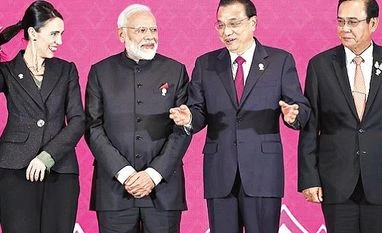 "India’s role in Asia after RCEP")