


<b>Shekhar Gupta: </b>Breaking the two and a half front siege
A powerful nation's Army must be able to fight on multiple fronts. But must it be made to do so?
 "Breaking the two and a half front siege")
premium
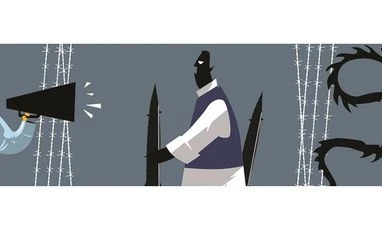
Illustration by Binay Sinha
General Bipin Chandra Rawat's statement, that his Army is prepared for a two-and-a-half front war has drawn a fair bit of comment. The fact is, India has faced multiple and multi-layered threats since 1959 and its Army has been the political leadership's go-to option. With one exception, 1962, it has delivered each time.
Many questions, however, arise from this, particularly now when the second front, China, has sprung to life after decades and the language coming out of Chinese official media will embarrass panelists on our commando-comic TV channels.
The first question is, almost 60 years after the two-and-a-half-front challenge first developed, how come it hasn't altered, after three full wars, break-up of Pakistan, many peace accords in the north-east, end of the Cold War, and nuclear weaponisation? No other major nation has continued to have the same combination of threats for six decades.
The second, is this remarkable continuity in existential military threat a result of India's diplomacy and strategic thought processes, or in spite of them? The question that follows: Does military power guide Indian diplomacy and strategy is subservient to it, or is it the other way around? The first was a Cold War phenomenon, especially for the Soviet Bloc, and it is widely acknowledged now that that ideological and intellectual battle was lost simply because the Warsaw Pact power collapsed under the weight of its armies and militarised thinking. Noted historian Niall Ferguson has indeed argued that the Cold War ended not because Ronald Reagan's America got the better of the Soviet Bloc, but because the latter succumbed to its Afghan (invasion) misadventure.
And third, if even after 60 years and in an altered world, our enemies and enmities still remain unchanged, as do our responses, does it not imply that our political leadership has failed on this most important touchstone of national interest?
Modern history also tells you no nation can successfully fight a two-front war and we aren't just talking about Hitler's Russian blunder. Diplomacy, therefore, has to have three priorities. First, avoid conflict while furthering the national interest. Two, achieve the desired resolution by the implicit leverage of military power without using it. And third, when war is thrust on you as in 1962 and ‘65 or is tempting as in 1971, ensure that all other fronts are kept quiet, leaving your Army free to deal with one.
There were fears of a new front opening in each one of our wars, and governments used different methods to prevent that. In 1962, when India faced its first two-and-a-half front situation, Nehru reached out to the US and Britain to lean on Pakistan to stay calm. The price for this was having to concede a high-level, serious (but insincere) negotiation with Pakistan over Kashmir (Swaran Singh-Bhutto talks, 1962-63) with plenty of "third party" intervention.
Many questions, however, arise from this, particularly now when the second front, China, has sprung to life after decades and the language coming out of Chinese official media will embarrass panelists on our commando-comic TV channels.
The first question is, almost 60 years after the two-and-a-half-front challenge first developed, how come it hasn't altered, after three full wars, break-up of Pakistan, many peace accords in the north-east, end of the Cold War, and nuclear weaponisation? No other major nation has continued to have the same combination of threats for six decades.
The second, is this remarkable continuity in existential military threat a result of India's diplomacy and strategic thought processes, or in spite of them? The question that follows: Does military power guide Indian diplomacy and strategy is subservient to it, or is it the other way around? The first was a Cold War phenomenon, especially for the Soviet Bloc, and it is widely acknowledged now that that ideological and intellectual battle was lost simply because the Warsaw Pact power collapsed under the weight of its armies and militarised thinking. Noted historian Niall Ferguson has indeed argued that the Cold War ended not because Ronald Reagan's America got the better of the Soviet Bloc, but because the latter succumbed to its Afghan (invasion) misadventure.
And third, if even after 60 years and in an altered world, our enemies and enmities still remain unchanged, as do our responses, does it not imply that our political leadership has failed on this most important touchstone of national interest?
Modern history also tells you no nation can successfully fight a two-front war and we aren't just talking about Hitler's Russian blunder. Diplomacy, therefore, has to have three priorities. First, avoid conflict while furthering the national interest. Two, achieve the desired resolution by the implicit leverage of military power without using it. And third, when war is thrust on you as in 1962 and ‘65 or is tempting as in 1971, ensure that all other fronts are kept quiet, leaving your Army free to deal with one.
There were fears of a new front opening in each one of our wars, and governments used different methods to prevent that. In 1962, when India faced its first two-and-a-half front situation, Nehru reached out to the US and Britain to lean on Pakistan to stay calm. The price for this was having to concede a high-level, serious (but insincere) negotiation with Pakistan over Kashmir (Swaran Singh-Bhutto talks, 1962-63) with plenty of "third party" intervention.
Illustration by Binay Sinha
Disclaimer: These are personal views of the writer. They do not necessarily reflect the opinion of www.business-standard.com or the Business Standard newspaper