


Asia stocks, dollar rise on China inflation data relief
MSCI's broadest index of Asia-Pacific shares outside Japan was up 0.4 per cent after dropping 1.1 per cent on Thursday
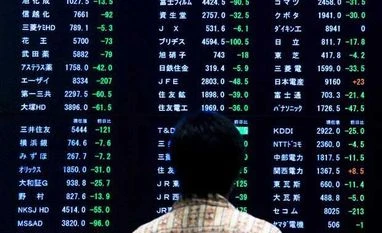 "A woman stands in front of a display showing market indices at the Tokyo Stock Exchange")
A woman stands in front of a display showing market indices at the Tokyo Stock Exchange
Asian stocks and the dollar bounced on Friday, erasing some losses from the previous day, as stronger-than-expected Chinese inflation data eased some concerns about the health of the world's second-biggest economy.
Spreadbetters forecast a slightly higher open for Britain's FTSE, Germany's DAX and France's CAC following a bounce in oil prices.
MSCI's broadest index of Asia-Pacific shares outside Japan was up 0.4 per cent after dropping 1.1 per cent on Thursday, when weak Chinese export numbers hit global equities, stopped a rise in US yields and halted the dollar's advance.
The index was headed for a loss of 2.1 per cent on the week.
Chinese data again set the tone on Friday, with September producer prices unexpectedly rising for the first time in nearly five years, while consumer inflation also beat expectations.
Also Read

The producer price increase will be good news for profits and for Beijing as the government struggles to reduce a mountain of corporate debt.
South Korea's Kospi added 0.6 per cent and Australian stocks were flat. Shanghai dipped 0.5 per cent while the Hang Seng rose 0.7 per cent.
Japan's Nikkei added 0.5 per cent. It looked set to end the week flat as investors braced for upcoming earnings reports, notably those of financials.
"Until new catalysts emerge, investors will likely monitor both US earnings and Japan Inc's earnings," said Kazuhiro Takahashi, an equity strategist at Daiwa Securities in Tokyo.
The dollar index rose 0.3 per cent to 97.774. It had climbed to a seven-week high against a basket of other major currencies earlier in the week on growing expectations of a December interest rate hike by the Federal Reserve.
The greenback, which slid Thursday to 103.340 yen on the Chinese trade data, gained 0.4 per cent to 104.110 yen, edging back towards a 2-1/2-month peak of 104.635. It was on track to gain 1 per cent on the week.
The euro slipped 0.3 per cent to $1.1027 after seeing a 2-1/2-month low of $1.0985 on Thursday. The common currency was en route for a 1.5 per cent weekly loss.
Investors will have another chance to gauge whether the world's biggest economy is ready for tighter monetary policy through US indicators due later, including September retail sales and the University of Michigan consumer sentiment report.
The markets will also tune into speeches by Fed Chair Janet Yellen and Boston Federal Reserve President Eric Rosengren for hints about the timing of the next interest rate hike.
Elsewhere in currencies, the pound dipped 0.4 per cent to $1.2204. It was on track to lose 1.8 per cent this week.
Sterling kept well above the 31-year trough below $1.1500 struck last Friday during its flash crash as some fears of a "hard Brexit" ebbed, but it remained under pressure as Britain's separation from the European Union is strewn with obstacles.
The Singapore dollar hit a seven-month low after the economy unexpectedly contracted in the third quarter, keeping alive easing prospects even though the central bank stood pat on policy earlier in the day.
Thailand's stocks rose 4 per cent and the baht gained about 1 per cent versus the dollar after the government urged the country to remain calm after the death of King Bhumibol Adulyadej.
"On the assumption that the succession goes smoothly, I would assume that foreign investor inflows will continue," said Andrew Bresler, director at Saxo Capital Markets based in Singapore.
Crude oil extended gains after bouncing overnight on a US government report showing hefty draws in diesel and gasoline.
Brent crude was up 0.3 per cent at $52.19 a barrel, having risen to a one-year peak of $53.73 on Monday on expectations for an OPEC output cut.
Don't miss the most important news and views of the day. Get them on our Telegram channel
First Published: Oct 14 2016 | 11:07 AM IST