


Truths about Savarkar: Arun Shourie's book is not a biography or analysis
In an early chapter of his book, indicatively titled "History is Made-Up", veteran editor and writer, Arun Shourie scrutinises an old speech/poetic recitation of former PM Atal Bihari Vajpayee
 "book")
Listen to This Article
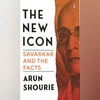
THE NEW ICON: Savarkar and the Facts
Author: Arun Shourie
Publisher: Penguin Random House
Pages: 543
Price: Rs 999
Also Read

 "book")
 "The Green Book: An Observer's Notebook")
 "book")
 "book")
 "Becoming Bangalore: Stories that Shaped a Hometown")
In an early chapter of his book, indicatively titled “History is Made-Up”, veteran editor and writer, also former Union minister, Arun Shourie scrutinises an old speech/poetic recitation of former prime minister Atal Bihari Vajpayee. The extensively cited public oration has a section of romanticised exaggeration on Savarkar’s “great escape”: “The way he jumped into the sea; He jumped for freedom; The waves of that stormy sea; The infinite ocean; Limitless water; Where is the shore; Where will I end up...”.
Hagiographic accounts of Savarkar, Mr Shourie contends, suggest that “Savarkar had swum miles to reach the shore and freedom.” He is not the first author to establish this account as a blown-up version of an incident (several writers, including the reviewer, have pointed to such mythification) in which the ship is not “far out at sea” but was “berthed alongside the quay”. Mr Shourie, however, goes further and establishes that Savarkar himself was part of the falsification of history, hence the title of this chapter, which includes other embellished episodes— including his interactions with Subhash Chandra Bose. On the Marseille incident in which Savarkar jumped “out of the porthole” of the SS Morea, Mr Shourie takes the readers through accounts readily available not in a “collection (of papers) published by some enemy of Hindutva in distant London, but by the Government of Bombay”. But more startlingly, an “entire chapter in The Life of Barrister Savarkar is devoted to the attempted escape…And it has all the ingredients of the myth.” Mr Shourie cites embroidered accounts from the laudatory “first biography” of Savarkar because the writer, Chitragupta, was none other than he himself writing under a pseudonym!
Mr Shourie’s book is neither Savarkar’s biography, nor an exploration or analysis of his thoughts, writings, speeches or participation in public life including positions on the national movement. Instead, he scrutinised the falsifications and untruths authored or stated by Savarkar and later by his ideological legatees. For instance, the Hindutva icon claimed that “Gandhi and I were friends.” But Mr Shourie substantiates his argument that Savarkar imagined himself as the legatee of the Marathas, Maharashtrians and Chitpavan Brahmins who produced a long line of heroes and martyrs, right up to Lokmanya Tilak. Despite his lineage, “while he was confined in the Andamans, suddenly another outsider had come and carried off the prize. Gandhi with his sanctimonious talk of ahimsa, his pretensions of Mahatmahood, this ‘walking plague’— a typical phrase of Savarkar for Gandhiji – had carried away his personal legacy.”
After correcting Savarkar’s version of his various meetings with the Mahatma – “Gandhiji was not in London in 1908 at all” and that “he never resided in India House”, Mr Shourie establishes Savarkar’s lifelong hatred for Gandhi and how he “continued to view with disdain Gandhiji’s insistence on non-violence.” Mr Shourie also lists several derogatory descriptions of Gandhi that Savarkar used to heap “ridicule and scorn” over decades: “poison filled snake…unfurls its hood it should be crushed”, and so on. No “expose” of Savarkar can be complete without references to numerous petitions he wrote to the British for mercy and the assassination of Gandhi, whether Savarkar had a role or not. Mr Shourie quotes heavily from Savarkar’s first petition in 1911, written barely two months into his imprisonment in the Cellular Jail. The author keeps citing from petitions written over a decade till March 1920. The issue of Savarkar’s petitions has been problematic for Hindutva followers because they depict him as not a veer but someone willing to seek forgiveness and compromise his claimed ideals. Mr Shourie makes it more difficult for Savarkar’s followers by referring to the statements of Madan Lal Dhingra and Bhagat Singh. Mr Shourie however, agrees with Sardar Patel’s view that the “RSS [Rashtriya Swayamsevak Sangh] was not involved (in Gandhi’s assassination) … at all,” an opinion with which Jawaharlal Nehru disagreed. In conclusion, the author contends that while Hinduism’s essence is the “inner-directed search”, Hindutva’s “is a project to capture, dominate, retain, twist and turn the State.” And, so Mr Shourie’s plea: “Save Hinduism from Hindutva.” Despite his exoneration of the organisation, his last plea will only earn the wrath of the RSS and its affiliates.
The reviewer has written, among others, The RSS: Icons of the Indian Right and Narendra Modi: The Man, The Times
More From This Section
 "book")
 "Book")
 "Bill Gates")
 "BOOK")
 "book")
Topics : BOOK REVIEW Book
Don't miss the most important news and views of the day. Get them on our Telegram channel
First Published: Feb 13 2025 | 10:36 PM IST