


PM Modi urges swadeshi, unveils GST reforms and Rs 1 trillion jobs plan
In his 79th Independence Day address, PM Modi called for a swadeshi push, announced GST reforms, a Rs 1 trillion jobs scheme, and self-reliance measures in energy and defence
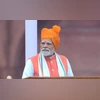 "PM Modi, Narendra Modi, Independence Day, Red Fort, Indian flag")
PM Modi announced a Rs 1 trillion Pradhan Mantri Viksit Bharat Rozgar Yojana (Photo: PIB)
Listen to This Article
Amid the United States’ steep tariffs on Indian goods, the urgent need for Indians to embrace the spirit of swadeshi, and the government’s resolve to achieve atmanirbharta (self-reliance) -- including for the country’s energy, defence and technological needs -- were the overarching theme of Prime Minister Narendra Modi’s address to the nation on the 79th Independence Day on Friday.
In his almost 110-minute speech, the PM promised a “double Diwali” bonanza for the people, saying that the government will soon announce the next generation reforms in the Goods and Services Tax (GST) regime aimed to reduce the tax burden on common people, which will make items of daily needs cheaper.
PM Modi announced a Rs 1 trillion Pradhan Mantri Viksit Bharat Rozgar Yojana.
He said the government will pay a sum of Rs 15,000 to any youth who gets their first job in the private sector. He said the government will support companies that help create new jobs. Modi said the scheme could help 35 million youths find job opportunities.
The government had earlier announced the PM Internship scheme in the 2024-25 Union Budget, under which youth get a stipend of Rs 5,000 per month for a year.
Also Read

 "cylinder blast")
 "PM Narendra Modi")
 "cloudburst")
 "PM Modi, Narendra Modi, Independence Day, Red Fort")
The PM said the government will set up a national task force to recommend next generation reforms within a specific time frame to help achieve the objective of a developed India by 2047.
Modi also announced a ‘high-powered demographic mission’, which will study demographic changes in border areas, and spoke about a “conspiracy” by ghuspathiye (infiltrators), to snatch jobs and lands of tribals, and were a threat to national security. The PM had flagged the problem of infiltration during his visit to West Bengal recently. The state goes to Assembly polls in April-May next year.
The government in its interim budget in February 2024 had announced setting up a high-powered committee to look at the challenges arising from “fast population growth and demographic changes”.
On the security front, the PM spoke of the need to build an indigenously manufactured next generation fighter jet.
Modi said that all places of national importance, defence installations as well as hospitals, railway stations and places of worship will get a security shield. He said Lord Krishna’s Sudarshan Chakra has inspired the government’s ‘Mission Sudarshan Chakra’, which will use technology to not only neutralise the enemy’s attack but “hit back” with multi-fold force.
At the Red Fort, commemorating the success of Operation Sindoor and extolling the success of India’s defence forces in destroying terror infrastructure in Pakistan was the theme of the Independence Day celebrations.
After the PM hoisted the national flag, two Mi-17 helicopters of the Indian Air Force, with one trooping the national flag and the other a flag depicting ‘Operation Sindoor’, showered petals on the gathering.
But beyond the exhortations that the country will not tolerate nuclear blackmail from Pakistan, and that “blood and water cannot flow together” in the context of the Indus Waters Treaty which India put in abeyance after the Pahalgam terror attack of April 22, PM Modi’s intent seemed to convey to the people the message that the nation needs to prepare itself for the fallout of the American tariffs on Indian goods.
With the US insisting that it should get access to India’s dairy and agricultural market, Modi said he would stand like a “wall” to protect the interest of India’s farmers, fisherfolk and those employed in the dairy industry. He said India’s agricultural exports amounted to Rs 4 trillion.
The PM urged all small and big shopkeepers that their signboards should display that they sell swadeshi goods. He said swadeshi will be a sign of India’s strength, not its weakness, and if needed, to be used to enfeeble others.
Modi bemoaned the tendency to rely on other people to fulfil one’s needs, which he said was “fraught with risks” and one should be alert to it at all times.
“It is not merely about rupees, pounds and dollars. Self-reliance is linked to one’s capabilities, and if the former weakens the latter does too,” Modi, who was attired in a saffron-coloured headgear, said, attributing the success of India’s defence forces during Operation Sindoor to India’s increasing self-reliance in defence production and the government’s ‘Make in India’ project.
The PM spoke of India’s semiconductor mission, and asserted that ‘made in India’ chips will be available by the end of the year.
With the US levying a 25 per cent penalty on India for its purchase of Russian crude oil, the PM said the country has had to remain dependent for its energy needs for petrol, diesel and gas on other countries, and spends trillions of rupees.
Modi stressed the urgency for India to become self-reliant in the sector, and elaborated upon his government’s efforts in the last 11 years to increase solar, hydro and nuclear power capacity, and deep sea oil exploration.
With the industry facing shortage of rare earth magnets, the PM said the government is now alert to the critical minerals sector, and striving to make India self-reliant in it with the launch of the National Critical Minerals Mission, with probes to find such minerals ongoing at 1200 places.
Flagging the need to create modern ecosystems in every sector to achieve the objective of atmanirbhar Bharat, the PM spoke of more research in the pharmaceutical sector, an indigenous next generation fighter jet, production of fertilisers and batteries for electric vehicles.
Modi said the government has launched the National Manufacturing Mission, and Indian entrepreneurs should look at producing goods with the goal of “daam kam, dum zyada”, that is goods that deliver more worth than their cost.
The PM urged citizens to devote themselves to the goal of achieving a samruddha Bharat (prosperous India) just as during the freedom struggle the Indians at the time had devoted themselves to attain a swatantra Bharat (independent India).
Modi asked influencers and politicians cutting across party lines to help in the spread of the ‘vocal for local mantra’, to buy products made in India.
The PM also spoke of the amendments to the Income Tax laws. He said that inflation is under control and the country’s macro-economic indicators are strong, which have been lauded by global rating agencies.
The PM said his government will mark the 200th birth anniversary of 19th Century social reformer Jyotiba Phule, and committed to prioritise the needs of those who are picchda (marginalised).
Modi spoke of the epidemic of obesity, asking people to use 10 per cent less oil in cooking. He said several languages, including Bengali, Marathi and Pali, have been granted the status of classical language, and reiterated that cultural diversity was India’s strength.
The PM also referred to the centenary of the Rashtriya Swayamsevak Sangh, which he said is a one of its kind non-governmental organisation, and the country takes pride in the hundred-year journey of the Sangh.
Modi also said that the Constitution was “strangled” 50 years back during the Emergency.
He also condoled the loss of lives in recent natural calamities, including flash floods in Uttarakhand.
More From This Section

 "trade deficit")
 "Donald Trump Vladimir Putin")
 "bond, bonds, bond market")
 "credit rating")
Don't miss the most important news and views of the day. Get them on our Telegram channel
First Published: Aug 15 2025 | 11:52 AM IST