


'The Archies' movie review: Vapid nostalgia that misses political nuances
Set in the mid-1960s, the Zoya Akhtar film signals virtues through reference to corporate greed, gender politics, and global warming, but delivers solutions that are too easy
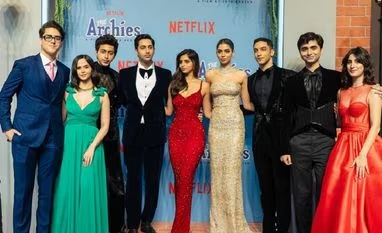 "Archies")
Image: Netflix India's X account
About an hour into The Archies, a Hindi/English adaptation of the popular comic series directed by Zoya Akhtar, the students at Riverdale High School learn that their school canteen will not be run anymore by the popular local cafe. Instead, they will be served pre-packaged lunches. Most of them express dissatisfaction over this because Pop Tates (Nikhil Kapoor), who runs the café, knows their preferences — who wants extra cheese, who likes a cherry on their chocolate milkshake — and adds that personal touch, which a faceless corporate vendor will not do.
The teacher encourages the students to discuss why this is happening, and one of them, Reggie (Vedang Raina) says all so-called development takes place to boost corporate profits. When another student, Archie (Agastya Nanda), the titular character of the film, says he does not care about politics because it has nothing to do with his life, his friends and classmates break out into a wonderfully coordinated song-and-dance number: “Everything is politics.”
It is somewhat cute to see beneficiaries of generational wealth and nepotism singing and dancing about politics. The film’s cast comprises the who’s who of Bollywood star kids. Nanda is the grandson of Amitabh Bachchan and Jaya Bachchan, nephew of Abhishek Bachchan and Aishwarya Rai Bachchan; his two love interests, Veronica and Betty, are played by Suhana Khan, the daughter of Shah Rukh Khan, and Khushi Kapoor, the daughter of Bonny Kapoor and Sridevi, respectively.
Zoya Akhtar, the writer and director of this film, is the daughter of Javed Akhtar, one of India’s most successful scriptwriter and lyricist. Akhtar has, in some of her previous films like Dil Dhadakne Do (2018) and Gully Boy (2019), examined the contours of class and gender politics. But the solutions her narratives suggest — and it is not essential for narratives to do so — ignore the structural inequities that cause them in the first place. Her resolutions are always firmly in the personal realm, not the social one. The Archies is no different.
Set in 1964, the film tells the stories of a group of friends in the fictional north-Indian town of Riverdale, populated mostly by Anglo-Indians. All of them are in their final year of high school and were born 17 years ago, in 1947. Even as they negotiate the challenges of growing up and falling in love, they are presented with a bigger challenge: a rich businessman, Hiram Lodge (Alyy Khan), who is also Veronica’s father, plans to destroy a sprawling park in the centre of the town and build a grand hotel in its place. When he faces the slightest resistance to his plans — a critical newspaper article, upright corporators — he throws money at it. But, Veronica, and her friends — Archie, Betty, Reggie, Jughead (Mihir Ahuja), Ethel (Aditi ‘Dot’ Saigal), Dilton (Yuvraj Menda) and others — start an advocacy campaign to stop the construction plans. The narrative weaves in issues that would be relevant to its contemporary audience — corporate greed, freedom of the press, queer rights and gender politics, nature activism. The New York Times review describes it as “inessential Bollywood-tinged fantasia”, “two hours of soda shops, chaste dates, candy-colored petticoats and athletic musical numbers”.
Also Read

This is, of course, not the first time that the teenage love of the Archie comics have inspired Hindi films. Film scholar Priya Joshi in her book Bollywood’s India: A Public Fantasy (2015) writes how the popular comic books inspired Raj Kapoor’s Bobby (1973). The film depicted a teenage romance between the superrich Raja (Rishi Kapoor) and Bobby (Dimple Kapadia); the lovers also hailed from two different communities — while Raja is upper-caste Hindu, Bobby is a Goan Christian. Joshi writes that Bobby uses the structure of a romantic comedy to create “a space where the violent ever after can be enacted safely, in play… The point is to indicate a threat, not eradicate it.”
Karan Johar, in his autobiography An Unsuitable Boy (2016), writes about how he was also a great fan of the Archie comics and how they inspired his debut feature film Kuch Kuch Hota Hai (1998). Starring Kajol, Shah Rukh Khan, and Rani Mukherjee in the central Betty-Archie-Veronica love triangle, the film has received considerable flak over the years for its problematic gender politics, with even Johar criticising it recently.
The Archies is conscious of this — Veronica and Betty are no pushovers; they chose each other and their friendship over Archie when they find out that he has been two-timing them. But strangely enough, they continue to remain friends with him, despite realising how he has been gaslighting them. What does this tell us about the gender politics of Akhtar’s film?
Archie’s greediness in romance is reflected in Hiram Lodge’s greediness, which threatens to destroy the natural assets of Riverdale. However, when the town’s people vote against his construction project, he decides, in his own words, “to go with the flow”. It is indeed a strange change of heart for an unethical corporate leader, completely in contradiction to the violence that is often unleashed on those laying impediments in the path of profit. Even the current climate change activism bears witness to this. Of course, a nostalgia-tinged fairy-tale such as The Archies can allow for such a happily-ever-after.
However, nostalgia is perhaps the most problematic aspect of The Archies. The film is full of references to what was hot in the 1960s — Shammi Kapoor, The Beatles, Freddie Mercury, Mohammed Rafi. The characters drive around in Ambassador cars and listen to vinyl records; they curl their hair and wear miniskirts. But there is no reference to the social and political issues that were roiling India, such as the after-effects of the war with China, the stalled economic growth and rising unemployment, the often violent language movements, and the far-left Naxalbari movement. So, one is left wondering, what purpose does this nostalgia serve?
In recent years, political scientists and historians have pointed out how nostalgia has become a powerful political tool, especially for populist rulers around the world. Turkish political scientist Ezgi Elci writes how nostalgia about a real or imagined past informs the discourse of leaders such as former US president Donald Trump, the Brexit Party, as well as Turkish president Recep Tayyip Erdogan’s constant evocation of the Ottoman Empire. Others have pointed out how Russia’s invasion of Ukraine is a result of Vladimir Putin’s Soviet nostalgia, a “desire to return to the past”. “Nostalgia is both a neglected and an underestimated feature of political discourse,” write Swedish sociologists Gabriella Elgenius and Jens Rydgren, but “a key ingredient of the ethnic nationalism and populism that defines the rhetoric of the radical right.”
At such a time, to make a film that uncritically packages nostalgia in polka dots and puts a virtue-signalling ribbon on top of it, is also corporate greed that appropriates very important discourses on gender, class, and global warming. Yes, Archie, everything is politics. But it matters who is talking about it.
Uttaran Das Gupta is a New Delhi-based writer and journalist. He teaches journalism at O P Jindal Global University, Sonipat
These are the personal opinions of the writer. They do not necessarily reflect the views of www.business-standard.com or the ’Business Standard’ newspaper
More From This Section
Topics : Zoya Akhtar TV series media and entertainment Politics Amitabh Bachchan Shah Rukh Khan Karan Johar Russia
Don't miss the most important news and views of the day. Get them on our Telegram channel
First Published: Dec 08 2023 | 2:58 PM IST