


Modi, Putin to meet in Tianjin amid US pressure on India's Russian oil buys
Amid US tariffs over Russian oil imports, Prime Minister Modi will meet President Putin in Tianjin after the SCO summit, with energy and trade balance key issues on the agenda
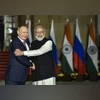 "Modi, Narendra Modi, Vladimir Putin, putin")
This will be Modi and Putin’s first in-person meeting after Trump became US President for a second time | Photo: PTI
Listen to This Article
At a time when India is facing relentless pressure from the White House to cut down its purchase of Russian crude oil, Prime Minister Narendra Modi will meet Russian President Vladimir Putin on Monday afternoon in the northern Chinese city of Tianjin.
The two leaders will meet after the Shanghai Cooperation Organisation (SCO) leaders’ meeting concludes, people in the know said. Putin landed in Tianjin on Sunday morning to attend the SCO summit, while Modi reached the city on Saturday evening, and held bilateral talks with Chinese President Xi Jinping on Sunday afternoon.
This will be Modi and Putin’s first in-person meeting after Trump became US President for a second time. The two had last met on the margins of the Brics Summit in Kazan, Russia, in October 2024.
New Delhi, while opting not to retaliate yet to the American tariffs, has in recent weeks sought to reinforce its friendship with Moscow, and recalibrate its ties with Beijing rather than surrender to Washington’s diktats.
Modi and Putin could take up some of the issues that their foreign ministers, Subrahmanyam Jaishankar and Sergey Lavrov, respectively, discussed in Moscow on August 22. They discussed India-Russia sustaining their energy cooperation through trade and investments, joint extraction of energy resources, including in the Russian Federation - in the Far East and on the Arctic shelf and the balance of the bilateral trade, which is currently in Russia’s favour.
Also Read

 "Narendra Modi, Xi Jinping")
 "PM Modi, Xi Jinping")
 "Prime Minister Narendra Modi and his Japanese counterpart Shigeru Ishiba travelled in the bullet train. | Photo: Reuters")
 "us tariffs")
 "Narendra Modi, Shigeru Ishiba (Photo: Reuters)")
India has sought to enhance its exports to Russia in sectors like pharmaceuticals, agriculture, and textiles as a means to correct the trade imbalance. New Delhi had also urged Moscow to “swiftly” address non-tariff barriers and regulatory impediments to facilitate more exports from India. Russia is India’s fourth-largest trading partner, while India is Russia’s second-largest.
Modi and Putin have spoken twice, on August 8 and 18, over the phone ever since Trump signed the executive order on August 7 to impose a 25 per cent penalty on Indian goods, which kicked in on August 27, for buying Russian oil. Jaishankar was in Moscow on August 22, while National Security Adviser Ajit Kumar Doval visited the Russian capital in the first week of August as South Block and Kremlin have stepped up their engagement with each other.
According to officials, New Delhi and Moscow have finalised Putin’s visit to India, likely to be in December, for the India-Russia Annual Summit. In contrast, the likelihood of the PM visiting New York to attend the UN General Assembly in the last week of September, where he could have potentially also visited Washington to meet Trump, looks bleak.
There is also a shadow over India hosting the Quad Summit in November. While at their meeting on Friday in Tokyo, Modi did formally invite Japanese PM Shigeru Ishiba to India, there is a question mark over the efficacy of the grouping that also comprises Australia and the US. In a report titled ‘The Nobel Prize and a Testy Phone Call: How the Trump-Modi Relationship Unravelled’, the New York Times on Saturday claimed that the US President no longer has plans to visit New Delhi in the fall for the Quad Summit.
With Modi and Putin slated to meet on Monday, Ukrainian President Volodymyr Zelenskyy dialled the Indian PM on Saturday. In a social media post on X, Zelenskyy said India is ready to make the necessary efforts and to deliver the appropriate signal to Russia. “We exchanged views on the ongoing conflict, its humanitarian aspect, and efforts to restore peace and stability. India extends full support to all efforts in this direction,” Modi said.
In another recent development, in a telephonic conversation with his Finnish counterpart Elina Valtonen on Saturday, External Affairs Minister Jaishankar said India should not be “unfairly targeted” in the context of the Ukraine conflict.
During his Moscow visit, Jaishankar had said that India is “perplexed” at Washington’s logic with China being the biggest purchaser of Russian oil, and not India, and the European Union is the biggest purchaser of Russian LNG, and not India. Jaishankar had described India-Russia ties as “among the steadiest of the major relationships in the world after the Second World War”. “Geo-political convergence, leadership contacts and popular sentiment remain its key drivers,” Jaishankar added.
On August 18, Modi posted on social media that he had received a phone call from his “friend” Putin, who shared insights with him on meeting with US President Donald Trump in Alaska. Modi and Putin spoke on August 8, a day after Trump signed the executive order imposing an additional penalty on India, where they “reaffirmed their commitment to further deepen” the India-Russia strategic partnership.
The PM will leave for Delhi after his meeting with Putin, while the Russian President is slated to attend an event related to the 80th anniversary of the end of the Second World War in Asia, which is to be held in Beijing on September 3.
More From This Section
 "India china")
 "Xi Jinping, Narendra Modi, India-China")
 "S Jaishankar, Jaishankar")
 "Modi, Narendra Modi")
 "Rajnath Singh, Defence Minister")
Don't miss the most important news and views of the day. Get them on our Telegram channel
First Published: Aug 31 2025 | 5:20 PM IST