


Pahalgam attack: Navy gets 'combat-ready' as firing across LoC continues
In 'Mann ki Baat' broadcast, Modi vows "harshest" response to perpetrators and conspirators
 "Indian Navy")
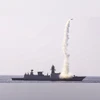
The Navy has conducted two major drills since the Pahalgam attack on April 22, 2025 | Photo: Indian Navy
Listen to This Article
Soldiers in India and Pakistan exchanged fire across the Line of Control over the weekend and the Indian Navy said on Sunday that its warships testfired missiles in the Arabian Sea to “revalidate and demonstrate” its “readiness” for long-range precision “offensive” strikes.
The actions by the defence forces of the two neighbours contributed to the increasing tension in the subcontinent, anticipating an Indian “kinetic response” to the Pahalgam terror attack, in which 26 people were killed, and New Delhi had pointed to “cross-border linkages” of the attack.
On Sunday, in his “Mann ki Baat” radio broadcast, Prime Minister Narendra Modi said terrorists and their backers had carried out the Pahalgam attack to destroy Kashmir again because they did not like the return of peace and prosperity.
He vowed the “harshest” response to the “perpetrators and conspirators”, while the National Investigation Agency (NIA), India’s the pre-eminent anti-terror agency, formally took over the probe into the attack by registering a first information report in Jammu, following orders from the Ministry of Home Affairs (MHA).
Several teams have been deployed to investigate the terror attack. Authorities razed the houses of three more people in Kashmir who they suspected of having terror links.
Also Read

 "Army, Soilder, Kathua")
 "India-Afghanistan flag, India Afghanistan flag")
 "Former diplomat Ajay Bisaria — India's last High Commissioner to Pakistan and subsequently envoy to Canada")
 "Protest, Pahalgam Protest")
 "India-Pakistan")
Sunday was also the last day for most Pakistani nationals who were in India on short-term visas to exit the country. At the Attari-Wagah India-Pakistan border in Punjab, Pakistani nationals continued to queue up to return to their country as the exit deadline for the dozen categories of short-term visa holders ended. As many as 537 Pakistani nationals, including nine diplomats and officials, left India in four days from the border point since April 24 after the government announced the visa revocation the previous day, officials said.
A total of 850 Indians, including 14 diplomats and officials, have returned from Pakistan through the crossing in Punjab in the past four days.
The deadline for exiting India for those holding the Saarc visa was April 26. For those carrying medical visas, the deadline is April 29. According to the Immigration and Foreigners Act, 2025, which came into effect on April 4, overstaying, violating visa conditions, or trespassing in restricted areas could lead to three years in jail and a fine of up to ₹3 lakh.
On Sunday morning, the Indian Navy said in a brief statement its ships undertook successful multiple anti-ship firing to “revalidate and demonstrate readiness of platforms, systems and crew for long range precision offensive strike”. “Indian Navy stands combat ready, credible and future ready in safeguarding the nation’s maritime interests anytime, anywhere, anyhow,” it said.
The navy released videos of live firing at sea but did not provide details such as when the exercise was carried out.
The military in Pakistan fired in areas opposite the Tutmari Gali and Rampur sectors Saturday night, military sources said.
“Our troops responded effectively with appropriate small-arms fire,” an Indian Army statement said.
Against the backdrop of the escalating tensions, the Indian Navy’s guided missile destroyer INS Surat fired a medium-range surface-to-air missile against a “sea skimming” target in the Western Indian Ocean last week. While India is still weighing options on retaliation, defence analysts said India would pick a time and the means to do so, but a long-term plan is urgently needed for “dealing with Pakistan”.
Retired lieutenant general K J S Dhillon, who was chief officer of the Indian Army’s northern and central commands, said India had retaliated diplomatically, which had put Pakistan in “a tight spot by exposing its actions to the world” but “the ‘second retaliation’ (from India) should and would be heavy and crushing”.
Dhillon said firing at the border showed how Pakistan continued to violate the ceasefire agreement.
The Indian government is under public pressure to deliver a decisive military response, greater than the two tactical strikes it carried out against Pakistan after the terrorist attacks in northern India in 2016, another retired Indian Army commanding officer, adding that the immediate window is closing.
“This was a red line for India that Pakistan has crossed,” he said of the Pahalgam attack. “The decision should have been taken on ‘incident day’. Even so, a cold start, if that’s the plan, is fine, keeping in mind India’s strategic considerations.”
He said precise military strikes and covert and overt intelligence operations were among the many options India has.
“‘Strategic restraint’ was a viable policy,” he said, referring to what seemed like the previous government’s approach to Pakistan in the aftermath of the 2008 Mumbai terrorist attacks.
“You can change certain things around it. You have had years to upgrade plans.”
India should “force compliance” on Pakistan, with hard military measures in the short term, he said, but in the meanwhile India’s armed forces should be prepared for the long haul.
Pakistan has denied involvement in the Pahalgam attack. India also has a large presence of troops along its China border although that complex bilateral relationship has lately improved.
In his “Mann Ki Baat” broadcast, the PM said there was vibrancy in Kashmir’s schools and colleges, construction had gained unprecedented pace, democracy was getting stronger, the number of tourists was increasing at a record rate, people’s income was increasing, and new opportunities were being created for the youth.
Modi said, “Enemies of the country, the enemies of Jammu and Kashmir did not like that. Terrorists and the masterminds of terror want Kashmir to be destroyed again and hence they executed such a big conspiracy.” “In this war against terrorism, the unity of the nation, the solidarity of 140 crore Indians, is our greatest strength. This very unity is the foundation of our decisive battle against terrorism,” he said.
“I can feel that the blood of every Indian is on the boil after seeing the pictures of the terrorist attack.” The Prime Minister said the attack had drawn condemnation from the whole world, noting that international leaders have called him up, written letters and sent messages.
In J&K, authorities demolished the houses of three more alleged active terrorists — in Bandipora, Pulwama and Shopian districts. With this, nine houses of suspected terrorists and overground workers of terror outfits have been razed so far since the April 22 attack in Baisaran. Security forces have raided more than 500 locations in the Valley in just five days and grilled hundreds of suspects. However, political parties in J-K urged the Centre to ensure that innocent people are not targeted while it goes after terrorists.
In a related development, External Affairs Minister S Jaishankar on Sunday had a talk on the phone with his British counterpart David Lammy.
More From This Section
 "Gaza airstrike, strike")
 "Marco Rubio")
 "moscow")
 "Russia Ukraine flag, Russia-Ukraine flag")
 "Indian Navy")
Topics : Indian Navy Narendra Modi Pahalgam attack India Pakistan relations Indian Army Pakistan army
Don't miss the most important news and views of the day. Get them on our Telegram channel
First Published: Apr 27 2025 | 10:56 PM IST