


Drones, hypersonic missile, long-range strike in Republic Day spotlight
'Battle array' format was showcased for the first time during the 77th Republic day parade, illustrating how personnel and equipment are deployed together during an actual conflict
 "Republic Day")
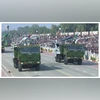
For the first time, the parade at Kartavya Path in the national capital presented elements of the armed forces in a “battle array | Image: X@ani_digital
Listen to This Article
India’s 77th Republic Day military parade at Kartavya Path in the national capital on Monday showcased the growing adoption of autonomous technologies, along with a focus on long-range precision strike and hypersonic capability, together reflecting the armed forces’ efforts to keep pace with the evolving nature of conflict and military technology.
In what was arguably the parade’s most significant highlight—and a reflection of the Indian Navy’s growing strike capabilities—the Defence Research and Development Organisation showcased the country’s first hypersonic weapon, the Long Range Anti-Ship Hypersonic Missile, along with its launch system. The weapon’s first successful flight test in November 2024 placed India among a select group of nations, including China, Russia and the United States, to have achieved hypersonic missile capability.
The Indian Air Force also showcased the country’s air power with a flypast involving 29 aircraft, including 16 fighter jets, nine helicopters and four transport aircraft. Notably, a spearhead formation comprising two French-origin Rafale fighter jets, two each of Russian-origin Sukhoi Su-30MKI and MiG-29 aircraft, and one Jaguar jet flew with the call sign “Sindoor”. This referenced India’s May 2025 response to the Pahalgam terrorist attack, codenamed Operation Sindoor, which lasted from May 7 to May 10 and led to the most intense clashes with Pakistan since the Kargil war in 1999.
For the first time, the parade presented elements of the armed forces in a “battle array”, illustrating how personnel and equipment are deployed together during conflict. Alongside the traditional marching contingents, the army personnel also took part in full combat gear. The army’s ‘Bhairav’ light commandos—part of the newly raised frontline formations, including commando battalions—also made their debut at the parade.
From heavy main battle tanks—ranging from the indigenous Arjun to the Russian-origin T-90—to infantry vehicles, smaller light strike vehicles and all-terrain vehicles, light unmanned aerial vehicles were seen integrated across platforms for intelligence, surveillance and reconnaissance (ISR). This is aimed at enhancing battlefield awareness and keeping pace with the compressed kill chain—the process of identifying, targeting, engaging and destroying a threat.
Also Read

 "Republic Day rehearsal, Republic Day")
 "EU chief Ursula von der Leyen")
 "EU leaders with PM Modi.")
 "Screengrab from the press conference by Foreign Secretary, Vikram Misri on May 7, 2025 (Photo: PIB)")
 "Donald Trump, Trump")
The army’s expanded ISR and loitering munitions arsenal was also featured through the newly constituted Shaktibaan and Divyastra systems, mounted on specialised high-mobility vehicles. Together, they demonstrated the capability to conduct surveillance using swarm and tethered drone systems, as well as the ability to direct precision artillery fire through an indigenously developed hybrid UAV. This capability is further reinforced by a wide spectrum of foreign-origin and indigenous aerial loitering munitions, which were on display at the parade and have, in some cases, been successfully employed against Pakistan’s air defence systems during Operation Sindoor. These systems also include long-range drones with ranges exceeding 1,000 kilometres for see-and-strike missions.
Another highlight was the Drone Shakti system, which enables the fabrication and maintenance of drones in forward areas.
India’s offensive long-range surface-to-surface arsenal was also on display. The Suryastra—the country’s first multi-calibre rocket launcher system capable of firing two different rocket types with ranges of 150 and 300 kilometres from a common launcher—underscored the growing emphasis on rocket artillery, a trend highlighted by the conflict in Ukraine.
The Indo-Russian BrahMos supersonic cruise missile—which made its successful combat debut during Operation Sindoor—was also on display.
Recently, Chief of the Army Staff General Upendra Dwivedi underscored that the creation of a dedicated rocket and missile force was the need of the hour, pointing to Pakistan’s recent establishment of such a force and China’s existing capabilities.
The parade also showcased the jointness achieved between the army, navy and air force, including through a tableau featuring a glass-cased “Integrated Operational Centre”, depicting the conduct of Operation Sindoor.
President Droupadi Murmu presided over the celebrations at Kartavya Path in the national capital, with António Costa, President of the European Council, and Ursula von der Leyen, President of the European Commission, attending as the chief guests.
More From This Section
 "External Affairs Minister S Jaishankar speaks during the High-Level Meeting of Like Minded Global South Countries on the sidelines of the United Nations General Assembly session, in New York, USA. (@DrSJaishankar/X)")
 "S Jaishankar, Jaishankar")
 "terrorists encounter, J & K terrorist encounter")
 "Sikh separatist leader Gurpatwant Singh Pannun")
 "Fishermen, Indian fishermen")
Topics : Republic Day Operation Sindoor defence sector
Don't miss the most important news and views of the day. Get them on our Telegram channel
First Published: Jan 26 2026 | 1:34 PM IST