


PM Narendra Modi, Donald Trump stress 'open and secure' Strait of Hormuz
PM speaks with US President, Jaishankar meets Iran envoy as Centre forms seven groups to manage risks to energy, trade and supply chains amid escalating West Asia conflict
 "Modi Trump")
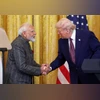
In a telephonic conversation with US President Donald Trump, Prime Minister Narendra Modi said they agreed to stay in touch regarding efforts towards peace and stability. (File photo: Reuters)
Listen to This Article
India on Tuesday continued its efforts to reach out to all sides involved in the West Asian conflict.
Prime Minister Narendra Modi received a phone call from US President Donald Trump. The two leaders stressed that the Strait of Hormuz “remains open, secure and accessible”. Modi said India supports de-escalation and the restoration of peace at the earliest.
In the national capital, External Affairs Minister S Jaishankar met Iran’s Ambassador to India Mohammad Fathali.
In a statement in the Rajya Sabha, the PM termed the situation arising from the severe global energy crisis due to the West Asia war “worrisome” for India. He said it was a matter of “serious concern” for the country that many ships were stranded in the Strait of Hormuz. “Serious consequences are inevitable” if the global circumstances created by this war persist for a long time, Modi said, adding “becoming increasingly self-reliant is the only option”.
The PM said the government had constituted seven empowered groups to deal with the potential long-term impact of the West Asia war across sectors, and urged states to work with the Centre in a “Team India” approach to address the crisis, just as they had done during the Covid-19 pandemic in 2020-21.
Also Read

 "aviation, aeroplane, flights, airport")
 "Sujata Sharma")
 "Ravi Viswanathan, Managing Director, TVS Supply Chain Solutions")
 "volatility index, stock market volatility, India VIX, stock market today, why are nifty, sensex down today, stock market, stock market news")
 "CII MSME, West Asia crisis, gas shortage India, MSME logistics, working capital stress")
The seven empowered groups comprise top bureaucrats, including senior officials from the Prime Minister’s Office and the Cabinet Secretariat.
Recalling that empowered groups of experts had helped address challenges during Covid-19, Modi said these seven groups would deal with the consequences of the war and evolve strategies on fuel, fertilisers, gas, supply chains and inflation.
In recent days, ships carrying crude oil and LPG from many countries have arrived in India. The PM said that an inter-ministerial group had also been formed; it would meet regularly to assess every difficulty in imports and exports and continuously work on necessary solutions.
Modi stress the situation was changing “moment by moment”. “I would also say to my fellow citizens that we must be prepared for every challenge. There is a strong possibility that the adverse effects of this war will last for a long time,” he said.
He appealed to state governments to ensure the benefits of the PM Garib Kalyan Anna Yojana reached the poor, workers and migrant communities on time. Stating proactive steps should be taken to ease the difficulties of migrant workers wherever they were employed, the PM asked state governments to make special arrangements to monitor such situations.
The government has also convened an all-party meeting on Thursday evening to share its assessment of the West Asia situation, its ramifications, and the country’s preparedness.
With two Indian LPG vessels, Pine Gas and Jag Vasant, crossing the Strait of Hormuz on Monday evening, 20 Indian-flagged vessels with around 540 Indian seafarers still remain in the western Persian Gulf region.
The telephonic conversation, initiated by the US President, came a day after he extended Washington’s deadline by five days for Iran to reopen the Strait of Hormuz. US envoy to India Sergio Gor said on social media that the two leaders “discussed the ongoing situation in West Asia, including the importance of keeping the Strait of Hormuz open”.
On Monday, Jaishankar and US Secretary of State Marco Rubio discussed the conflict’s impact on the international economy and energy security. The minister also met ambassadors of Gulf Cooperation Council countries, and spoke to his Sri Lankan counterpart. Sri Lanka has sought India’s help with its energy supplies.
Later in the evening, Modi spoke with Sri Lankan President Anura Kumara Dissanayake and discussed the evolving situation in West Asia, with particular focus on disruptions to global energy security.
“As close and trusted partners, we reaffirmed our commitment to work closely together in addressing shared challenges,” the PM posted on X.
The seven empowered groups will monitor domains ranging from strategic issues like defence, external affairs and public order to economy, finance and supply chain, including exports and imports. They will also monitor energy security, including oil, LPG and LNG.
The groups will also monitor the availability of fertilisers and other agricultural inputs; prices and supply of essential commodities; transport and logistics related to civil aviation, shipping and railways; and information, communication and public engagement.
They will facilitate a well-planned and coordinated response required to mitigate the adverse impact of the situation and improve the resilience of the domestic economy, an official aware of the development said, stressing that these groups would identify issues and take immediate necessary steps to tackle them.
The broad terms of reference of the cross-functional empowered groups include assessing risks to energy supplies and pricing, and measures to mitigate supply disruptions, manage price volatility, and ensure that the country’s strategic reserves are adequate.
The groups have also been told to examine potential disruptions to trade, supply chains and logistics, including shipping routes, ports, aviation corridors and critical imports and exports. Apart from identifying alternative import sources to reduce dependence and improve resilience, the groups are required to ensure stable logistics and efficient distribution systems.
Monitoring domestic availability and price stability of essential commodities, and developing short-, medium- and long-term strategies to mitigate adverse effects of any disruptions, are part of the groups’ to-do list.
They have also been authorised to invite any official not enlisted, as well as experts from various fields, for consultations on the issues they are dealing with. Sources said the panels had been directed to submit their recommendations and suggestions in a time-bound manner.
The PM chaired a meeting of the Cabinet Committee on Security on Sunday evening and delivered a statement on the situation in West Asia in the Lok Sabha on Monday. In his statement in the Rajya Sabha on Tuesday, the PM said he had spoken twice since the beginning of the war with the heads of most countries in West Asia, including Gulf nations, and that the government was also in touch with Iran, Israel and the US.
More From This Section
 "External Affairs Minister S Jaishankar during his virtual address at a conference titled “India and Russia: Towards a new bilateral agenda”")
 "Renewable energy, climate")
 "PM Modi")
 "Rajnath Singh, Defence Minister")
 "Taragiri")
Don't miss the most important news and views of the day. Get them on our Telegram channel
First Published: Mar 24 2026 | 9:10 PM IST