


Asian stocks edge higher ahead of US inflation data, Trump-Putin meeting
While Japan's stock market was closed for a holiday, futures climbed to 42,465 and suggested the index will test its all-time high of 42,426 this week
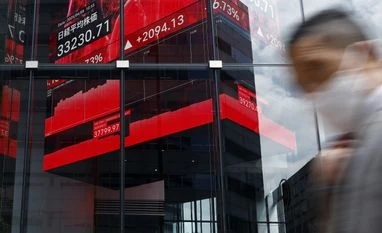 "Asian stocks, Asian stock market")
Currencies were quiet with markets thinned by Japan's absence, with the dollar index a fraction lower at 98.104 after slipping 0.4 per cent last week | Image: Bloomberg


Listen to This Article
Major share indexes crept higher in Asia on Monday as upbeat company earnings underpinned high valuations in the tech sector, while a crucial report on US inflation would likely set the course of the dollar and bonds.
While Japan's stock market was closed for a holiday, futures climbed to 42,465 and suggested the index will test its all-time high of 42,426 this week.
Trade and geopolitics loom large with a US tariff deadline on China due to expire on Tuesday amid expectations it will get extended again, while President Donald Trump and Russian leader Vladimir Putin are due to meet in Alaska on Friday to discuss Ukraine.
The main economic release will be US consumer prices on Tuesday, with analysts expecting the impact of tariffs to help nudge the core up 0.3 per cent to an annual pace of 3.0 per cent and away from the Federal Reserve target of 2 per cent.
An upside surprise would challenge market wagers for a September rate cut, though analysts assume it would have to be a very high number given a downward turn in payrolls is now dominating the outlook.

 "Asian market, Asian stocks")
 "Asian stcks, asian shares, share market")
 "Stock markets, Indian markets")
"The tone from the Fed has shifted as a number of officials expressed concerns about growth following the July employment report," said Bruce Kasman, chief economist at JPMorgan.
"We now expect the Fed to restart its easing cycle in September," he added. "Recession risks are elevated at 40 per cent, but we do not yet see a case for a larger than 25bp series of cuts."
Markets imply around a 90 per cent probability of a September easing, and at least one more cut by year end.
Trump's pick for Fed governor, Stephen Miran, may or may not be in place in time to vote for a cut in September, while the choice of a new chair has broadened out to around 10 contenders.
The prospect of lower borrowing costs has supported equities, along with a run of strong earnings.
Analysts at BofA note 73 per cent of companies had beaten on earnings, well above the 59 per cent long run average, while 78 per cent beat on revenue.
"While mentions of 'weak demand' ticked up and tariff concerns remain, corporate sentiment and guidance are improving," they said in a note.
S&P 500 futures and Nasdaq futures both edged up 0.2 per cent on Monday to near record highs.
Analysts were unsure what to make of a report in the Financial Times that tech majors Nvidia and AMD have agreed to give the US government 15 per cent of their revenues from chip sales in China, under an arrangement to obtain export licenses for the semiconductors.
EUROSTOXX 50 futures added 0.2 per cent, while FTSE futures rose 0.1 per cent and DAX futures firmed 0.3 per cent.
China exports deflation
MSCI's broadest index of Asia-Pacific shares outside Japan gained 0.1 per cent, while South Korea was flat having bounced 2.9 per cent last week.
Chinese blue chips added 0.3 per cent after data showed consumer price inflation ticked up in July, but producer prices kept falling as the country's massive manufacturing sector exported deflation to the rest of the world.
Figures on industrial output and retail sales for July are due on Friday, and forecasts are for a slight slowdown after a jump the previous month.
Currencies were quiet with markets thinned by Japan's absence, with the dollar index a fraction lower at 98.104 after slipping 0.4 per cent last week.
The euro added 0.2 per cent to $1.1666 and further away from a recent trough of $1.1392, while the dollar dipped to 147.53 yen having met resistance around 147.90.
The Australian dollar eased to $0.6520 ahead of a meeting of the Reserve Bank of Australia which is widely expected to sanction a rate cut, having stunned markets in July by skipping an easing to await more inflation data.
The figures turned out benign, so investors have again fully priced a quarter-point cut to 3.60 per cent.
In commodity markets, gold fell 0.6 per cent to $3,378 an ounce after wild swings last week on reports the US would slap 39 per cent tariffs on some gold bars, which are major exports of Switzerland. [GOL/]
Gold futures pared gains on Friday when the White House said it planned to issue an executive order clarifying the country's stance on gold bar tariffs.
Oil prices slipped amid risks the talks between Trump and Putin could make progress to a ceasefire in Ukraine and possibly an eventual easing of sanctions on Russian oil exports. [O/R]
Brent dropped 0.5 per cent to $66.24 a barrel, while US crude eased 0.6 per cent to $63.48 per barrel.
(Only the headline and picture of this report may have been reworked by the Business Standard staff; the rest of the content is auto-generated from a syndicated feed.)
More From This Section
 "SBI, State Bank Of India")
 "bombay stock exchange, BSE")
 "voltas")
 "Siemens")
 "Rupee, Indian Rupee")
Don't miss the most important news and views of the day. Get them on our Telegram channel
First Published: Aug 11 2025 | 9:59 AM IST