


India moves closer to being Maoist-free, Amit Shah lists govt's steps
35 'most-affected' districts in 2014 down to zero; only 2 remain: Shah
 "Home Minister Amit Shah")
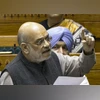
Shah blamed the Congress for failing to uproot Maoism during its tenures in the government at the Centre and in the Naxalism-affected states, such as Chhattisgarh | (Photo: Sansad TV)
Listen to This Article
In the Lok Sabha (LS) on Monday, Union Home Minister Amit Shah listed the development initiatives the Narendra Modi-led government has undertaken over nearly 12 years in districts affected by left-wing extremism (LWE). He said these achievements were possible due to the government’s tough approach in tackling Naxalism, and questioned the record of Congress-led governments, alleging that the party has “Naxal sympathisers” within its ranks.
On August 24, 2024, Shah announced that Naxalism would be eradicated in India by March 31, 2026. Speaking in the LS during the debate on ‘Efforts to free the country from LWE’, the home minister said that of the 126 LWE-affected districts in 2014, only two remain affected today. He observed that there are no “most-affected LWE districts”, compared with 35 in 2014.
Shah stated that the government has constructed 12,000 kilometres (km) of the 17,579 km road network in LWE-affected districts at a cost of ₹20,000 crore. He added that 6,025 post offices, 1,804 bank branches, and 1,321 ATMs have been opened in these districts, and banks have appointed 37,850 banking correspondents.
“All of this has been accomplished in nearly 12 years,” Shah said, while outlining plans to construct hospitals and panchayat offices in these districts. He asserted that the National Democratic Alliance government, unlike previous Congress-led governments, has been relentless in neutralising those who take up arms against the State.
Shah blamed the Congress for failing to uproot Maoism during its tenures at the Centre and in Naxal-affected states such as Chhattisgarh. He said 12 states had turned into the Red Corridor, with no rule of law; 120 million people lived in poverty for years; and 20,000 people, including 5,000 security personnel, were killed due to Naxal violence.
Also Read

 "Amit Shah, Home Minister")
 "Guwahati: Union Home Minister Amit Shah addresses the gathring during inauguration of Pragjyotishpur Medical College and Hospital, in Guwahati, Sunday, March 15, 2026. (PTI Photo)")
 "Amit Shah, Home Minister")
 "Lok Sabha, LS")
 "Parliament, New Parliament, Lok sabha, Rajya sabha")
He recalled that Prime Minister Manmohan Singh had acknowledged that Naxalism posed a greater challenge than issues in Kashmir or the Northeast, yet “Congress did nothing about it”.
Shah alleged that the National Advisory Council, established during the United Progressive Alliance (UPA) government, included “urban Naxals” among its members. He said development in Bastar had stalled because of the shadow of red terror. “Now this shadow is lifting, and Bastar is developing,” he said, adding that the Centre and state government are building schools and opening ration shops in every village there.
Shah credited the Central Armed Police Forces, especially the Commando Battalion for Resolute Action (CoBRA) and the Central Reserve Police Force, along with Chhattisgarh Police, District Reserve Guard personnel, and tribal citizens, for their role in ending Maoist violence.
Congress MP Saptagiri Ulaka countered that the UPA government had launched Operation Green Hunt and created CoBRA to address the Naxal threat. He said that the Congress lost much of its leadership in Chhattisgarh to Naxalism and that the UPA had balanced welfare and security, arguing that bullets alone cannot stop Naxalism.
Trinamool Congress MP Mahua Moitra questioned why the House was discussing Naxalism when a far more serious crisis in West Asia was directly affecting the country.
The Union government recently reviewed the National Policy and Action Plan to address LWE across 38 districts in nine states, including Jharkhand, Bihar, Andhra Pradesh, Chhattisgarh, Madhya Pradesh, Maharashtra, Odisha, Telangana, and West Bengal.
More From This Section
 "Nitish Kumar")
 "Assam Assembly")
 "People waiting in line with empty LPG cylinders amid the ongoing supply crisis in Guwahati")
 "Rahul Gandhi, Rahul, Congress leader")
 "polls, elections, voters, votes")
Don't miss the most important news and views of the day. Get them on our Telegram channel
First Published: Mar 30 2026 | 9:02 PM IST