


US promotes AI sovereignty, exports at India AI impact summit 2026
The summit also served as a platform to unveil several new initiatives under the American AI Exports Programme
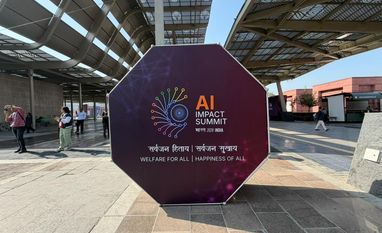 "India AI Impact Summit, AI Summit")
The summit convened heads of state, foreign ministers, and business leaders to discuss the future of AI | Image: Khalid Anzar
Listen to This Article
The United States used the India AI Impact Summit 2026 to outline an ambitious strategy aimed at strengthening global partnerships around artificial intelligence, emphasizing sovereignty, adoption, and the export of American AI technologies.
At the high-profile gathering, Assistant to the President and Director of the White House Office of Science and Technology Policy Michael Kratsios led the US delegation. He was joined by Under Secretary of State Jacob Helberg, Under Secretary of Commerce William Kimmitt, and Ambassador Sergio Gor. The summit convened heads of state, foreign ministers, and business leaders to discuss the future of AI and its growing role in national development strategies.
In remarks delivered at the summit, Kratsios underscored what he described as America's leadership in AI innovation and its commitment to helping partner nations accelerate adoption while maintaining control over their technological futures.
"Real AI sovereignty means owning and using best-in-class technology for the benefit of your people, and charting your national destiny in the midst of global transformations." Director Kratsios said.
He encouraged countries to pursue strategic autonomy paired with rapid deployment of advanced AI systems, rather than striving for full technological self-sufficiency. According to Kratsios, collaboration with the United States allows countries to leverage top-tier tools while keeping sensitive data within their own borders.
Also Read

 "Jayant Chaudhary")
 "India AI Impact Summit 2026, Bharat Mandapam")
 "ai, artificial intelligence")
 "Asian stcks, asian shares, share market")
 "Qualcomm and Tata Electronics")
"We believe that independent partners are critical to unlocking the prosperity AI adoption can open to all of us. That is why the President launched the American AI Exports Program," he said, adding that working with components of the American AI stack enables nations to build on what he characterized as the world's leading technologies.
Kratsios also delivered a pointed critique of international regulatory frameworks that seek centralized oversight of artificial intelligence. "We believe AI adoption cannot lead to a brighter future if it is subject to bureaucracies and centralized control," he said, signalling the administration's rejection of global governance mechanisms in favour of national sovereignty.
A central theme of his remarks was the widening divide between developed and developing economies in AI capability and deployment. "The pace of adoption and sophistication of deployment continues to stratify. Developing countries are falling behind developed economies at a fundamental inflection point," he said.
He urged emerging economies to accelerate the integration of AI into health care, education, energy infrastructure, agriculture, and citizen-facing government services, arguing that these sectors offer immediate, tangible benefits.
The summit also served as a platform to unveil several new initiatives under the American AI Exports Programme. Among them is the National Champions Initiative, through which the Commerce Department will integrate leading AI firms from partner nations into customised American AI export stacks to bolster domestic capacity.
Another announcement was the creation of the US Tech Corps, a new initiative of the Peace Corps that will deploy volunteer technical experts to partner countries to assist with last-mile implementation of advanced AI systems for public services.
In addition, the Treasury Department will launch a new fund at the World Bank aimed at helping countries overcome financial barriers to AI adoption. The initiative will complement financing tools offered by the Export-Import Bank, the US International Development Finance Corporation, the State Department, and the Small Business Administration.
Finally, the Commerce Department's National Institute of Standards and Technology announced that its NIST/CAISI AI Agent Standards Initiative will support the development of interoperable and secure standards for agentic AI systems, with the goal of increasing public trust in next-generation technologies.
As the administration rolls out what it describes as a whole-of-government strategy to expand American AI exports, US officials delivered a clear message at the summit: the United States intends to position its AI ecosystem as the partner of choice for nations seeking both technological advancement and sovereign control in an era of rapid digital transformation.
(Only the headline and picture of this report may have been reworked by the Business Standard staff; the rest of the content is auto-generated from a syndicated feed.)
More From This Section
 "OpenAI and Nvidia")
 "Scrolling")
 "Facebook Messenger")
 "Sunil Gupta, MD and CEO, Yotta Data Services")
 "India AI Impact Summit 2026, artificial Intelligence")
Don't miss the most important news and views of the day. Get them on our Telegram channel
First Published: Feb 20 2026 | 1:54 PM IST