


Samsung Galaxy Z Fold 7 review: Big displays, compact body, smarter UI
Samsung's Galaxy Z Fold 7 combines a thinner design, upgraded cameras, foldable-optimised software, and advanced AI features to deliver a premium experience in a more practical form factor
 "Samsung Galaxy Z Fold 7")
Samsung Galaxy Z Fold 7
Listen to This Article
Samsung has made considerable progress in refining its book-style foldable smartphone since the category’s debut in 2019. The seventh-generation model, the Samsung Galaxy Z Fold 7, is a significant departure from the original. It introduces comprehensive upgrades over its predecessor, making it more of an evolution than the incremental updates seen in earlier models. Key enhancements include larger cover and foldable displays, improved durability, a thinner and lighter form factor, foldable-specific software experiences, and an enhanced camera system. But do these changes collectively offer a more refined foldable experience? Let us find out:
Design
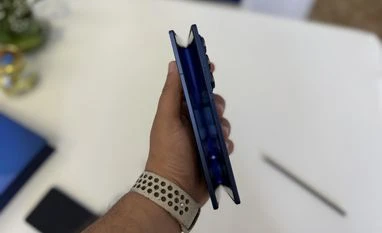
The bulky form factor once synonymous with foldable smartphones becomes a thing of the past with the Galaxy Z Fold 7. The device measures 8.9mm at its thinnest point when folded and an impressive 4.2mm when unfolded. These figures may seem abstract in isolation but contribute to a seamless transition from traditional bar-shaped smartphones.
It is worth noting that these measurements exclude the protruding rear camera bump, a vertically aligned unit placed in the top-left corner. This results in a noticeable wobble when the device is laid flat on surfaces such as tabletops. However, at 215g, the Z Fold 7 is lighter than many premium bar-style smartphones, including the Galaxy S25 Ultra and the Apple iPhone 16 Pro Max.
The device features an aluminium frame, Gorilla Glass Ceramic 2 on the front, Gorilla Glass Victus 2 on the rear, and a thicker ultra-thin glass layer on the foldable screen. It is rated IP48 for dust and water resistance. Although the durability appears comparable to bar-type smartphones, users are advised to handle the device with care, as neither accidental damage nor dust and water ingress are covered under the standard warranty.
As with its predecessor, the Z Fold 7 folds completely flat, eliminating the visible gap along the hinge. Despite protective elements in place, dust does manage to find its way in, as observed during usage.
Also Read

 "One UI 7 on Samsung Galaxy S25 series")
 "Samsung Galaxy F36 5G")
 "Samsung Galaxy F36 5G")
 "Samsung Galaxy Watch 8 and Watch 8 Classic")
 "Aditya Babbar, Vice President, MX Business, Samsung India")
Displays
The Galaxy Z Fold 7 is thinner, lighter, and marginally wider than its predecessor. This broader design accommodates a 6.5-inch cover display and an 8-inch foldable inner screen. Samsung stated that the broader design enables a 21:9 aspect ratio for the cover display, offering an experience akin to that of a bar-shaped smartphone when folded, and it largely succeeds in doing so.
Although most bar-style smartphones have long since moved away from the 16:9 aspect ratio, only a few adopt 21:9. Despite this, 21:9 is considered the second-best aspect ratio, with 16:9 still dominating content formats such as movies and TV shows. The 21:9 display provides an enhanced experience for supported video content and offers more information per scroll for vertical-feed apps like Instagram, X, and LinkedIn. The same holds true for gaming, where select titles benefit from a wider field of view.
However, the tall aspect ratio makes single-handed use impractical. To address this, Samsung has optimised One UI 8: the universal app menu search is now bottom-aligned, the quick settings menu is better laid out, and select Google apps like Chrome support relocating the address bar to the bottom. Even so, many commonly used third-party apps still necessitate two-handed use.
The inner foldable display has an aspect ratio approaching square. This makes it suitable for productivity tasks rather than video consumption or gaming. With a default taskbar and multi-view interface, it delivers a tablet-like experience. While multitasking remains a strength, competing devices such as the OnePlus Open offer more advanced multitasking capabilities. Samsung could have further refined the foldable display’s software functionality. Interestingly, the S Pen, a defining feature of the Fold series, has been omitted in favour of a thinner and lighter build.
Cameras
Samsung claims to deliver an “Ultra” camera experience on the Galaxy Z Fold 7 by equipping it with the same primary sensor as the Galaxy S25 Ultra. This sensor is also found in the Galaxy S25 Edge (review). Additionally, the camera on the main display now uses a punch-hole cutout instead of an under-display configuration for improved clarity. Other camera modules remain unchanged from the previous generation.
While these upgrades may appear incremental on paper, they translate to noticeable improvements in use. The primary sensor captures high-quality images with strong detail, contrast, and a wide dynamic range. It consistently performs well across conditions, though it occasionally struggles with neon lighting in artificial environments. The large sensor offers enhanced depth-of-field, emulating portrait effects even for non-human subjects. With a resolution of 200MP, the sensor enables default 2x and 3x zoom shots, despite the presence of a dedicated telephoto lens.
The telephoto sensor performs well but lacks the uniform colour science of the main sensor, leading to visible discrepancies. Although the impact on photography is minimal, this inconsistency is noticeable in video footage. The telephoto lens excels in well-lit conditions but falters in low light, often softening details to reduce noise.
The ultra-wide sensor delivers good performance but introduces softens on the edges as it irons out distortion, resulting in some detail loss. It also shows colour inconsistency compared to the main sensor. Autofocus support in the ultra-wide module enables the “Samsung Focus Enhancer” mode, facilitating macro-style captures – a practical if not standout addition.
Regarding front cameras, the unit on the cover display is centre-aligned and doubles as a biometric sensor. Visual cues like a moving white ring improve the facial recognition process, although the unlocking speed is modest. Face unlock is also available on the inner display, and interestingly, enrolment through one camera enables it on both displays. The inner display camera unit is placed at an odd spot though, adding to distractions.
Video capabilities match those of the Galaxy S25 series. Features include 10-bit HDR video for enhanced contrast and colour, log format for improved post-processing flexibility, UHD 4K recording at 60 fps across all sensors, and seamless switching between front and rear cameras during recording. The device also supports 8K video capture at 30 fps.
Software and AI
The Galaxy Z Fold 7 debuts with Samsung’s One UI 8, based on Android 16. The software is optimised to fully leverage the foldable form factor, particularly the main inner display. As mentioned earlier, the user interface has been adjusted for improved one-handed usability on the cover screen.
On the foldable display, tablet-style features enhance productivity and multitasking. These include a taskbar for quick app access, multi-view functionality for split-screen use in supported apps (e.g., WhatsApp, LinkedIn, Outlook), and the ability to maintain distinct layouts for the cover and main displays.
Artificial Intelligence remains central to Samsung’s ecosystem. While the Galaxy Z Fold 7 introduces few new AI features, enhancements to existing ones place it ahead of most rivals.
New AI-powered features include:
- Side-by-side comparison of original and edited images in generative editing mode
- Suggested erasures for one-tap removal of image distractions
- An “audio eraser” toggle now available within the main video interface
In collaboration with Google, the Galaxy Z Fold 7 introduces an improved “Circle to Search” feature, which now includes in-game support. Users can access gameplay tips in a floating window, though the implementation is still rudimentary. A similar feature is under trial by Microsoft in Xbox via Copilot, which may have served as inspiration.
Performance and battery
Powered by the Qualcomm Snapdragon 8 Elite for Galaxy, the Z Fold 7 offers flagship-level performance. However, it heats up significantly under sustained workloads such as 4K video recording at 60 fps, graphically demanding gaming, multimedia editing, and GPS navigation. This thermal issue adversely affects battery life, which remains modest even under normal usage conditions.
The device supports 25W wired and 15W wireless charging. Both are relatively slow by current standards, with the device taking over an hour to fully charge via the fastest available method.
Verdict
The Samsung Galaxy Z Fold 7 advances the foldable smartphone category with meaningful upgrades that go beyond superficial refinements. With a starting price of Rs 174,999, it remains a premium offering, but its combination of a thin-and-lightweight design, enhanced camera system, foldable-optimised software experience, and industry-leading AI capabilities justify the investment for users seeking both innovation and utility.
The device excels in key areas: its broader cover display brings usability closer to conventional smartphones, the inner foldable screen offers a tablet-like experience tailored for productivity, and the refined One UI 8, based on Android 16, supports enhanced multitasking and one-handed operation. Imaging performance, particularly through the main camera, is reliable and consistent, with support for high-quality video capture across all sensors.
On the flip side, some limitations persist: app optimisation for the tall 21:9 cover screen remains a work in progress, thermal management under intensive workloads needs improvement, and the battery performance is modest at best. Additionally, the absence of S Pen support, once a key differentiator, may disappoint long-time Fold users.
Nonetheless, the Galaxy Z Fold 7 represents a significant step forward in making foldable smartphones more practical for everyday use. It sets a new benchmark in design, functionality, and software synergy, positioning itself as a genuinely viable flagship device that could turn foldables mainstream.
Pricing and variants
12GB RAM + 256GB storage: Rs 174,999
12GB RAM + 512GB storage: Rs 186,999
16GB RAM + 1TB storage: Rs 210,999
Hands-on
More From This Section
 "Vivo X Fold 5 running Origin Workbench platform")
 "OnePlus Buds 4")
 "Nothing Phone 3 with Glyph Matrix display")
 "Vivo X200 FE")
 "OnePlus Nord CE 5")
Don't miss the most important news and views of the day. Get them on our Telegram channel
First Published: Jul 18 2025 | 4:23 PM IST