


Five years on, no end in sight to China's real estate market crisis
Now a symbol of China's real estate boom and bust, Evergrande was delisted from the Hong Kong Stock Exchange on Monday
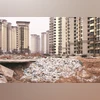 "Evergrande Group")
Unfinished residential buildings developed by China Evergrande Group. Photo: Reuters
Listen to This Article
By Daisuke Wakabayashi & Joy Dong
When China Evergrande, once the biggest Chinese property developer, went public in Hong Kong in 2009, the country’s real estate market was red-hot. The frenzy over the company was so intense that for every lucky person who bought at least one share of stock, 46 others were shut out.
How times have changed.
Now a symbol of China’s real estate boom and bust, Evergrande was delisted from the Hong Kong Stock Exchange on Monday, four years after the company first warned that it was facing financial difficulties and two years after it sought bankruptcy protection. Evergrande’s collapse, with $300 billion in debt, mirrors the slow and painful unwinding of China’s property sector.
Government policies staved off a sudden crash, and instead delivered a grinding slowdown.
The housing downturn has not delivered the devastating shock that the United States suffered in the 2008 financial crisis, but it has been hanging over the economy for five years with no end in sight. Last month, new home prices dropped at their fastest pace in nine months and the prices of secondhand homes continued to slide, according to the National Bureau of Statistics of China. As the slump continues, the government has stepped in to prop up just enough indebted property companies to prevent a broad collapse. China Vanke, one of the country’s biggest developers, has repeatedly leaned on its top shareholder, the state-owned firm Shenzhen Metro, for loans to cover obligations from its $51 billion of debt. Shenzhen Metro has extended $3.4 billion over nine loans to Vanke this year. Vanke reported on Friday that it lost $1.7 billion in the first six months from January through June, 21 percent worse than a year earlier.
Also Read

 "rare earth magnet, magnet")
 "typhoon podul")
 "China-Taiwan drills, China-Taiwan, Taiwan")
 "BYD")
 "Typhoon Krathon, Krathon, Typhoon, Taiwan Typhoon")
When Beijing rolled out rules in 2020 to curb the excessive borrowing of property developers, it kicked off a downward spiral, pushing many real estate firms to the brink. But the government has stopped short of an industrywide bailout, instead taking steps such as relaxing purchase restrictions and encouraging banks to lend more.
Andrew Collier, a senior fellow at the Harvard Kennedy School, said the result was that the “pain is going to go on for a very long period of time.”
It’s a different approach from the one adopted in China’s last significant real estate downturn, around 2015, when Beijing spent hundreds of billions of dollars to pay residents cash to trade in dilapidated shacks in smaller cities and towns. While that policy revived the market, it also unleashed another building boom fuelled by developers taking on excessive debt.
While some of the largest developers are still trying to restructure, many smaller ones have gone under. And the downturn has devastated businesses and jobs in sectors that rose up around the real estate boom. The continuing property market slide comes at a vulnerable moment for the Chinese economy. A trade war has limited China’s ability to rev up its export engine, while consumer spending remains soft. The government is plowing money into semiconductors, robotics and other technologies, but those investments are unlikely to pay off quickly enough to fill the hole left by a shrinking property sector. It’s hard to overstate the real estate industry’s importance. At its peak, the sector accounted for roughly 30 per cent of China’s economy. Proceeds from land sales to property firms filled local government coffers. Many Chinese households turned to real estate, believing it was a safe investment for their savings.
The recent data is alarming. While new construction has slowed drastically, the inventory of available homes is growing, not shrinking.
More From This Section
 "Coffee, coffee beans")
 "Nasdaq")
 "Donald Trump, Trump")
 "United Nations")
 "Liquefied Natural Gas, LNG, OIL SECTOR")
Topics : China Real Estate Evergrande
Don't miss the most important news and views of the day. Get them on our Telegram channel
First Published: Aug 25 2025 | 11:02 PM IST