


Hungarian author Laszlo Krasznahorkai wins Nobel Prize 2025 in Literature
Born in 1954 in Gyula, Hungary, Krasznahorkai is celebrated for his visionary, apocalyptic storytelling that reaffirms art's redemptive power amid chaos and human despair
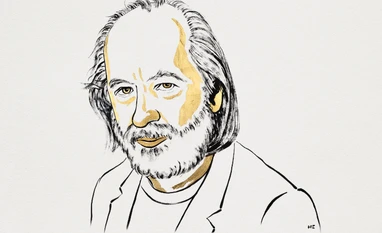 "Laszlo Krasznahorkai")
Laszlo Krasznahorkai
Listen to This Article
Hungarian author Laszlo Krasznahorkai on Thursday was awarded the 2025 Nobel Prize in Literature for his “compelling and visionary oeuvre that, in the midst of apocalyptic terror, reaffirms the power of art,” the Nobel Committee announced.
The Swedish Academy described him as “a great epic writer in the Central European tradition that extends through Kafka to Thomas Bernhard, and is characterised by absurdism and grotesque excess".
From small-town Hungary to global acclaim
Born in 1954 in the small southeastern town of Gyula, Krasznahorkai achieved his literary breakthrough with Sátántangó (1985; Satantango, 2012). The novel depicts the desolation of residents in a decaying collective farm in rural Hungary, just before the fall of communism.
The Swedish Academy noted that the novel “portrays, in powerfully suggestive terms, a destitute group of residents on an abandoned collective farm in the Hungarian countryside just before the fall of communism.”
The book was later adapted into a 1994 film directed by Béla Tarr, cementing Krasznahorkai’s reputation as one of Hungary’s most important literary voices.
Also Read

 "Mary E Brunkow, Fred Ramsdell, and Shimon Sakaguchi")
 "Nobel Prize")
 "Stock Market LIVE Updates, October 10, 2025")
 "iPhone 16, Nothing Phone 3, Pixel 9 Pro Fold, Samsung Galaxy S24")
 "Indian stock market, stock market")
‘Master of the apocalypse’
Krasznahorkai’s second novel, Az ellenállás melankóliája (1989; The Melancholy of Resistance, 1998), earned him international recognition. Set in a Carpathian valley where a ghostly circus brings chaos and violence, the book explores the fragility of order and the rise of authoritarianism.
American critic Susan Sontag hailed him as the “master of the apocalypse”, praising his exploration of despair and resistance in the face of collapse.
The Nobel Committee noted, “Employing dreamlike scenes and grotesque characterisations, Laszlo Krasznahorkai masterfully portrays the brutal struggle between order and disorder. None may escape the effects of terror.”
Notable works
Krasznahorkai’s oeuvre spans novels that combine dense prose with philosophical depth and bleak humour, exploring the limits of civilisation and endurance.
- Háború és háború (1999; War & War, 2006): Follows an archivist’s journey from Budapest to New York to share an ancient epic, showcasing Krasznahorkai’s signature, flowing sentences.
- Báró Wenckheim hazatér (2016; Baron Wenckheim’s Homecoming, 2019): Chronicles a ruined baron’s return to Hungary, blending tragic and comic tones in a meditation on homecoming and decay.
- Herscht 07769: Florian Herscht Bach-regénye (2021; Herscht 07769: A Novel, 2024): Portrays unrest in a small German town, interweaving violence, compassion, and the perspective of a childlike “holy fool.”
A literary style defined by intensity
Krasznahorkai’s writing is known for its long, unbroken sentences that often span several pages, reflecting the continuous flow of human consciousness. His style, influenced by Kafka’s existential unease and Bernhard’s dark satire, explores the absurdity and beauty of human perseverance in times of moral collapse.
Over the decades, his works have been translated into more than 30 languages, earning him several major literary awards, including the Man Booker International Prize (2015) for lifetime achievement.
A legacy of apocalyptic beauty
Laszlo Krasznahorkai’s Nobel win celebrates a lifetime devoted to examining humanity’s confrontation with meaning, decay, and redemption. His works, steeped in Central European melancholy, continue to challenge readers to find grace amid ruin.
As the Nobel Committee concluded, his prose “stands as a reminder that even in the face of terror and despair, art retains the power to illuminate the human condition.”
More From This Section
 "Oil")
 "Keir Starmer")
 "Donald Trump, Trump")
 "solar-thermal power plant")
 "rare earth magnets")
Topics : Nobel Literature Prize BS Web Reports
Don't miss the most important news and views of the day. Get them on our Telegram channel
First Published: Oct 09 2025 | 4:39 PM IST