


Myanmar quake: Thailand probes Bangkok skyscraper collapse over China link
The high-rise that collapsed near Chatuchak market was a project jointly undertaken by Italian-Thai Development Plc and China Railway Number 10 (Thailand) Ltd
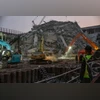 "earthquake, Thailand, earthquake in Thailand")
According to Myanmar’s military government, the earthquake has resulted in at least 1,700 deaths. (Image: Bloomberg)
Listen to This Article
A powerful 7.7-magnitude earthquake struck Myanmar on Friday, causing destruction over 1,000 km away in Thailand. In Bangkok, a 33-storey high-rise under construction collapsed, raising concerns about its structural integrity.
Thailand’s Deputy Prime Minister Anutin Charnvirakul visited the collapse site on Saturday and ordered an investigation. The skyscraper was being built by a joint venture that included a Chinese firm, prompting questions about construction standards.
Structural failure raises alarm
The high-rise, still dotted with cranes, could not withstand the quake’s tremors. Rescuers have so far recovered eight bodies from the debris.
The collapsed building was intended to be the new headquarters of Thailand’s State Audit Office (SAO). Construction had been underway for three years, with a budget exceeding 2 billion Thai baht (approximately $58 million).
It was a joint project between Italian-Thai Development Plc and China Railway Number 10 (Thailand) Ltd, a subsidiary of China Railway Number 10 Engineer Group Company. The Chinese firm held a 49 per cent stake — the maximum allowed for foreign investors in Thailand, according to The Telegraph UK.
Also Read

 "earthquake, Thailand, earthquake in Thailand")
 "Myanmar earthquake")
 "earthquake")
 "Operation Brahma, India's aid, India's aid to Myanmar")
China Railway Number 10 (Thailand) was established in 2018 as a contractor for infrastructure projects. Thai media reports indicate that in 2023, the company recorded a net loss of 199.66 million baht against revenues of 206.25 million baht and expenses of 354.95 billion baht.
Its shareholders include Sophon Meechai (40.8 per cent), Prachuab Sirikhet (10.2 per cent), and Manas Sri-anant (3 per cent).
Government launches probe
Following the collapse, Thailand’s Ministry of Industry dispatched an inspection team to determine whether poor-quality materials or design flaws played a role. ALSO READ | Myanmar earthquake rescue efforts intensify with death toll set to rise
Charnvirakul has ordered a high-level probe. “I am appointing the investigation committee. I have given them seven days to report back as to what's going on and what caused the falling down,” he told journalists.
Death toll and rescue efforts
As of Sunday, at least 18 people had died in Bangkok, with 33 injured and 78 still missing, according to city authorities. Many of the victims were workers who were crushed under the rubble.
Rescue teams are racing against time, digging through massive debris piles of shattered concrete and twisted metal. Thai police commander Teerasak Thongmo stated that his team, along with rescue dogs, was searching for survivors.
Meanwhile, in Myanmar, the earthquake has claimed around 1,700 lives, injured 3,400 people, and left over 300 missing.
Possible engineering flaws
According to a BBC report, Amorn Pimarnmas, president of Thailand’s Structural Engineers Association, noted that while earthquake-resistant building regulations exist in 43 provinces, fewer than 10 per cent of structures comply.
Given that the collapsed skyscraper was relatively new, it should have met updated building codes. However, Pimarnmas suggested that Bangkok’s soil conditions may have contributed to the collapse, amplifying tremors three to four times. Additionally, experts pointed to a structural weakness known as a ‘flat slab’ design. ALSO READ | Myanmar earthquake released energy of '334 atomic bombs', says geologist
Myanmar earthquake: Top updates
1. The earthquake, which was felt as far away as Bangkok and several provinces in China, has caused widespread devastation, leaving many injured or trapped under rubble. According to Myanmar’s military government, the disaster has resulted in at least 1,700 deaths, approximately 3,400 injuries, and nearly 300 missing persons.
2. The United States Geological Survey (USGS) has projected that the final death toll could surpass 10,000, based on its preliminary models.
3. Despite the ongoing crisis, an armed resistance group opposing Myanmar’s military government has condemned the junta for continuing airstrikes on villages, even as the nation struggles with the aftermath of the earthquake, news agency Reuters reported.
4. The Karen National Union, one of Myanmar’s oldest ethnic armed groups, criticised the junta, stating that it “continues to launch airstrikes on civilian areas, even as the people endure immense suffering from the earthquake”.
5. On Sunday, the World Health Organisation (WHO) classified the Myanmar earthquake as a top-level emergency and issued an urgent appeal for $8 million to support relief efforts, aiming to prevent disease outbreaks and save lives.
6. WHO said that $8 million is required to meet urgent health needs over the next 30 days, with a focus on efforts to “save lives, prevent disease, and stabilise and restore essential health services”.
More From This Section
 "Donald Trump, Trump, Volodymyr Zelenskyy, Zelenskyy")
 "Indonesian Flag")
 "Donald Trump, Trump")
 "Yemen")
 "Elon Musk, Musk")
Topics : Myanmar Bangkok BS Web Reports Earthquake
Don't miss the most important news and views of the day. Get them on our Telegram channel
First Published: Mar 31 2025 | 11:02 AM IST