


Trump threatens Japan with tariff, aims for trade deals after July 4
Trump's latest round of brinkmanship with Tokyo on Monday comes just over a week before a July 9 deadline for higher tariffs to restart for dozens of trading partners, including Japan
 "Donald Trump, Trump")
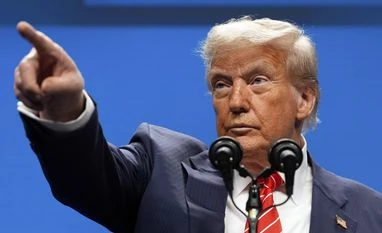
Trump for weeks has sought to exert leverage with negotiating partners ahead of the deadline. (Photo: PTI)
Listen to This Article
By Catherine Lucey, Jennifer A. Dlouhy and Akayla Gardner
President Donald Trump threatened to impose a fresh tariff level on Japan, while his top economic adviser said the White House aims to finalise deals with partners after the July 4 holiday.
Trump’s latest round of brinkmanship with Tokyo on Monday comes just over a week before a July 9 deadline for higher tariffs to restart for dozens of trading partners, including Japan. He cited what he said was the country’s unwillingness to accept US rice exports.
“They won’t take our RICE, and yet they have a massive rice shortage,” Trump posted on social media. “In other words, we’ll just be sending them a letter, and we love having them as a Trading Partner for many years to come.”
Trump for weeks has sought to exert leverage with negotiating partners ahead of the deadline, vowing to cut short talks with those he sees as being difficult and instead send them letters setting tariff rates.
Also Read

 "India is totally reliant on Qatar and the UAE for over half of its LNG supplies unlike China")
 "India-USA")
 "markets, Sensex, nifty")
 "Rupee")
 "Donald Trump, Trump")
The president paused his country-by-country tariffs in April to allow time for negotiations. Since then, he and his team have repeatedly pledged that a slate of deals was weeks away. But to date, the only two agreements announced have been broad frameworks with China and the UK.
Meanwhile, White House National Economic Council Director Kevin Hassett signaled Monday that agreements with several governments would be announced after US Independence Day. He said the administration’s focus has been on passing Trump’s massive tax and spending bill through Congress before the holiday.
“It might be that people take an hour or two off on the Fourth to watch the fireworks and then we’ll get back, and we’re going to start to announce the frameworks,” Hassett said Monday on Fox Business. “We’re expecting to meet with the president and explain the frameworks that have been negotiated and see if he approves or not.”
Talks between the US and Japan are expected to continue despite Trump’s latest threat, according to Hassett.
“Nothing is over. I know what he just posted, but there’ll still be discussions right up to the end,” he told reporters.
Stocks in Tokyo fell shortly after the market opened Tuesday morning, with the Topix benchmark down as much as 0.7 per cent as traders digested the latest Trump comments.
The rice supply shortage that the US president cited has frustrated Japanese consumers already unhappy about an ongoing cost-of-living crunch. Rice prices have doubled in the last year, prompting Prime Minister Shigeru Ishiba’s government to release emergency reserves into the market and sideline conventional distribution channels.
While that move may stop voter anger boiling over, it has upset the farming industry, which is a long-time voting bloc for the ruling party.
Expanding imports of American rice might help ease the imbalance in the market, but that move would increase angst in the domestic farming sector, especially if their interests are seen to be sacrificed to secure a lowering of tariffs for the car industry.
Ishiba may want to hold off making any concessions that affect that segment of the population ahead of an upper house election on July 20.
This is not the first time the Trump administration has singled out Japan’s protection of its rice industry as unfair. In March, White House Press Secretary Karoline Leavitt accused Japan of setting tariffs on rice at 700 per cent, a claim the Japanese government has said is inaccurate.
Deadline nears
Trump’s threats to cut off talks with nations have sometimes seen trading partners retreat on policies that drew his ire, leading to resumed negotiations. The president said Friday he was ending all trade talks with Canada in retaliation for its digital-services tax. But after Ottawa withdrew that tax, Hassett told reporters Monday there had been “lots of progress in our discussions with Canada.”
Japan is one of the most significant US trading partners, putting it in a category of economies that Trump administration officials has said are in line for deals — rather than imposed rates.
US Commerce Secretary Howard Lutnick said last week that the administration would finalize a slate of trade deals with roughly 10 of the “top” US partners, while others would receive letters setting duty levels.
US and Japanese officials have yet to resolve thorny issues surrounding tariff levels and trade barriers in talks that have stretched on for months.
Japan has pressed for relief from Trump’s 25 per cent auto tariffs, saying they are crippling a crucial industry. But the US president has balked at the request, saying Japan does not import a significant number of American-made vehicles. Japan is facing a separate 24 per cent levy on all exports to the US, which was lowered to 10 per cent during the negotiating period.
Earlier Monday, Leavitt said the US was nearing deals with India and other nations ahead of the deadline reimposing higher tariffs that were paused for 90 days in April in order to conduct talks.
“He is going to set the rate for many of these countries if they don’t come to the table to negotiate in good faith, and he is meeting with his trade team this week to do that,” Leavitt said.
A frenzy of meetings and calls between foreign governments, industries and the administration has marked the weeks leading up to the deadline, with officials and executives lobbying for carve-outs from Trump’s import taxes.
When asked if there should be tariff exemptions for products that typically can’t be grown in the US, such as cocoa and coffee, US Agriculture Secretary Brooke Rollins said in an interview that “everything’s on the table right now.”
For “certain products that we can’t produce here,” Rollins continued, “it’s important to have a full understanding and a robust strategy” that keeps grocery prices down and promotes American agriculture.
More From This Section
 "hack, Cyber Crime, Scam")
 "Crime, Prison, Law, Arrest, Punishment")
 "apple, apple logo")
 "US Senate")
 "Bob Vylan, rappers, fight, Israel")
Topics : Trump tariffs trump tariff Japan
Don't miss the most important news and views of the day. Get them on our Telegram channel
First Published: Jul 01 2025 | 7:21 AM IST