


North Korea: The costs of war, calculated
Even a limited war with North Korea would kill millions, devastate the environment, and bankrupt the US preventing it should be the peace movement's highest priority
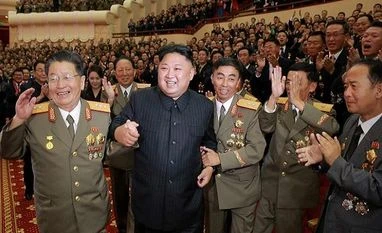 "North Korean leader Kim Jong Un during a celebration for nuclear scientists and engineers who contributed to a hydrogen bomb test. Photo: KCNA via Reuters")
North Korean leader Kim Jong Un during a celebration for nuclear scientists and engineers who contributed to a hydrogen bomb test. Photo: KCNA via Reuters


Donald Trump is contemplating wars that would dwarf anything that his immediate predecessors ever considered.
He has dropped the mother of all bombs in Afghanistan, and he’s considering the mother of all wars in the Middle East. He is abetting Saudi Arabia’s devastating war in Yemen. Many evangelicals are welcoming his announcement of US recognition of Jerusalem as the capital of Israel as a sign that the end of days is nigh. The conflict with Iran is about to heat up early next year when Trump, in the absence of any congressional action, will decide whether to fulfill his promise to tear up the nuclear agreement that the Obama administration worked so hard to negotiate and the peace movement backed with crucial support.
But no war has acquired quite the same apparent inevitability as the conflict with North Korea. Here in Washington, pundits and policymakers are talking about a “three-month window” within which the Trump administration can stop North Korea from acquiring the capability to strike US cities with nuclear weapons.
That estimate allegedly comes from the CIA, though the messenger is the ever-unreliable John Bolton, the former flame-thrower of a US ambassador to the U N Bolton has used that estimate to make the case for a preemptive attack on North Korea, a plan that Trump has also reportedly taken very seriously.
North Korea, too, has announced that war is “an established fact.” After the most recent US-South Korean military exercises in the region, a spokesperson from the Foreign Ministry in Pyongyang said, “The remaining question now is: when will the war break out?”
This aura of inevitability should put prevention of conflict with North Korea at the top of the urgent to-do list of all international institutions, engaged diplomats, and concerned citizens.
A warning about the costs of war may not convince people who want Kim Jong Un and his regime out regardless of consequences (and nearly half of Republicans already support a preemptive strike). But a preliminary estimate of the human, economic, and environmental costs of a war should make enough people think twice, lobby hard against military actions by all sides, and support legislative efforts to prevent Trump from launching a preemptive strike without congressional approval.
Such an estimate of the various impacts can also serve as a basis for three movements — anti-war, economic justice, and environmental — to come together in opposition to what would set back our causes, and the world at large, for generations to come.
It’s not the first time the United States has been on the verge of making an extraordinary mistake. Can the costs of the last war help us avoid the next one?
Doomed to Repeat?
If Americans had known how much the Iraq War was going to cost, perhaps they wouldn’t have gone along with the Bush administration’s march to war. Perhaps Congress would have put up more of a fight.
Invasion boosters predicted that the war would be a “cakewalk.” It wasn’t. About 25,000 Iraqi civilians died as a result of the initial invasion and about 2,000 coalition forces died up through 2005. But that was just the beginning. By 2013, another 100,000 Iraq civilians had died because of ongoing violence, according to the conservative estimates of the Iraq Body Count, along with another 2,800 coalition forces (mostly American).
Then there were the economic costs. Before it blundered into Iraq, the Bush administration projected that the war would only cost around $50 billion. That was wishful thinking. The real accounting only came later.
My colleagues at the Institute for Policy Studies estimated in 2005 that the bill for the Iraq war would ultimately come in at $700 billion. In their 2008 book The Three Trillion Dollar War, Joseph Stiglitz and Linda Bilmes provided an even higher estimate, which they later revised further upwards toward $5 trillion.
The body counts and the more accurate economic estimates had a profound impact on how Americans viewed the Iraq War. Public support for the war was around 70 percent at the time of the 2003 invasion. In 2002, the congressional resolution authorizing military force against Iraq passed the House 296 to 133 and the Senate 77-23.
By 2008, however, American voters were supporting Barack Obama’s candidacy in part because of his opposition to the invasion. Many of these people who supported the war — a majority of the Senate, former neoconservative Francis Fukuyama — were saying that if they knew in 2003 what they subsequently learned about the war, they would have taken a different position.
In 2016, not a few people supported Donald Trump for his purported skepticism about recent US military campaigns. As a Republican presidential candidate, Trump declared the Iraq War a mistake and even pretended that he’d never supported the invasion. It was part of his effort to distance himself from hawks within his own party and the “globalists” in the Democratic Party. Some libertarians even supported Trump as the “anti-war” candidate.
Trump is now shaping up to be quite the opposite. He is escalating US involvement in Syria, surging in Afghanistan, and expanding the use of drones in the “war on terror.”
But the looming conflict with North Korea is of an entirely different order of magnitude. The anticipated costs are so high that outside of Donald Trump himself, the most resolute of his hawkish followers, and a few overseas supporters like Japan’s Shinzo Abe, war remains an unpopular option. And yet, both North Korea and the United States are on a collision course, propelled by the logic of escalation and subject to the errors of miscalculation.
By making sure that the probable costs of a war with North Korea are well known, however, it is still possible to persuade the US government to step back from the brink.
The Human Costs
A nuclear exchange between the United States and North Korea would go off the charts in terms of lives lost, economies wrecked, and the environment destroyed.
In his apocalyptic scenario in The Washington Post, arms control specialist Jeffrey Lewis imagines that, after widespread conventional US bombing of the country, North Korea launches a dozen nuclear weapons at the United States. Despite some errant targeting and a half-effective missile defense system, the attack still manages to kill a million people in New York alone and another 300,000 around Washington, D C Lewis concludes: