


Movie Review: Talvar delivers a blunted blow
It could have been a genre-defying film, but it doesn't quite get there
 "Movie Review: Talvar delivers a blunted blow")
“The public sees the statue of justice as blindfolded, with scales in one hand,” says the director of Central Department (fig leaf for the real life Bureau) of Investigation, Swamy (Prakash Belwadi), to his joint director Ashwin Kumar (Irrfan) half way through the new Vishal Bhardwaj-Meghna Gulzar film Talvar. “It doesn’t see the sword in the other hand. That has rusted through 60 years of disuse. We have a real chance to clean some of that rust through your investigation of the double murder case in the 32 days before I retire.”
Talvar is a clever title for this barely fictionalised account of the investigation of the Aarushi Talwar murder. The reference to the last name is obvious. The above scene leaves no one in any doubt as to what Bhardwaj, who produced and wrote the film, and Gulzar, who directed it, have in mind. Some equally valid but unintentional allusions could be to the bluntness and double-edgedness of the sword.
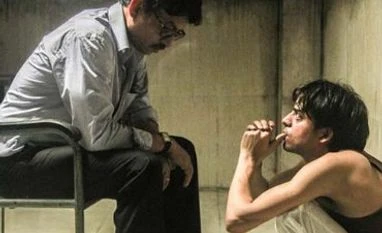
A Talvar review for Indian readers does not need a plot summary, because it is a near-perfect recreation of the events to give it a documentary feel. It is also many other things. It is grim, gritty, hard-edged and brisk. It does not play up the sensational or pander to voyeurism, no mean achievements in themselves. The squalid interiors of the interrogation chambers and crisp editing create the right ambience. Appropriate mood music, Bhardwaj’s forte, is an unobtrusive but vital contributor to this.
The movie has excellent performances from Irrfan (what else is new?) and Belwadi as well as the unknowns who play the local keystone cops and the largely Nepali domestic staff of the Tandon (Talwar) family. But Konkona Sen Sharma and Neeraj Kabi as the parents of the murdered girl are wasted because of the script. Tabu’s walk-on as the estranged wife of Kumar is unnecessary and distracting.
It is, however, neither an edge-of-the-seat whodunit thriller because the makers signal their take on the guilty party early on, or an absorbing police procedural like Fargo, where a patient investigator methodically unravels the clues to get at the truth. Irrfan’s Ashwin is too hot-tempered and smugly self-righteous to fit that mould.
Unfortunately, Bhardwaj’s plot device of presenting alternative perceptions of reality doesn’t quite work either. He does a recreation according to the bumbling local investigating officers and contrasts it with another according to the drug-induced recollections of the Nepali staff undergoing what is referred to as narco-analysis in India.
Talvar is a clever title for this barely fictionalised account of the investigation of the Aarushi Talwar murder. The reference to the last name is obvious. The above scene leaves no one in any doubt as to what Bhardwaj, who produced and wrote the film, and Gulzar, who directed it, have in mind. Some equally valid but unintentional allusions could be to the bluntness and double-edgedness of the sword.
A Talvar review for Indian readers does not need a plot summary, because it is a near-perfect recreation of the events to give it a documentary feel. It is also many other things. It is grim, gritty, hard-edged and brisk. It does not play up the sensational or pander to voyeurism, no mean achievements in themselves. The squalid interiors of the interrogation chambers and crisp editing create the right ambience. Appropriate mood music, Bhardwaj’s forte, is an unobtrusive but vital contributor to this.
The movie has excellent performances from Irrfan (what else is new?) and Belwadi as well as the unknowns who play the local keystone cops and the largely Nepali domestic staff of the Tandon (Talwar) family. But Konkona Sen Sharma and Neeraj Kabi as the parents of the murdered girl are wasted because of the script. Tabu’s walk-on as the estranged wife of Kumar is unnecessary and distracting.
It is, however, neither an edge-of-the-seat whodunit thriller because the makers signal their take on the guilty party early on, or an absorbing police procedural like Fargo, where a patient investigator methodically unravels the clues to get at the truth. Irrfan’s Ashwin is too hot-tempered and smugly self-righteous to fit that mould.
Unfortunately, Bhardwaj’s plot device of presenting alternative perceptions of reality doesn’t quite work either. He does a recreation according to the bumbling local investigating officers and contrasts it with another according to the drug-induced recollections of the Nepali staff undergoing what is referred to as narco-analysis in India.
Perhaps the makers of the film were motivated by the large-scale disbelief of mostly middle class Indians that one of their own would indulge in what amounts to honour killing leading to the guilty verdict. The very messy and sloppy conduct of the trial added to that unease. Avirook Sen’s coverage of the trial and his subsequent book represent this part of the opinion spectrum. But it would need a deep exploration of the internal dynamics of the Tandon family and the angst (or its absence) of the parents after the murder to bring conviction. The film has none of that.
A famous parable has a Chinese philosopher dreaming that he was a butterfly. He was never sure thereafter whether he was a philosopher who dreamt he was a butterfly or a butterfly that dreamt it was a philosopher. Rashomon aspires to and captures that sublime ambivalence of perception of reality. The theme offered Bhardwaj an opportunity of making a genre-defying film, a trend-setter even. He certainly has the potential to do so, as his masterly interpretations of Shakespeare, especially Haider, show. Sadly, for this reviewer, Talvar never quite gets there.

Don't miss the most important news and views of the day. Get them on our Telegram channel
First Published: Oct 03 2015 | 12:16 AM IST