


MNCs to buy shares directly from the market
Latest RBI move allows this through stock exchanges, amid flattened valuations and cheaper rupee, without open offer trigger
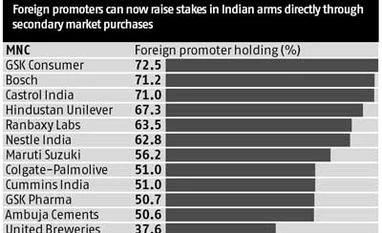)
The move by the central bank to ease rules for investment by foreign entities could see a spate of multinational companies (MNCs) raise stake in their Indian arms, coming as it does amid a cheaper rupee and depressed stock valuations.
The Reserve Bank of India (RBI) on Friday allowed foreign entities to acquire shares of companies where they have control directly through the stock exchanges. Earlier, investments by such entities were treated as foreign direct investment (FDI) and had to take place through tedious off-market transactions.
The RBI notification will impact a little over over 35 listed foreign-owned and listed companies, as their parents will now be able to buy up to five per cent stake directly on the floor of the exchange.
“Allowing foreign promoters of listed Indian companies to acquire shares on the floor of the exchange without prior regulatory approval will not only benefit such promoters in timely consolidation of their holdings when share prices are low but also benefit the sellers of shares, who would be able to sell to such promoters without paying any long-term capital gains tax,” said Nishchal Joshipura, head of mergers and acquisitions at Nishith Desai Associates.
Added Lalit Kumar, partner at J Sagar Associates,” Earlier, foreign entities had to identify an Indian seller and then buy through off- market deals, which was time-consuming. Foreign promoters can now transact just like FIIs (institutional investors) do.”
Domestic brokerage Dolat Capital Markets, in a client note, said foreign firms will actively pursue this opportunity to consolidate shareholding in their Indian arms, which could boost their share prices.
“Foreign promoters can now start buying in the market without prior RBI approval or without making a formal open offer, provided they comply with listing norms. Stocks could move up in anticipation of the parent shoring up its stake,” said Jatin Padharia, part of the institutional equity sales team at the brokerage.
Under the takeover regulations of the Securities and Exchange Board of India, a promoter can only increase its holding by five per cent in a financial year without triggering a compulsory open offer. While the maximum promoter holding in Indian companies is capped at 75 per cent, promoters can buy another five per cent through a voluntary open offer. Three of these — by Hindustan Unilever, GlaxoSmithKline Consumer and CRISIL— were made by foreign parents this year.
Ultra-low interest rates in the developed world and better growth prospects in India make it attractive for MNCs to raise holdings in their Indian arms. Promoters of MNCs such as Nestlé, Castrol, Pfizer, Colgate and Cummins might also look to consolidate holdings, said Padharia.
Yogesh Chande, consultant at Economic Laws Practice, said before he started advising its foreign clients, clarity was needed on whether the easing of norms would apply to all MNCs or only those that had acquired control after making an open offer in accordance with the Sebi takeover regulations, as stated in the RBI notification.

Don't miss the most important news and views of the day. Get them on our Telegram channel
First Published: Sep 11 2013 | 10:50 PM IST