


Reliance, Essar could spell trouble for state fuel retailers
With diesel prices fully deregulated, private retailers are ready to expand their presence
)
Last week, when shares of public sector oil-marketing companies, or OMCs, rallied 7 per cent after the announcement of diesel deregulation, many officials from the companies wondered if the euphoria was misplaced. The spike was an overreaction, they said, for though selling diesel at market-linked prices would remove the under-recoveries on the sale of the fuel, the OMCs would stand to lose their market share in the medium to long term.
The three state-owned oil sellers - Indian Oil Corporation, Bharat Petroleum Corporation and Hindustan Petroleum Corporation - together account for 98 per cent of the fuel retailing market in India. Diesel sales comprise around 55 per cent of overall sales of the three together. With deregulation of prices, the private retailers - Reliance Industries, Essar Oil and Shell India - would return to a market that has been the preserve of public sector players for almost a decade now. And if the Oil and Natural Gas Corporation also decides to venture into fuel retailing through its listed-subsidiary, Mangalore Refinery and Petrochemicals, it would add to the squeeze in the market.
A foray by private oil refiners into the domestic oil marketing space could, according to an October 22 report by India Ratings, a credit rating and research firm, "gradually lead to greater competitive intensity and private refiners eating into the market share of existing national oil companies over the long run, as also impacting revenue and profit margins".
Changing the game
Since 2008, when crude oil prices surged toward $150 a barrel, the diesel retail game has been in favour of state-owned OMCs. The government's policy of providing subsidy to state-owned fuel retailers either made private fuel sellers shut down their retail outlets or slow their pace of expansion. With deregulation, private companies would take just six to nine months to begin full-fledged operations and corner a chunk of the market. As a senior Indian Oil official says, "In a year's time, we can see Reliance and Essar Oil garnering 10-12 per cent of the market. Shell is not a major player and hence not a challenge to us."
Reliance now no longer needs to tie up with Hindustan Petroleum, with which it was holding discussions for support to re-open its retail outlets. "After deregulation, Reliance only needs to address the issue of dealer commission," says a Reliance retailer. Since July, the company has been negotiating with dealers on the higher commission that they are demanding. The company did not respond to an emailed questionnaire.
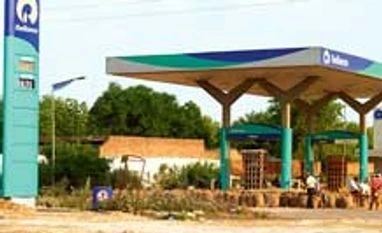
Reliance held a 12-per cent market share in 2005, but this has slipped to less than 0.5 per cent now. It had spent Rs 5,000 crore in setting up 1,470 retail outlets, of which around 300 are operational today. Its mainstay was diesel sale and till 2008, it accounted for 14 per cent of the diesel sales in the country. Reliance retailers say the company has decided to re-open the company-owned pumps first and it will spend Rs 50 lakh on renovating each one of them.
Essar Oil, the private player with the largest number of retail outlets currently operating - 1,400 - expects a gradual pick up in diesel sales from its outlets, which only sell petrol at the moment. It has another 300 retail outlets in various stages of commissioning. The company usually follows the franchise model in which the bulk of the investments is done by the franchisees and it only offers its service and quality assurance to customers.
While Essar Oil refused to divulge the sales volumes, it said in an emailed response that "diesel deregulation has removed the uncertainty and has given a level playing field to all marketing companies. This will expedite the private oil marketing companies' joining the retail network".
To provide an additional source of revenue to its franchisees, Essar Oil has explored multi-fuel options such as compressed natural gas and an increase in non-fuel activities by forging alliances with retailers in segments such as lubricants, food & beverages, farm products, telecom and banking & finance.
Shell India, an international energy company licenced to build and operate fuel outlets in India, has around 75 of its 82 large-format outlets functioning in six states. It had secured a marketing licence from the government to set up a network of up to 2,000 fuel retail stations. The company could not be contacted despite several attempts to seek its comment. Shell India had earlier told Business Standard that though it continues to invest, the flow has been slow.
Fuel economics
Among the private players, Reliance stands to gain the most from the deregulation of diesel prices because of its state-of-the-art fuel pumps, say industry experts. Thangapandian Srinivasulu, executive director, Gulf Petrochem, and former CEO (marketing) of Essar Oil, says, "The size and format of Reliance's outlets will ensure huge volume sales. It has more nozzles to dispense fuel, and has terminals for fuel storage that other players, including Essar Oil and Shell, do not have." On an average, Essar Oil retail outlets have five nozzles for dispensing fuel, while Reliance outlets have 12.
Two advantages that private fuel retailers have over state OMCs are location and the freedom to price their product. Both Reliance and Essar Oil have most of their outlets along highways. "The highways could be an advantage if private players want to ramp up their presence overnight," says an Indian Oil official. Industry sources say that Reliance could up the ante by going below the market price to sell volumes. Essar Oil also says it could price its fuel competitively.
As a result, the state OMCs are likely to have their refining margins dented. "Though the public sector companies have ramped up their services and automated their retail outlets, there could be pressure on their refining margins in the long run," says the refining and marketing head of a private company on the condition of anonymity.

Don't miss the most important news and views of the day. Get them on our Telegram channel
First Published: Oct 29 2014 | 10:30 PM IST