


Bulletproof glass ceiling blocks women from army combat roles
In 2013, the US military opened ground combat roles for women but, controversially, without relaxing physical standards
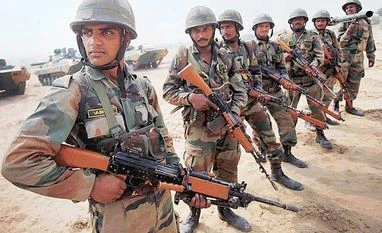 "Bulletproof glass ceiling blocks women from army combat roles")
Allowing women into military combat units is fiercely contested even in countries like the United States (US) where gender equality is advanced. In relatively conservative India, Defence Minister Manohar Parrikar was forced to backtrack less than a month after mooting the idea of all-women combat units in the army, and their entry into Sainik Schools and the National Defence Academy (NDA).
In a statement in the Rajya Sabha on Tuesday, the defence minister announced: "Presently there is no proposal to raise a women's combat unit in the army".
Significantly, Parrikar has disavowed only a "women's combat unit", i.e. an all-women unit. He has not so far rejected the possibility of women officers serving as officers in mixed gender combat units.

Earlier, President Pranab Mukherjee - the Supreme Commander of the military - speaking at the inauguration of the budget session of parliament in February, stated that women would soon be inducted into the combat streams of all three services.
The Indian Air Force (IAF) has already inducted women into combat, with its first three women fighter pilots commissioned last month on an "experimental" basis. The navy, too, deploys women officers on frontline warships, carrying them into harm's way even while they perform non-combatant duties. Yet land combat remains a bastion denied to women, with powerful resistance from macho officers and veterans who pooh-pooh the notion of throwing women into hand-to-hand, physical combat.
This resistance is summarised by a highly regarded American veteran, Colonel Fred Dibella, who joined the US Army in 1969. Lamenting the political correctness behind the thrust for allowing women into combat, Dibella wrote: "Up to now, we have recognized the blatantly obvious: that battles and wars are won by Alpha Males. And why is that? Uh… because men and women may well be equal in the eyes of God, but they damned sure ain't identical in the laws of physics and psychology. Men are, by and large, bigger, stronger, faster, more aggressive, more violent, more ferocious, more intense, more powerful, more brutal, more belligerent, more destructive, AND THEREFORE MORE LETHAL than women" (capitals in original).
In India, identical attitudes are compounded by societal mores that relegate women to a subordinate role. Lieutenant General (Retd) Vinod Bhatia, a former paratrooper and director general of military operations points out: "Women officers have performed excellently in the non-combat roles that they have been permitted so far. But combat soldiers in the rank and file, most of them coming from rural areas, are not attuned to taking orders from women. This will be a real issue in hand-to-hand combat, like we had in Kargil, when officers have to not just issue orders but also personally lead the charge."
Despite resistance, women officers have carved out a growing space in the army. As Parrikar told the Rajya Sabha on Tuesday, until 1992, women could only serve in the military as doctors and nurses. That year women officers were allowed into four non-combat army branches: Army Service Corps (ASC) and Army Ordnance Corps (AOC), which manage logistics; the Army Education Corps (AEC), which trains and educates soldiers; and the Judge Advocate General (JAG) branch, the military's internal legal department. Women "short service officers" could serve five years, extendable to 10.
Four years later, in 1996, another four departments were opened to "short service" women officers: combat support arms, Engineers and Signals; Intelligence and Electrical & Mechanical Engineering (EME). Subsequently, the Aviation and Air Defence (AD) branches were also opened to women. Since 2008, women have been granted permanent commissions into the AEC and JAG branches.
On Tuesday, parliament was told that 1514 women officers were serving in the military, as on April 1. These women are now allowed everywhere, except into combat arms - the armoured corps, infantry and mechanised infantry - and in the artillery.
Meanwhile, the American experience is stuttering along. In 2013, the US military opened ground combat roles for women but, controversially, without relaxing physical standards, and with a two-year period for evaluating its feasibility. Last year, three out of 19 women who enrolled in the Ranger School passed its notoriously difficult course. Not a single woman officer has yet passed the even tougher Marine Corps Infantry Officer Course.
Even so, President Barack Obama's administration continues to pursue the goal of bringing women into ground combat. Last year, General Martin Dempsey, the head of the US military, questioned the tough, exclusionary standards, stating in a memo: "If women can't pass the standards at Ranger School, SEAL School, and other similar training programs, then the standards will have to be justified to me."
In India, objections to allowing women into ground combat centre not only on the difficulty of meeting physical standards, but equally on the possibility that women could be captured and raped. Wing Commander (Retd) Neelu Khatri, who served fifteen years in the IAF, dismisses this as irrelevant. "Women combatants would have volunteered for the job, full well knowing that they could be killed on the job. Rape is a lower-order hazard than death, and is a risk that male soldiers equally face."
Actor and adventurer Gul Panag, the daughter of a combat soldier, says she always aspired to join the army until she learnt women were not allowed into combat arms. "Women must be allowed to compete for commissions into combat arms, but without relaxing the physical requirements. If concessions are granted, the role of women will degenerate into tokenism, defeating its own purpose,"
Some senior officers agree. Says one, off the record: "Equal opportunity means allowing women into combat units. This will require Indians to overcome regressive patriarchal attitudes to women, where men see them as their property, to be protected but not allowed independent roles. By empowering women as combat officers, the army would be spearheading social change by changing women's subordinate status."
Don't miss the most important news and views of the day. Get them on our Telegram channel
First Published: Jul 30 2016 | 12:15 AM IST