


Assam election ends with 82% turnout in 2nd phase
The 2016 Assam election saw neck to neck contest between the ruling Congress and the BJP-AGP-BPF alliance
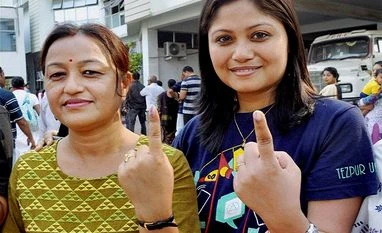 "Voters showing their inked finger marks after casting vote in a polling station during the second and final phase of Assam State Assembly election 2016 in Guwahati")
Voters showing their inked finger marks after casting vote in a polling station during the second and final phase of Assam State Assembly election 2016 in Guwahati
As second phase voting concluded on Monday at 5 pm, it finally ringed the curtains down on assembly polls in Assam. Altogether, the fates of 525 candidates were sealed in various electronic voting machines across 61 constituencies, spread across central and lower Assam.
High voter turnout was again witnessed in the second phase poll. As per preliminary estimates of the election commission, the state witnessed a high voter turnout of 82 per cent. The turnout too was around 82 per cent in the first phase.
High voter turnout was again witnessed in the second phase poll. As per preliminary estimates of the election commission, the state witnessed a high voter turnout of 82 per cent. The turnout too was around 82 per cent in the first phase.
The 2016 Assam election saw neck to neck contest between the ruling Congress and the Bharatiya Janata Party (BJP), which contested the polls in alliance with Asom Gana Parishad (AGP), Bodoland People’s Front (BPF) and two smaller players representing the tiwa and rabha communities.
The Congress party, which has been in power in Assam uninterrupted since 2001, was seen battling heavy anti-incumbency this time around. ‘Porivorton’, meaning change, had almost become the buzzword in the charged up Assam political atmosphere. The BJP, which till recently was a marginal player in Assam’s politics (in the last assembly election it managed to win just five seats) had been seeing its fortunes swelling in Assam since the 2014 Lok Sabha polls.
Riding on the ‘Modi wave’, the party performed unexpectedly well in Assam in 2014. It won seven of the 14 Lok Sabha seats, with the Congress managing to win just three.The anti-incumbency against the Congress in this election also favoured the BJP as it could position itself as a serious alternative political force in Assam’s politics.
Riding on the ‘Modi wave’, the party performed unexpectedly well in Assam in 2014. It won seven of the 14 Lok Sabha seats, with the Congress managing to win just three.The anti-incumbency against the Congress in this election also favoured the BJP as it could position itself as a serious alternative political force in Assam’s politics.
The reason behind BJP’s spectacular 2014 performance was because it could make good inroads into upper Assam constituencies, which were Congress’ stronghold. In this assembly election too, the party is hoping for a repeat of 2014 in upper Assam, which went to poll in the first phase on April 4. If the party can manage to sweep upper Assam, as it did in 2014, it would surely emerge as a strong contender for government formation.
Almost all the constituencies that went to poll on Monday, spread across central and lower Assam, have sizeable Muslim voters. At least 25 constituencies, out of the 61, have Muslims in majority. The Muslims had been traditionally Congress’ trusted vote-base. But with the arrival of All India United Democratic Front (AIUDF) in Assam political scene in 2005, headed by cleric Maulana Badruddin Ajmal, there have been erosions in Congress Muslim vote-base.
The central and lower Assam have dominant migrant Bengali-Muslim population and Ajmal, being a Bengali-speaking, finds greater appeal among them. In 2014 Lok Sabha poll, AIUDF swept lower Assam, upstaging the Congress. For Congress, regaining ground in lower Assam becomes crucial to remain as a probable in government formation post results on May 19. Many of the constituencies, which went to poll on Monday, saw tough contest between the Congress and the AIUDF.
The central and lower Assam have dominant migrant Bengali-Muslim population and Ajmal, being a Bengali-speaking, finds greater appeal among them. In 2014 Lok Sabha poll, AIUDF swept lower Assam, upstaging the Congress. For Congress, regaining ground in lower Assam becomes crucial to remain as a probable in government formation post results on May 19. Many of the constituencies, which went to poll on Monday, saw tough contest between the Congress and the AIUDF.
In second phase, the Congress had fielded 57 candidates, followed by AIUDF (47), BJP (35), AGP (19) and BPF (10). There were altogether 1,04,35,271 voters in second phase of poll.

Don't miss the most important news and views of the day. Get them on our Telegram channel
First Published: Apr 11 2016 | 7:15 PM IST