


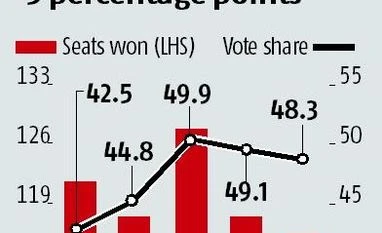
Story in numbers: Vote share of parties with longest-serving CMs
In the 2012 Assembly election, the BJP won 115 of 182 seats, with an average vote share of 53% in these seats
 "Story in numbers: Vote share of parties with longest-serving CMs")
premium
PM Modi was the chief minister of Gujarat from 2001 to 2014. He succeeded Keshubhai Patel in October 2001.
Modi, then CM, served two and a half successful terms. The Bharatiya Janata Party (BJP) in Gujarat secured a stronger base, its vote share increased five percentage points from 44.8% in 1998 to 49.9% in the seats contested in the 2002 state Assembly election.
In the 2012 Assembly election, the BJP, with Modi as its chief ministerial candidate, won 115 of 182 seats, with an average vote share of 53% in these seats.
Gujarat is one of the few states with long-serving CMs and political parties.
Modi, then CM, served two and a half successful terms. The Bharatiya Janata Party (BJP) in Gujarat secured a stronger base, its vote share increased five percentage points from 44.8% in 1998 to 49.9% in the seats contested in the 2002 state Assembly election.
In the 2012 Assembly election, the BJP, with Modi as its chief ministerial candidate, won 115 of 182 seats, with an average vote share of 53% in these seats.
Gujarat is one of the few states with long-serving CMs and political parties.