


The Conscience of the Party: A definitive biography of Hu Yaobang
The book documents Hu's more accommodating policies towards ethnic minorities, who had suffered greatly during the Cultural Revolution
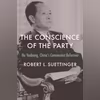 "The Conscience of the Party: Hu Yaobang, China's Communist Reformer")
The Conscience of the Party: Hu Yaobang, China’s Communist Reformer
Listen to This Article
The Conscience of the Party: Hu Yaobang, China’s Communist Reformer
Author: Robert L Suettinger
Publisher: Harvard
Pages: 480
Price: ₹4,121
Also Read

 "ALL OR NOTHING: How Trump Recaptured America")
 "The Search for India's Rarest Birds")
 "I Am What I Am")
 "MONEY, MYTHS AND MANTRAS: The ultimate investment guide")
 "India-Indonesia Relations: A Civilisational Partnership")
More importantly, the author profiles Hu as a political reformer, who led the way to distancing the CPC from government and the military, enabling their professionalisation after years of favouring “red over expert”. As head of the party, Hu not only led the campaign to rehabilitate scores of veteran party cadres who had fallen victim to the violent purges perpetrated by Mao during the Cultural Revolution (1966-1976), but also the many intellectuals, academics and professionals who had been purged during earlier mass political campaigns. These rehabilitated cadres and professionals became the human resource base for the country’s modernisation drive. Within the party, Hu sought to dispense with life-time tenures of senior leadership, urging veteran cadres to retire and make way for younger leaders. It is this stance that alienated veteran cadres, including many of those rehabilitated, thanks to Hu’s efforts. Deng Xiaoping was able to engineer his removal from party leadership by mobilising the geriatric but still influential party leaders.
According to the author, Hu Yaobang’s break with the senior party leadership came after he showed sympathy for the student demonstrations that erupted in December 1986, targeting corruption in the party, protesting high rates of inflation and urging democratic reforms. The more conservative party leaders, including Deng, faulted Hu for not having taken strong, repressive action against the student demonstrations. Hu was dismissed from office in 1987 though he retained his Politburo position. He died in April 1989.
In death, Hu became something of a hero to China’s youth and public mourning for him became the trigger for the much larger student demonstrations that took place at the historic Tiananmen Square in April 1989 that led inexorably to their brutal and bloody repression on June 4, 1989. China’s economic reforms would be temporarily rolled back as they were seen by some veteran party leaders as the reason for the opposition to the party’s centralised and undisputed authority. It was only in 1992 that Deng Xiaoping undertook his much publicised “southern tour” to validate the economic reforms, in particular, the setting up of special economic zones and the promotion of foreign investment. It is this late turnaround that burnished Deng’s reputation as China’s champion reformer and Hu’s contributions receded into the background. Mr Suettinger’s book puts this important period in contemporary Chinese history into a more balanced perspective.
The book documents Hu’s more accommodating policies towards ethnic minorities, who had suffered greatly during the Cultural Revolution. I had occasion to visit both Xinjiang and Tibet during the 1983-86 period and personally witnessed the more liberal policies in place, including on religious, linguistic and cultural practices. These began to be reversed in later years.
On foreign policy, the author points out that Hu initiated a shift away from a virtual alliance with the US towards a more centrist stance, taking measures to improve relations with the then Soviet Union and emphasising China’s Third World credentials. This aspect of Hu’s leadership is not well known, but I do recall that our embassy reporting at the time had noted these shifts.
Mr Suettinger had studied China as a CIA analyst for several years and brings a rigorous analytical approach to this very detailed biography. He has drawn from a vast array of original Chinese language sources and covered Hu’s life and legacy in considerable detail. If there is a downside to this book, it is that it has too much detail. We get a potted history of the CPC through this narrative of the life and times of Hu. The focus on his role as a party leader and the significance of his efforts towards creating a more democratic, more responsive party are somewhat lost in the details. Nevertheless, this is a timely corrective to the inordinate and often adulatory depiction of Deng Xiaoping’s role as the wise, pragmatic and decisive reformist leader to the exclusion of the important role played by others and is, therefore, welcome.
The reviewer is a former Foreign Secretary
More From This Section
 "book")
 "book")
 "Karma's Child")
 "book")
 "book")
Topics : BOOK REVIEW books China
Don't miss the most important news and views of the day. Get them on our Telegram channel
First Published: Feb 25 2025 | 12:24 AM IST