


IndiGo Q2FY26 results: Net loss widens by 161% on rupee depreciation
IndiGo posts ₹2,582-cr net loss in Q2 as rupee slide triggers ₹2,900-cr forex hit; revenue up 10.4% to ₹19,600 cr, with rising international traffic and stable grounded fleet
 "IndiGo, IndiGo Airlines, IndiGo aircraft")
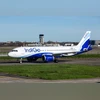
IndiGo reported an adjusted EBITDA, excluding the impact of foreign exchange movement and hedging gains, of Rs 3,800 crore at a margin of about 20 per cent. (Photo: Bloomberg)


Listen to This Article
India’s largest airline IndiGo -- which clocked a record profit in the first quarter of this financial year -- on Tuesday reported a 161.6 per cent jump in its consolidated net loss for the second quarter of 2025-26 (Q2FY26) against the same period last year, primarily due to rupee depreciation and continued outflow of foreign direct investment (FDI) amid US’ imposition of tariff.
The loss widened to ₹2,582 crore in the second quarter of FY26, against the loss of 986.7 crore reported during the same period last year.
“Our exposure to foreign exchange risks is primarily due to (aircraft) lease liabilities and maintenance obligations that are denominated in US dollars. While we have some dollar-denominated assets in the form of deposits, the net exposure as of the end of September is approximately $9 billion dollars. This would amount to a foreign exchange loss of around ₹900 crore for every rupee’s depreciation at the quarter-end,” said IndiGo’s chief financial officer (CFO) Gaurav Negi during the earnings conference call with analysts.
“We saw ₹3.18 depreciation at the end of September quarter, as compared to the end of June quarter. So, we ended up with about ₹2,900 crore foreign exchange loss,” he mentioned.
The tariff imposition on India and the continued FDI outflow in the second quarter led to the sharp rupee depreciation, he said.
Also Read

 "IndiGo")
 "SpiceJet")
 "indigo airlines, indigo")
 "Pieter Elbers, IndiGo CEO")
Negi mentioned that the company has actively been taking steps to mitigate these exposures by hedging part of its foreign currency outflow and has $850 million positioned in its hedge book.
“We have recognised the gain on hedging of about ₹200 crore in this quarter. In the coming years, we will continue to enhance this position,” he stated.
“Additionally, as we continue to scale up our international operations and enhance our brand globally, we expect the natural hedge -- the dollar inflows from international revenue -- to increase. This will provide us further insulation from currency fluctuation over time,” he said.
IndiGo reported an adjusted Ebitda (earnings before interest, taxes, depreciation and amortisation) -- which is excluding the impact of foreign exchange movement and hedging gains -- of Rs 3,800 crore at a margin of about 20 per cent.
“This is compared to adjusted Ebitda of about ₹2,700 crore at a margin of about 16 per cent that was recorded in the same period last year,” Negi noted.
While the aircraft lease liabilities are long term in nature and are payable for eight to ten years from a cash flow standpoint, IndiGo recognises the currency impact at the end of each reporting period based on accounting standards.
The company’s total income increased by 10.4 per cent Y-o-Y to ₹19,600 crore.
“In terms of topline, the quarter was marked by revenue performance exceeding our earlier expectation due to stronger than anticipated performance in August and September, especially in the domestic market,” Negi mentioned.
“We added capacity in an optimised manner and grew by about three per cent in terms of seat deployment and about eight per cent in terms of ASKs (available seat kilometers). This resulted in flattish domestic capacity growth and a growth of more than 26 per cent on international sectors as compared to the same period last year,” Negi added.
The number of passengers handled by IndiGo in the second quarter grew by about four per cent on a year-on-year basis while the overall industry's passenger growth remained largely stagnant, he noted.
The CFO said that the number of grounded planes, due to Pratt and Whitney engine issues that have been going on for several months, remains stable in the range of 40s.
“Based on the latest guidance, as received from the OEM (Pratt and Whitney), the number of grounded planes is expected to remain at the current level till the end of the financial year,” he added.
The new set of flight duty time limitation (FDTL) norms for pilots have kicked in from November 1 and they will have a financial impact.
“So, given that the FDTL has now kicked in, there is going to be some element of cost dimension that will play out. There is going to be an increased cost that we will have to incur related to the implementation of FDTL... While it is a scaled down version from what was initially proposed by the regulators, nonetheless, there will be some incremental cost,” he stated.
India’s revised FDTL norms, aimed at reducing pilot fatigue, came fully into effect from November 1, after a phased rollout that began in July. The rules increase pilots’ weekly rest to 48 hours, expand the night duty period to 12 AM-6 AM, limit the number of night landings, and require airlines to file quarterly fatigue reports.
a
More From This Section
 "Nexus Select Trust")
 "Adani Enterprises, Adani group")
 "Adani Ports, Adani Group, Gautam Adani")
 "C S Setty, Challa Sreenivasulu Setty, Chairman, State Bank of India (SBI) (Photo: Kamlesh Pednekar)")
 "solar, solar power, solar panels, solar projects")
Don't miss the most important news and views of the day. Get them on our Telegram channel
First Published: Nov 04 2025 | 7:27 PM IST