


Carney calls Trump 'transformative' prez for 'stopping' India-Pak conflict
Mark Carney has now joined the list of leaders who have praised Trump's efforts in bringing 'peace' between India and Pakistan
 "Donald Trump, Mark Carney")
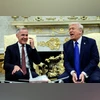
U.S. President Donald Trump and Canada's Prime Minister Mark Carney react as they meet in the Oval Office at the White House in Washington, D.C., U.S., October 7, 2025 | Photo: REUTERS
Listen to This Article
Canadian Prime Minister Mark Carney met with US President Donald Trump on Tuesday (local time) and lauded his efforts for "bringing peace" between India and Pakistan, when the two nuclear-armed neighbours were engaged in a four-day military confrontation.
Describing Trump as a "transformative president", Carney said, "You are a transformative president, the transformation in the economy, unprecedented commitments of Nato partners to defence spending, peace from India, Pakistan through to Azerbaijan, Armenia, disabling Iran as the force of terror." He made these remarks during bilateral talks with Trump in the Oval Office.
Ever since Trump announced on May 10 that both India and Pakistan had agreed to a ceasefire, the US President has repeated his claims nearly 50 times about bringing the conflict to an end.
Carney joins Pakistan PM, Army chief in lauding Trump
Mark Carney has now joined the list of leaders who have praised Trump's efforts in bringing "peace" between India and Pakistan. Previously, Pakistan's Prime Minister Shehbaz Sharif and Field Marshal Asim Munir have thanked Trump for his efforts on several occasions, more recently in September, when Trump hosted the two at the White House for a closed-room discussion.
Munir, who has met Trump twice this year, first in June, nearly a month after the ceasefire was reached, thanked Trump for "ending a potential war". Referring to Munir's statement, Trump, on October 1, said, "He (Asim Munir) said to a group of people that were with us... that this man (Trump) saved millions of lives because he saved the war from going on. That war was going to get very bad... I loved the way he said it."
Also Read

 "Nvidia")
 "Canada, Mark Carney")
 "Donald Trump, Greta Thunberg")
 "israel, hostages, hamas, gaza, palestine")
 "Donald Trump, Trump")
While the Pakistani leaders have been consistently lauding Trump's efforts and subsequently nominating him for a Nobel Peace Prize, India has maintained that the understanding to stop all firing was achieved following direct talks between the Directors General of Military Operations (DGMOs) of the two militaries.
Trump-Carney meeting highlights
The meeting on Tuesday marked Carney's second visit to the White House after becoming the prime minister earlier this year. During their meeting, Trump expressed optimism that the two countries could eventually reach a trade deal, but remained vague about how and when an agreement might be achieved.
Trump also described the two North American nations as being in "natural conflict" as they are competing for the same business, Bloomberg reported. He said, "He wants to make cars, we want to make cars, and we’re in competition. And the advantage we have is, we have this massive market." However, he added that the two North American neighbours have "come a long way" in terms of trade talks.
Carney told Trump that Canada is the US' largest foreign investor and suggested that the pace of investment may accelerate, "probably $1 trillion in the next five years, if we get the agreement we expect to get".
“There are areas where we compete, and it’s in those areas where we have to come to an agreement that works," he said. “But there are more areas where we are stronger together, and that’s what we’re focused on."
During the meeting, Trump once again joked about making Canada the 51st state of the United States, a claim he made several times during the start of his presidency this year. While Carney laughed, he has previously told Trump that Canada would never be up for sale.
The US President also said that he was open to extending the free trade agreement with Mexico and Canada via a renegotiation or through different deals. He said, "We could renegotiate it, and that would be good, or we can just do different deals, he said. We're allowed to do different deals if we want. We might make deals that are better for the individual countries."
The free trade agreement, introduced during Trump’s first term, permits most goods from Canada and Mexico to enter America duty-free. Since returning to the office, however, Trump has signalled his intent to renegotiate the arrangement, saying he is open to revisiting the process if it helps strengthen America’s economic standing.
While Canada currently has a tariff of 35 per cent, Mexico has been hit with a 25 per cent tariff.
More From This Section
 "Security, Pulwama Security, Army, soldier")
 "Piyush Goyal, Piyush")
 "Pascale Sourisse, senior executive vice-president, international development, Thales")
 "Modi Putin")
 "India, EU, European Union, India flag")
Topics : Donald Trump Shehbaz Sharif Lt Gen Asim Munir Mark Carney US-Canada Trump tariffs India Pakistan relations USMCA BS Web Reports
Don't miss the most important news and views of the day. Get them on our Telegram channel
First Published: Oct 08 2025 | 8:55 AM IST