


Kalyani ties up with BEML, Data Patterns for AMCA stealth jet race
The three firms will participate in the AMCA programme as a consortium, with Bharat Forge in the lead, the sources said, adding that a memorandum of understanding was signed on Friday
 "Advanced Medium Combat Aircraft")
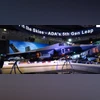
Full-scale model of the Advanced Medium Combat Aircraft, which was showcased at the 15th edition of Aero India in Bengaluru in February this year. (PHOTO: PIB)
Listen to This Article
Bharat Forge Ltd, part of the $3.5 billion Kalyani Group, is partnering with state-run BEML Ltd and private-sector defence and aerospace electronics firm Data Patterns (India) to respond to the Expression of Interest (EoI) notice issued by the Aeronautical Development Agency (ADA) for the prototype development and production of India’s first indigenous fifth-generation stealth fighter jet — the Advanced Medium Combat Aircraft (AMCA), sources told Business Standard on condition of anonymity.
The three firms will participate in the AMCA programme as a consortium, with Bharat Forge in the lead, the sources said, adding that a memorandum of understanding was signed on Friday.
Pune-headquartered Bharat Forge is a private sector defence player, having secured both domestic and export orders for heavy artillery systems, with a footprint in armoured vehicles and, more recently, small jet engines. Bengaluru-headquartered BEML is a ‘Schedule A’ company under the Ministry of Defence (MoD), operating across the defence, railways, mining, and construction sectors. Chennai-headquartered Data Patterns, another private sector company, provides indigenous solutions in the areas of radars, electronic warfare, avionics, glass cockpit displays, automatic test equipment, communication systems, and fire control systems.
“The government envisions the AMCA programme as a pathway to establish a parallel fighter jet production line — one that necessitates significant private sector involvement, either through tie-ups with Hindustan Aeronautics Limited (HAL) or other public and private firms,” the sources said.
The main contenders have finalised their strategies ahead of the September 30 deadline to respond to the EoI, issued in June by the AMCA’s design agency — the ADA, an autonomous body under the MoD — to shortlist Indian companies capable of building prototypes of the stealth jet and supporting its testing and certification.
Also Read

 "Rajnath Singh")
 "Caption: Indian Air Force's Light Combat Aircraft (LCA) Tejas Mk-I. Image Credit: PIB")
 "Su-57")
 "Mig-21 Bison")
 "Tejas")
The ADA’s EoI marks only the qualification stage. Once responses are evaluated, the agency will issue a request for quotation to build five prototypes and one structural test specimen. The first flight of the AMCA prototype is expected by end of 2028 or 2029, a defence source had earlier told Business Standard. Series production is expected to begin around 2035, with the Indian Air Force likely to induct seven squadrons — totalling 126 AMCA jets.
Private defence majors such as the Kalyani Group, Larsen & Toubro (L&T), the Tata group, the Adani Group, and the Mahindra group are keen to participate in the programme. Defence public sector undertaking (DPSU) HAL, which has served as the default domestic production agency for combat aircraft, is also in the running.
L&T on Wednesday announced a strategic partnership with state-run aerospace and defence electronics firm Bharat Electronics Limited (BEL), with the consortium set to compete in the AMCA EoI process.
“Both L&T and Bharat Forge have brought electronics partners on board — unsurprising, given how heavily an advanced fighter’s capabilities depend on sensors and mission electronics. With the stealth shaping and airframe already designed, and the engine largely outside the scope of the contenders, the competitive edge may well lie in efficient systems and avionics integration,” said another source.
Tata Advanced Systems (TASL) may participate independently, sources had earlier told Business Standard.
The ADA EoI followed the MoD’s late-May approval of an execution model that gives both private and public Indian defence firms equal opportunity to compete for the AMCA programme — whether independently, as joint ventures, or as consortia. This marks a departure from long-standing convention, and is seen as the first concrete opportunity to break HAL’s monopoly in combat aircraft manufacturing, potentially opening the door to a private-sector fighter jet producer.
In a July interview, HAL Chairman and Managing Director D K Sunil had said some of the EoI’s evaluation criteria were weighted against the DPSU. Specifically, companies receive zero marks out of 100 if their order book is 3x their turnover. He also noted that bidding solo, rather than as part of a JV or consortium, would result in a loss of points. Another stipulation requires that, in a JV or consortium, the lead company’s stake cannot exceed 50 per cent.
Whichever entity wins the AMCA prototype contract will be the natural choice for series production of the final platform, as indicated by the EoI, which requires shortlisted contenders to possess the capability to establish a manufacturing facility for the purpose.
More From This Section
 "MEA spokesperson Randhir Jaiswal")
 "Ministry of External Affairs official spokesperson Randhir Jaiswal")
 "MiG-21 aircraft")
 "G4 Foreign Ministers Meeting")
 "S Jaishankar, Jaishankar")
Don't miss the most important news and views of the day. Get them on our Telegram channel
First Published: Sep 27 2025 | 6:00 AM IST