


Trade union strike: Normal life remains unaffected; sporadic violence in WB
The trade unions claimed that the strike was successful, and a large number of workers abstained from work, impacting postal, banking, insurance, and mining sectors
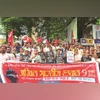 "Employees of LIC during the 24-hour nationwide general strike against the central government's alleged anti-labour policies, in Prayagraj on Wednesday. | Photo: PTI")
Employees of LIC during the 24-hour nationwide general strike against the central government’s alleged anti-labour policies, in Prayagraj on Wednesday. | Photo: PTI
Listen to This Article
Normal life was not impacted in most parts of the country due to a nationwide strike called by the 10 central trade unions to protest against the labour policies of the Centre, though some sporadic incidents of violence were reported from West Bengal.
However, the trade unions claimed that the strike was successful, and a large number of workers abstained from work, impacting postal, banking, insurance, and mining sectors.
Reports of violence were received from pockets of West Bengal after Left-wing activists clashed with police and supporters of the ruling Trinamool Congress in some districts.
Left-leaning bank unions, All India Bank Employees Association, All India Bank Officers Association and Bank Employees Federation of India also supported the strike, leading to disruption in services in some parts of the country.
However, there was no impact on private sector banks and many large public sector banks like State Bank of India, Punjab National Bank and Bank of Baroda.
Also Read

 "Workers from various trade unions shout slogans during an anti-government protest rally, organised as part of a nationwide strike, in Mumbai")
 "Labourers, Labourer. Labour Day")
 "NMDC")
 "Modi, Narendra Modi")
 "Pavan Guntupalli")
The All India Power Engineers Federation claimed that over 2.7 million power sector workers hit the road across the country to protest against privatisation.
In a statement, a forum of the 10 central trade unions said there was a bandh-like situation in many states of the country.
They include Puducherry, Assam, Bihar, Jharkhand, Tamil Nadu, Punjab, Kerala, West Bengal, Odisha, Karnataka, Goa, Meghalaya, and Manipur.
Reports of partial bandhs were also received from parts of Rajasthan, Haryana, Telangana, and Andhra Pradesh, among others, the forum said. There were industrial and sectoral strikes held in Madhya Pradesh, Maharashtra, Uttar Pradesh, Uttarakhand and Gujarat, it added.
Several political parties supported the strike call, including the Congress, Communist Party of India (Marxist), and Communist Party of India.
In Bengaluru, Congress general secretary Randeep Singh Surjewala said the nationwide strike is aimed at opposing the Narendra Modi government's “anti-worker and anti-farmer” policies, and its “failures” to create jobs and fill existing vacancies.
In Odisha, the Biju Shramik Samukhya, a trade union affiliated to the Opposition Biju Janata Dal (BJD), joined the protests.
In Telangana, Bharat Rashtra Samithi leader K Kavitha said that her party and Telangana Jagruti supported the strike as the BJP-led government at the Centre has eroded workers’ rights.
The trade unions have said that the central government is implementing reforms that weaken workers' rights.
They called the one-day strike in support of their demand for doing away with the four labour codes along with contractualisation, privatisation of public sector undertakings and increasing minimum wages to ₹26,000 per month, among others.
The forum had last year submitted a 17-point demand to Labour Minister Mansukh Mandaviya.
The government has not been conducting the annual labour conference for the last 10 years, the forum claimed.
However, the Confederation of All India Traders, which BJP Lok Sabha member Praveen Khandelwal leads, said there was no impact of the strike on commercial activity in the national capital.
“All 700 markets and 56 industrial areas in Delhi are functioning as usual,” said Chamber of Trade and Industry (CTI) chairman Brijesh Goyal.
More From This Section
 "Nirmala Sitharaman")
 "study loan, education loan")
 "RBI, Reserve Bank of India")
 "rbi reserve bank of india")
 "RBI, Reserve Bank of India")
Topics : Trade unions Trade union strike West Bengal
Don't miss the most important news and views of the day. Get them on our Telegram channel
First Published: Jul 09 2025 | 10:02 PM IST