


US-Israel-Iran conflict: What it means for India, rupee and your portfolio
For long-term investors, the most reliable strategy during geopolitical stress has remained unchanged: stay invested, diversify sensibly
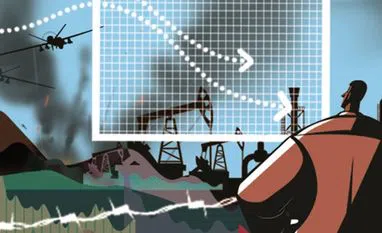 "India equity markets, Sensex fall, Nifty decline, US Israel Iran strike, Khamenei death, crude oil price surge, Strait of Hormuz disruption, domestic inflation India, RBI policy impact, safe-haven assets, gold and oil market, FPI outflows India, geop")
Illustration: Ajaya Mohanty


Listen to This Article
With hostilities escalating between the US, Israel, and Iran, global markets have entered a period of intense shadow-boxing. On March 2, 2026, the impact is visible: the Nifty 50 and Sensex are down nearly 1.8%, gold and crude oil are surging, and bond yields are climbing.
To help investors cut through the noise, Ashish Gupta, CIO, Axis Mutual Fund has broken down the situation to help investors understand if this conflict changes the long-term India story.
How is the current conflict impacting Indian market data today?
As of March 2, 2026, the "fear gauge" is active. The immediate market reaction shows:
- Equities: Nifty 50 and Sensex have retreated by 1.8%.
- Commodities: Brent Crude has spiked 6%, while Gold has risen 3% as investors seek safe havens.
- Bonds: Government bond yields are trending slightly higher, reflecting a cautious stance on inflation.
Q: What is the biggest "transmission" risk for the Indian economy?
Also Read

 "oil tankers, sea shore, trading")
 "Iran, US Israel attacks on Iran, Israel Iran conflict, US Iran, Israel Iran")
 "US Israel strike Iran")
 "Saudi Aramco, oil refinery")
The most immediate shock comes through Crude Oil. India imports over 80% of its oil, making it highly sensitive to Middle East stability.
A specific "red line" for markets is the Strait of Hormuz (SoH). This narrow waterway is a global energy artery, handling 20% of global crude and 30% of LNG trade. Crucially, 50% or more of India’s energy imports transit through this strait. Any disruption here would immediately pressure India’s energy security, widen the current account deficit, and feed inflation.
Q: Will the Rupee collapse under this geopolitical stress?
While the US Dollar typically strengthens during global crises, putting pressure on the Rupee (INR), there are three reasons not to panic:
- Orderly Moves: Historically, INR depreciation during such crises has been gradual, not a freefall.
- Foreign Reserves: India’s massive forex reserves act as a high-quality buffer.
- Controlled Deficits: Unlike previous decades, India’s current account and fiscal deficits are currently well-managed.
"INR may likely witness volatility because of FII flows Episodes such as the 2013 taper tantrum, the 2020 pandemic shock and the 2022 Ukraine Russia war underline this point. While the rupee may depreciate temporarily during global stress, currency moves have rarely translated into a persistent decline in Indian equities. RBI Policy: the anchor during geopolitical stress The Reserve Bank of India (RBI) plays a critical stabilising role during global shocks. The RBI has historically looked through temporary, geopolitically driven inflation spikes, focusing instead on core inflation trends and the durability of growth," said Gupta
Will the war impact India's investment trajectory?
"For India - geographically distant but economically exposed - the more relevant question is not whether near-term volatility will rise, but whether such episodes meaningfully alter the country’s long-term investment trajectory. History suggests they rarely do. Wars and geopolitical conflicts typically trigger short-term market turbulence, but they have not resulted in sustained equity underperformance, particularly when conflicts remain regional. Indian markets have demonstrated this resilience repeatedly - absorbing external shocks, pricing risk briefly and then reverting to fundamentals," said Gupta.
Q: How has the Nifty 50 historically reacted to war and conflict?
The pattern is surprisingly consistent: Short-term fear, long-term resilience. History shows that regional conflicts rarely result in sustained equity underperformance.
Indian equity history over the past 15 years offers a clear picture of how markets behave during conflict driven stress.
• Arab Spring / Middle East unrest (2011): Volatile year but driven more by global growth fears than geopolitics. Markets recovered as domestic fundamentals stabilised.
• Crimea conflict (2014): Despite global tensions, Nifty 50 delivered ~31% returns that year, led by reform optimism.
• Uri surgical strikes (2016): Brief sell-off, followed by recovery; Nifty 50 moved higher in the following year.
• Balakot airstrikes (2019): Minimal and short-lived market impact; Nifty 50 ended the year with 12% gains.
• Russia–Ukraine war (2022): Nifty 50 fell 5% on invasion day but finished the year in positive territory, despite oil shocks and aggressive global rate hikes.
• Israel–Hamas conflict (2023): Initial dips of less than 1% on high-tension days; markets stabilised quickly as oil fears eased.
• Operation Sindoor (2025): Initial market jitters gave way to stability as escalation risks remained contained, reinforcing the market’s tendency to look through short-term
uncertainty.
The pattern is consistent: conflict driven drawdowns are shallow and temporary, while longer-term returns are dictated by earnings growth, liquidity and domestic demand.
"Markets price duration and economic impact, not emotion. Once it becomes clear that supply disruptions are manageable, policy frameworks remain intact and growth is not structurally impaired, risk premiums compress. For India-where growth is driven by domestic consumption, capex recovery, digitisation and manufacturing realignment-geopolitical shocks are typically
interruptions, not inflection points," said Gupta.
Staying invested through volatility associated with conflicts
While periods of conflict can lead to short-term volatility, experience suggests that making portfolio decisions purely in response to these has often proven less effective than maintaining a long-term investment approach.
"Investors who exited equities during earlier conflict-driven sell-offs frequently missed the recoveries that followed-sometimes within a relatively short span. The takeaway from these episodes is not to ignore risk, but to approach it with discipline and perspective," said Gupta.
Discipline over panic
The US – Iran - Israel conflict is a serious geopolitical event, but for Indian investors, it is not unprecedented. Over the past 15 years, every major conflict has tested sentiment and almost every time, Indian equities have proven resilient. Markets may fall, currencies may weaken and oil may spike. But fundamentals reassert themselves over a period of time.
What should be the investor’s strategy during this 2026 flare-up?
The most reliable strategy remains discipline over panic.
Stay Invested: Those who exited during the 2022 Ukraine invasion or the 2020 pandemic shock often missed the V-shaped recoveries that followed.
Diversify: Ensure your portfolio isn't overly exposed to oil-sensitive sectors like aviation, paints, or chemicals in the near term.
Use the Dip: Historical data suggests that declines driven by geopolitical headlines are often excellent opportunities to add to existing holdings at a discount.
The Bottom Line: Fundamentals eventually reassert themselves. While the headlines are serious, the trajectory of the Indian economy remains anchored by core inflation trends and domestic demand.
More From This Section
 "Sebi")
 "Travel insurance")
 "Credit card")
 "real estate")
 "ai in healthcare, india public health")
Topics : Israel Iran Conflict
Don't miss the most important news and views of the day. Get them on our Telegram channel
First Published: Mar 02 2026 | 4:27 PM IST