


Green card holders turned US citizens now risk losing citizenship: Decoded
Under new Trump-era orders, the US is stepping up denaturalisation proceedings. Here's what it means for Indian immigrants
 "Donald Trump")
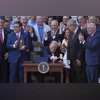
US President Donald Trump bangs a gavel presented to him by House Speaker Mike Johnson of La., after he signed his signature bill of tax breaks and spending cuts at the White House, Friday, July 4, 2025, in Washington. Photo: AP/PTI
Listen to This Article
Imagine you left your home country, toiled in a foreign land for years before getting a green card and, eventually, US citizenship—only to be told that citizenship is now being taken away because of something you did years ago. This is the threat naturalised immigrants are facing in the United States under Donald Trump’s second term.
The US Department of Justice recently expanded efforts to strip citizenship from naturalised Americans, especially those accused of fraud or with a criminal record. An internal memo dated June 11 placed denaturalisation among the department’s top five civil enforcement priorities.
“The civil division shall prioritise and maximally pursue denaturalisation proceedings in all cases permitted by law and supported by the evidence,” said Assistant Attorney General Brett A Shumate in the memo.
Nearly 25 million immigrants in the US hold naturalised citizenship, according to 2023 government data.
What is denaturalisation?
Also Read

 "Donald Trump")
 "Donald Trump")
 "immigration, visa, travel")
 "Jay Chaudhry, Zscaler founder, billionaire")
 "US visa social media directive, US visa rules Indian students, Indian students US visa screening, F1 visa decline India, Indian non-immigrant visa trends, US visa approvals India FY25, Indian students US study 2025, F1 J1 M1 visa types India, US visa")
There are three ways to become a US citizen: By birth within the country, through American parentage, or via naturalisation. Only the third is reversible.
“In order to take away US citizenship, the US government must show that there was some fraud undertaken in applying for that citizenship,” said David Lesperance, an international immigration expert. “In the case of birthright or lineage citizenship, the person would need to have never qualified from the beginning. But when someone naturalises, this process is called denaturalisation.”
Under federal law (8 USC 1451), the government can start court proceedings to revoke naturalisation if it believes the person concealed or misrepresented facts. “In all cases, the individual has the right to legal representation and the government carries the burden of proof,” Lesperance told Business Standard.
Dan Berger, partner at Pennsylvania-based immigration law firm Green and Spiegel, explained the two routes available to the government. “There is civil denaturalisation, which requires ‘clear, convincing and unequivocal’ evidence. Then there is criminal denaturalisation, which requires proof beyond a reasonable doubt that the individual knowingly used fraud to obtain citizenship, either for themselves or someone else.”
The grey area for green card holders
Green card holders, unlike citizens, can still be deported. Their status is reviewed by an immigration judge, not a federal judge.
“The government could try to take away a green card if it finds fraud in the application or if the person has a serious criminal conviction or doesn’t keep the US as a primary residence,” Berger told Business Standard.
While US citizens can live abroad indefinitely, green card holders are expected to live in the US. Prolonged absence or non-filing of taxes from abroad can lead to removal proceedings.
Lesperance listed five ways green card holders could lose their permanent resident status:
1. Living abroad: Even short absences can trigger abandonment if border officials believe the person no longer resides in the US.
2. Voluntary surrender: Signing Form I-407 gives up permanent resident status and may carry financial consequences.
3. Fraud or misrepresentation: This includes lying or omitting information during any immigration process—not just the green card.
4. Criminal convictions: Under Trump’s administration, any offence—not just violent crimes—may be grounds for removal.
5. Failure to remove conditions: Conditional green cards must be converted to permanent status. If this is missed, removal can follow.
“Green card holders who suspect they might be challenged under any of these categories should seriously consider not leaving or attempting to enter the US under the current administration,” Lesperance warned.
But, what about minor or old offences?
Civil denaturalisation has no time limit. “So it can be initiated based on something that happened decades ago,” said Berger. Criminal denaturalisation, however, has a ten-year statute of limitations.
The key test is whether the offence or misrepresentation would have changed the outcome of the citizenship application. “For example, if someone didn’t disclose unpaid child support or missing tax filings - these are issues that might have led to a denial,” he said.
There’s legal precedent limiting denaturalisation. In Maslenjak v. United States (2017), the US Supreme Court ruled that citizenship can only be revoked if the lie or omission was material—that is, it must have affected the government’s decision.
“Minor mistakes or irrelevant lies are not enough,” said Lesperance. “The government must show it would have denied citizenship had it known the truth.”
What happens if a person becomes stateless?
The US doesn’t require new citizens to give up their original nationality, but many foreign governments, India included, automatically cancel citizenship once a person takes up another.
“Under the Citizenship Act, 1955, Indian citizenship ends automatically when someone acquires a foreign nationality,” said Lesperance. “But if that foreign citizenship is later revoked, it raises interesting legal questions. A person could argue that their Indian citizenship should be reinstated.”
For now, though, there is no safety net for those who become stateless in the US. A 2023 policy introduced under the Biden administration, which allowed stateless individuals to receive some leniency or case-specific support, was quietly rolled back in 2025.
Current rules offer no formal pathway or special treatment for stateless persons. USCIS officers may consider statelessness as part of their discretionary powers—but that’s not guaranteed.
Stateless individuals cannot access international travel documents, unless they’re classified as refugees or asylees. “There are many stateless persons in the world who are not only disadvantaged in mobility but often in being able to remain where they are physically located,” said Lesperance.
Consequences of denaturalisation
Loss of rights: The person loses access to a US passport, voting rights, and government jobs.
Risk of deportation: This depends on their prior immigration status and any criminal record.
Impact on family: Minor children who gained citizenship through their parent may lose it if the parent is denaturalised.
According to Berger, “The person reverts to the status they had before becoming a citizen. The government can then attempt to remove that status as well.”
Public figures not immune
The crackdown has now extended beyond ordinary immigrants. Zohran Mamdani, the newly elected mayor of New York City, is under scrutiny.
Republican Congressman Andy Ogles has accused Mamdani of concealing support for terrorism during the naturalisation process. “The president is considering an investigation,” said White House Press Secretary Karoline Leavitt.
And in a June 13 ruling, a federal judge revoked the US citizenship of Elliott Duke, a military veteran originally from the UK, who had admitted to distributing child sexual abuse material before becoming a citizen. Duke had renounced their British citizenship and is now stateless, according to NPR.
What Indians in the US should know
India has the second-largest population of foreign-born nationals living in the US. In 2024, nearly 49,700 Indians were naturalised as US citizens.
“Our best advice to all immigrants is to be careful and accurate on all immigration applications, whether for temporary visas, green cards or citizenship,” said Berger.
He added, “There are nonprofits across the US that support citizenship applications. And if someone faces denaturalisation, they must get strong legal counsel to challenge it in federal court.”
More From This Section
 "New York, USA")
 "Saudi Arabia")
 "Canada Flag")
 "UAE golden visa")
 "US Visa")
Topics : Donald Trump BS Decoded US immigration policy US immigrants BS Web Reports immigration Decoded
Don't miss the most important news and views of the day. Get them on our Telegram channel
First Published: Jul 11 2025 | 11:21 AM IST