


Air quality in Delhi remains 'severe' with AQI over 400 at multiple sites
Air quality plunged across Delhi-NCR, with several zones breaching the 400 AQI threshold as foggy conditions and dipping temperatures intensified pollution on Sunday
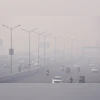 "Smog, Delhi Pollution, Delhi Air Quality, Pollution")
The Commission for Air Quality Management (CAQM) has revised the Graded Response Action Plan (Grap) for NCR. (Photo:PTI)
Listen to This Article
Air quality in Delhi-NCR deteriorated further on Sunday, with several monitoring stations crossing the 400 mark and entering the ‘severe’ category. A shallow layer of fog settled over the region as temperatures dipped, reducing visibility and trapping pollutants closer to the surface.
Bawana reported the highest AQI at 435 at 7 am, while NSIT Dwarka recorded the lowest at 313, according to Central Pollution Control Board (CPCB) data, reported PTI.
A dense layer of toxic smog lingered over Anand Vihar, where the AQI climbed to 428, categorised as ‘severe’. Other major locations reported the following levels:
Chandni Chowk: 390
RK Puram: 397
Also Read

 "Pollution, Gurugram Pollution")
 "Smog, Delhi Pollution, Delhi Air Quality, Pollution")
 "Smog, Delhi Pollution, Delhi Air Quality, Pollution")
 "students, student, School students")
 "Smog, Delhi Pollution, Delhi Air Quality, Pollution")
ITO: 384
Punjabi Bagh: 411
Patparganj: 401
Pusa: 360
Dwarka Sector-8: 386
Neighbouring regions fared no better:
Noida: 396 (very poor, nearing severe)
Greater Noida: 380 (very poor)
Ghaziabad: 426 (severe)
By 4 pm Saturday, Delhi’s 24-hour average AQI stood at 370 (very poor), a level considered harmful even for healthy individuals. Out of 38 operational stations, 11 recorded severe AQI, according to CPCB data.
As per CPCB norms, AQI is classified as: 0–50 ‘good’, 51–100 ‘satisfactory’, 101–200 ‘moderate’, 201–300 ‘poor’, 301–400 ‘very poor’, and 401–500 ‘severe’.
What is the latest in efforts to curb pollution?
The Commission for Air Quality Management (CAQM) has revised the Graded Response Action Plan (Grap) for NCR, shifting measures across stages to allow quicker action.
Key changes include:
- Stage IV severe measures moved to Stage III, empowering states to decide whether public, municipal and private offices operate at 50 per cent capacity, while the Centre may impose work-from-home.
- Stage III measures moved to Stage II, including staggered office timings across Delhi and surrounding districts.
- Stage II measures shifted to Stage I, covering uninterrupted power supply, traffic synchronisation, pollution alerts and stronger public transport.
Following CAQM's directions, the Delhi government ordered private offices to function with only 50 per cent on-site staff, with the rest working from home. Staggered timings for government and MCD offices are already in force till February 2025.
In the NCR, the Uttar Pradesh government has banned diesel auto rickshaws in Noida and Ghaziabad. A phased ban will extend across the UP cluster, with Baghpat enforcing a full ban after December 31, 2025.
What's the weather forecast for today?
Winter is beginning to set in across Delhi-NCR even as pollution levels worsen. According to the IMD, minimum temperatures will remain normal, between –1.5 degrees Celsius and 1.5 degrees Celsius for the next two days before dipping below normal to a range of –1.6 degrees Celsius to –3 degrees Celsius.
Shallow fog is expected on the morning of 23 November 2025, followed by shallow to moderate fog on subsequent mornings. The sky will remain mainly clear with fog during early hours. For Sunday, the maximum temperature is likely to be between 25 degrees Celsius and 27 degrees Celsius, while the minimum is expected to range from 10 degrees Celsius to 12 degrees Celsius.
More From This Section
 "Bhupender Yadav, Bhupender")
 "PM Modi, G20 summit")
 "PM Modi, G20, G20 Summit")
 "Al Falah University")
 "Modi, PM Modi, Narendra Modi")
Topics : Air Quality Index Delhi air quality Air quality Delhi Pollution Delhi weather BS Web Reports
Don't miss the most important news and views of the day. Get them on our Telegram channel
First Published: Nov 23 2025 | 9:25 AM IST