


PMO gets a new address: Seva Teerth more connected to ground, says PM
Prime Minister shifts from South Block under Central Vista project; clears proposals on Lakhpati Didi, Agriculture Infrastructure Fund and Startup India Fund
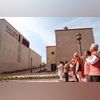 "Prime Minister Narendra Modi inaugurated the new Prime Minister's Office (PMO), called Seva Teerth (Photo: X/@narendramodi)")
Prime Minister Narendra Modi inaugurated the new Prime Minister’s Office (PMO), called Seva Teerth (Photo: X/@narendramodi)
Listen to This Article
Prime Minister Narendra Modi on Friday afternoon chaired the meeting of the Union Cabinet at South Block, the final such meeting in that location, and later inaugurated the new Prime Minister’s Office (PMO), called Seva Teerth.
In the first set of decisions from Seva Teerth, the PM signed files related to women, farmers, youth, and “vulnerable citizens”, approved by the Union Cabinet earlier in the day. According to a government statement, the PM signed files relating to doubling the target of Lakhpati Didis to 60 million, doubling the Agriculture Infrastructure Fund to ₹2 trillion, and allocating a corpus of ₹10,000 crore for the Startup India Fund of Funds 2.0.
The government said the PM’s first decisions from Seva Teerth “reflect a spirit of seva (service) and touch every section of society”. The PM RAHAT scheme, under which accident victims will get cashless treatment of up to ₹1.5 lakh, was also launched.
Earlier in the day, the PM inaugurated Seva Teerth and Kartavya Bhavan 1 and 2, marking the relocation of the PMO from South Block under the Central Vista redevelopment.
The PM reached the Seva Teerth complex in a motorcade along with Union Ministers Manohar Lal and Jitendra Singh and top PMO officials, and inaugurated the complex housing the PMO, the National Security Council Secretariat, and the Cabinet Secretariat. Modi garlanded a statue of Lord Ganesha in the PMO. He also unveiled the plaque of Seva Teerth at the new complex, with its motto ‘Nagrik Devo Bhava’ (citizen is akin to god).
Also Read

 "BNP Chairman Tarique Rahman")
 "AI Impact summit 2026")
 "Modi, Narendra Modi")
 "Narendra Modi")
 "Modi, Narendra Modi")
The relocation to Seva Teerth will bring together the PMO and the offices of the Cabinet Secretariat and the National Security Council Secretariat that were located at different places.
The PMO will now be called Seva Teerth, while the Central Secretariat buildings have been named Kartavya Bhavan.
“The inauguration marks a transformative milestone in India's administrative governance architecture and reflects the Prime Minister's commitment to building a modern, efficient, accessible, and citizen-centric governance ecosystem,” a statement from the PMO said on Thursday.
For decades, several key government offices and ministries functioned from fragmented and ageing infrastructure spread across multiple locations in the Central Vista area.
This dispersion led to operational inefficiencies, coordination challenges, escalating maintenance costs, and sub-optimal working environments. The new building complexes address these issues by consolidating administrative functions within modern, future-ready facilities, it said.
Addressing a gathering, the PM said that after Independence, many important decisions and policies for the nation were made from buildings such as South Block and North Block, structures which were built as symbols of the British Empire and intended to keep India chained in slavery for centuries. He said that Raisina Hills was chosen so that these buildings would stand above all others, allowing none to be equal.
Modi said the new Seva Teerth complex is not on a hill but more connected to the ground. He said that with new technologies rapidly emerging, the old buildings were proving inadequate for expanding facilities and adopting new tools.
The PM said that even decades after Independence, numerous ministries of the central government were functioning from more than 50 different locations in Delhi. He said that every year, ₹1,500 crore was being spent on rent for these ministry buildings, while daily logistics costs were incurred for 8,000 to 10,000 employees moving between offices. He said that with the construction of Seva Teerth and Kartavya Bhavans, these expenses will be reduced and employees’ time will be saved.
The PM said the old buildings would house a museum for the nation, making it part of the Yuge Yugeen Bharat Museum. He said that even years after Independence, the Prime Minister’s residence was once called Race Course Road, the Vice President had no designated residence, and the road leading to Rashtrapati Bhavan was called Rajpath in a democracy. He said that in 2014 the country resolved that the colonial mindset would no longer continue.
Seva Teerth houses the Prime Minister’s Office, the National Security Council Secretariat, and the Cabinet Secretariat, all of which were previously located at different places.
Kartavya Bhavan 1 and 2 accommodate several key ministries, including finance, defence, health and family welfare, corporate affairs, education, culture, law and justice, information and broadcasting, agriculture and farmers’ welfare, chemicals and fertilisers, and tribal affairs.
Government sources pointed out that the shift came on February 13, which marked 95 years since the formal inauguration of New Delhi as India’s modern capital in 1931.
More From This Section
 "KLA Corporation signs MoU with Tamil Nadu for ₹3,600 crore R&D campus")
 "Pinarayi Vijayan, Pinarayi, Vijayan, Kerala CM")
 "MK Stalin, Stalin")
 "Lok Sabha, LS")
 "Kiren Rijiju, Kiren, Rijiju")
Don't miss the most important news and views of the day. Get them on our Telegram channel
First Published: Feb 13 2026 | 9:05 PM IST